
A commercial flat roof rarely fails all at once. It fails a little at a time — a blistered seam here, a clogged drain there, a soft spot that quietly grows after every summer storm — until a property manager is staring at a stained ceiling tile and wondering how much this is going to cost. Understanding the essential tips for commercial flat roof repair is the difference between a $400 patch and a $40,000 emergency replacement, and in the Greater Toronto Area, where freeze-thaw cycles, humid summers, and heavy snow loads all take turns punishing a membrane, that difference shows up fast.
This guide walks through what actually causes flat roof failure on commercial buildings, how to tell a minor repair from a structural problem, what materials and methods contractors use to fix each type of damage, and how to build a maintenance routine that keeps small issues from becoming five-figure ones. Whether you manage a strip mall in Mississauga, a warehouse in Vaughan, or a mixed-use building downtown, the same fundamentals apply.
At Universal Roofs, we’ve been repairing and replacing flat roofs across the GTA since 2005, and the pattern is always the same: buildings that get a proper inspection and timely repair twice a year rarely need emergency service. Buildings that don’t, eventually do.
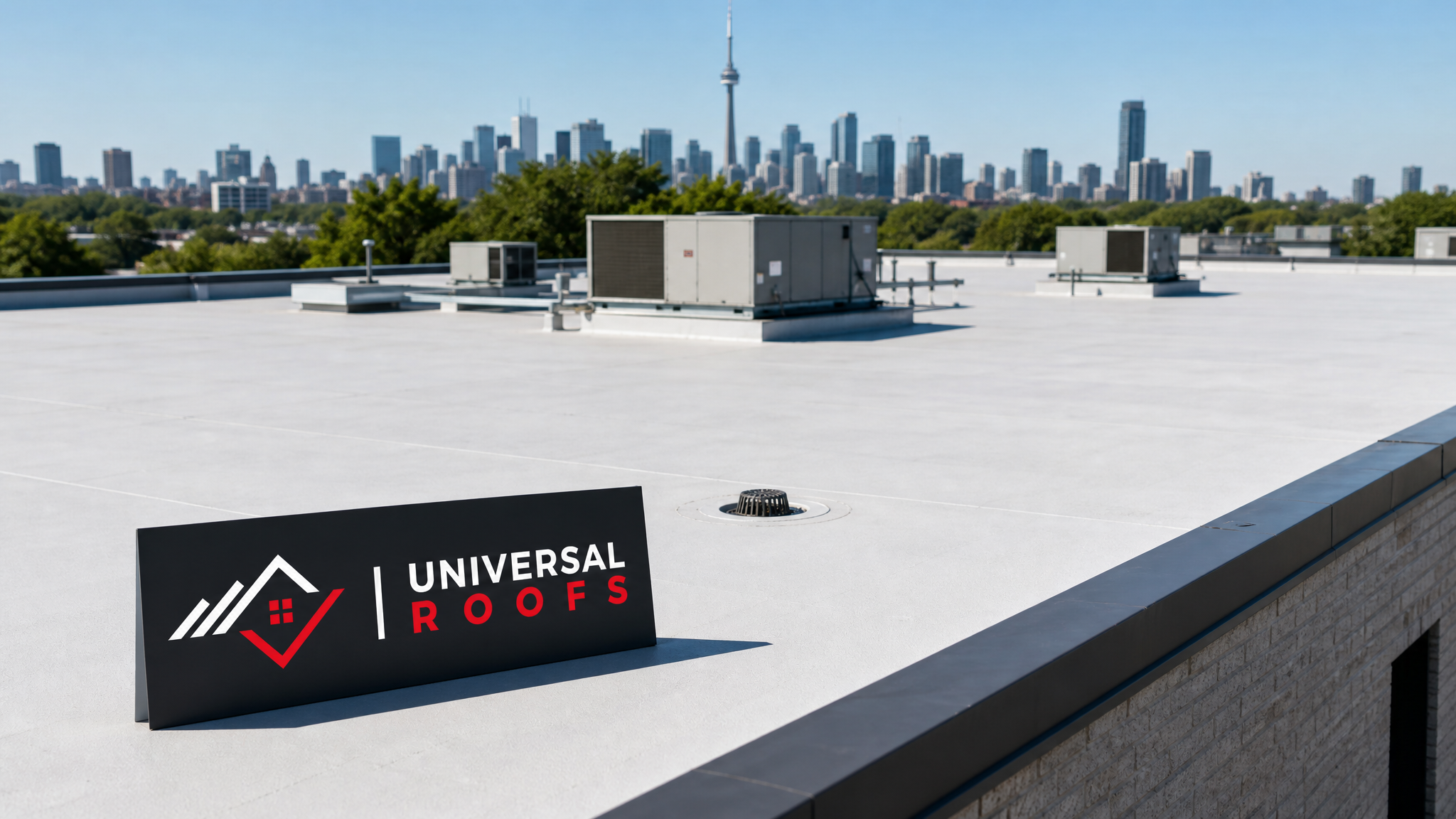
Why Commercial Flat Roofs Fail in the GTA Climate
Flat and low-slope commercial roofs are engineered to shed water through a slight slope toward drains and scuppers rather than relying on gravity the way a pitched residential roof does. That design works well, but it depends on every seam, flashing point, and drain staying intact. In Toronto’s climate, several forces conspire against that:
- Freeze-thaw cycling. Water that pools on a membrane during a mild January thaw refreezes overnight, expanding by roughly 9% and stressing seams and cracks until they widen.
- UV degradation. Long summer days bake membranes like EPDM and modified bitumen, causing them to dry out, shrink, and crack over 15-20 years of service.
- Ponding water. Any depression deeper than about 3 mm that holds water for more than 48 hours after rain accelerates membrane breakdown and adds significant dead-load weight.
- Rooftop mechanical traffic. HVAC technicians walking across a membrane to service rooftop units can puncture aging material, especially near unit curbs and conduit runs.
- Debris-clogged drains. Leaves, gravel ballast, and wind-blown debris block internal drains and scuppers, turning a five-minute rainstorm into standing water that sits for days.
Understanding which of these factors is driving damage on your specific roof is the first of the essential tips for commercial flat roof repair — because the fix for UV-cracked membrane is completely different from the fix for a clogged drain, even though both can produce the same leaking ceiling tile two floors down.
Spotting the Warning Signs Before They Become Leaks
Most commercial flat roof failures give warning signs for months, sometimes years, before water actually reaches the interior. Catching these early is one of the most valuable habits a facilities manager can build.
Interior clues include ceiling tile staining (even faint yellow-brown rings), a musty smell near the top floor, peeling paint near exterior walls, and unexplained increases in humidity in top-floor units. Exterior clues are easier to catch on a rooftop walk: bubbling or blistering in the membrane surface, cracked or lifted seams, granule loss on modified bitumen (showing as bald, shiny patches), rust streaks around metal flashing, and standing water more than two days after the last rainfall.
Membrane material also affects what to watch for. TPO and PVC membranes tend to fail at heat-welded seams first. EPDM (rubber) membranes usually fail at glued seams or flashing transitions, and can develop shrinkage cracks near parapet walls. Modified bitumen fails through granule loss, blistering, and cracked flashing cement. Knowing your roof’s membrane type — check your building’s roofing warranty documents or ask during your next roof repair visit — helps a contractor diagnose the problem in minutes instead of hours.
| Warning Sign | Likely Cause | Urgency | Typical Fix |
|---|---|---|---|
| Ponding water lasting 3+ days | Poor drainage slope or clogged drain | Moderate — schedule within 2 weeks | Drain clearing, tapered insulation, or crickets |
| Bubbling or blistering membrane | Trapped moisture under membrane | Moderate to high | Cut, dry, and patch or re-weld affected section |
| Cracked or lifted seams | UV ageing, thermal movement | High if near interior | Seam re-weld (TPO/PVC) or seam re-glue (EPDM) |
| Rust streaks on flashing | Failed sealant at metal transitions | Moderate | Re-flash, re-caulk, or replace flashing |
| Active ceiling leak | Membrane breach has reached deck | Emergency — same day | Emergency patch, then full diagnostic repair |
| Granule loss / bald spots | UV and weathering on modified bitumen | Low to moderate | Recoat or cap sheet overlay |
Choosing the Right Repair Method for Your Membrane
Not every flat roof problem calls for the same tool. The right approach depends on the membrane material, the size and location of the damage, and how much life is left in the roof overall.
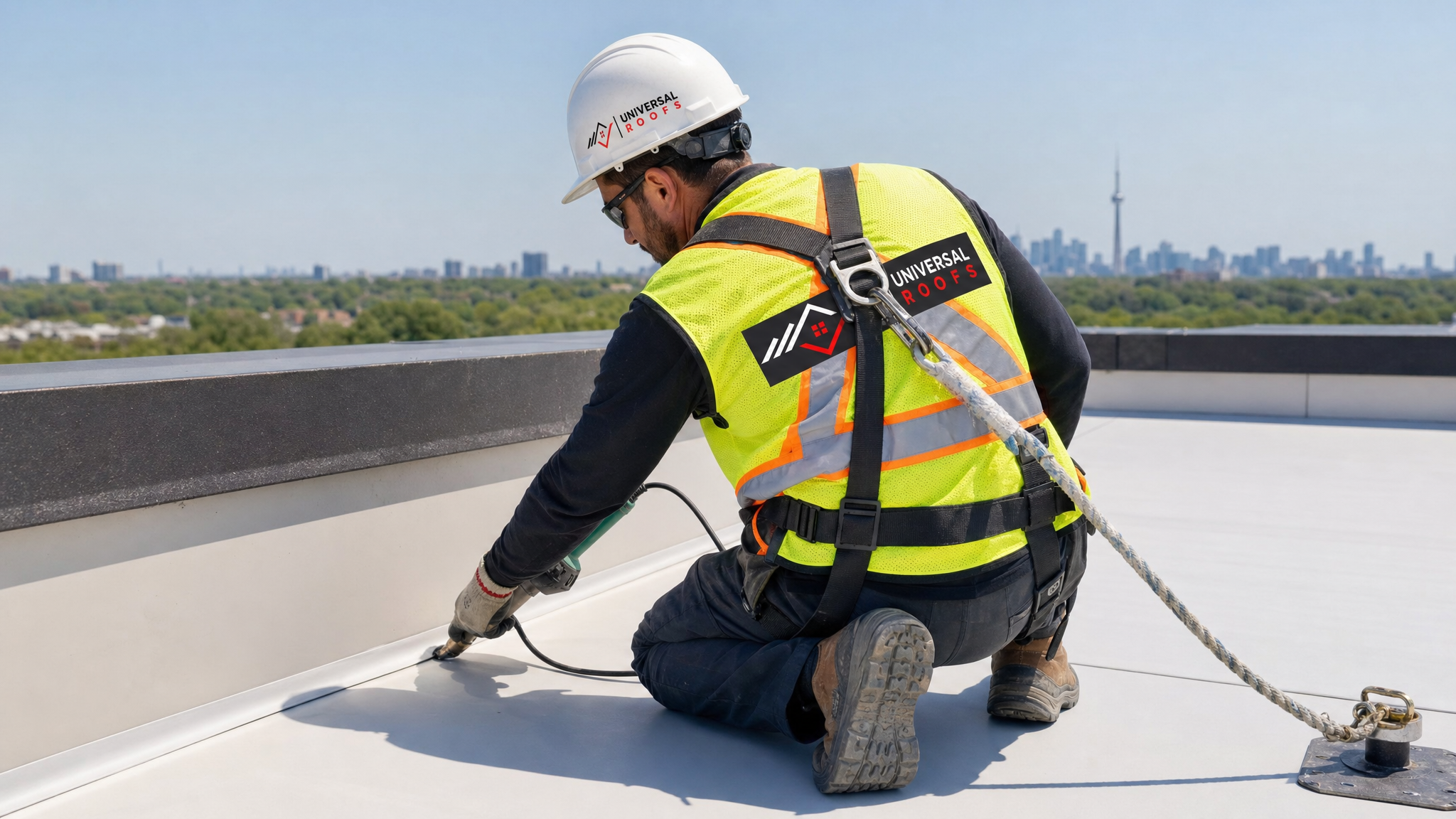
TPO and PVC membranes are typically repaired using hot-air welding, where a heat gun softens the membrane so a patch can be fused directly into the existing material, creating a bond that is often stronger than the surrounding sheet. This works well for punctures, seam separation, and flashing repairs, provided the membrane surface is clean and dry before welding.
EPDM (rubber) membranes use a different process: liquid adhesives or seam tape bond a patch over the damaged area, often reinforced with a peel-and-stick flashing tape at corners and penetrations. Because EPDM doesn’t heat-weld the way thermoplastics do, surface prep — cleaning with the correct primer — matters even more here.
Modified bitumen is generally repaired with a torch-applied or cold-adhesive patch, sometimes followed by a reflective coating to slow further UV damage. Because modified bitumen is a multi-ply system, a contractor needs to confirm how many plies are compromised before patching, or the repair may fail within a season.
Built-up roofing (BUR), still common on older commercial buildings, is repaired by cutting out the damaged plies, drying the substrate fully, and installing new felt layers with hot asphalt or cold adhesive, tying the new section into the old with proper overlap.
In every case, the underlying insulation and deck need to be checked for saturation. A patch applied over wet insulation will fail again within months because trapped moisture keeps expanding and contracting with temperature — this is one of the most common mistakes in DIY or rushed repairs, and one reason a proper flat roofing assessment matters more than the patch itself.
Repair, Recover, or Replace: Making the Right Call
One of the hardest decisions a building owner faces is whether a given problem is worth fixing in isolation, or whether it’s a symptom of a roof nearing the end of its service life. A few benchmarks help:
- If the roof is under 10 years old and the damage is isolated (a single seam, one penetration, one blister), a targeted repair almost always makes sense.
- If the roof is 10-15 years old and showing multiple, unrelated failure points, a recover (installing a new membrane over the existing one, where code allows) can extend life by 10-15 years at a fraction of full tear-off cost.
- If the roof is past 15-20 years, has wet insulation across more than 25% of the surface, or has had three or more emergency repairs in two years, a full roof replacement is usually the more economical long-term choice, even though the upfront number is larger.
Ontario building code also restricts how many roof layers can be recovered over before a tear-off is mandatory (typically two), so an older building may not have the recover option available regardless of budget.
| Decision Factor | Repair | Recover | Full Replacement |
|---|---|---|---|
| Roof age | 0-10 years | 10-15 years | 15+ years |
| Wet insulation extent | None detected | Under 10% | Over 25% |
| Typical cost (per sq. ft., CAD) | $2 – $8 localized | $6 – $10 | $9 – $16+ |
| Disruption to operations | Minimal, same day | Low, 1-3 days | Moderate, 1-3 weeks |
| Expected added life | 1-5 years | 10-15 years | 20-25 years |
Seasonal Timing: Why Summer Is the Best Repair Window
Membrane adhesives, sealants, and hot-air welds all cure best in dry conditions above roughly 10°C, which is why late spring through early autumn is the ideal repair season across the GTA. Attempting seam work in cold, damp weather often produces a bond that looks fine on installation day but fails within a single freeze-thaw cycle.
Since we’re in the middle of summer right now, this is genuinely the best window of the year to get non-emergency repairs done properly — membranes are flexible, adhesives cure fully, and contractors can complete multi-day recover projects without racing an incoming snowfall. Booking repairs now, rather than waiting for the first autumn leak, also avoids the scheduling crunch that hits every roofing contractor in the GTA once the weather turns in October and November.
Summer is also the right time to have drains, scuppers, and internal gutters cleared of the season’s accumulated debris, and to check flashing around any rooftop-mounted skylights or mechanical curbs, since these penetration points account for a disproportionate share of commercial roof leaks.
Building a Preventive Maintenance Program
The single most cost-effective thing a commercial property owner can do is move from reactive repairs to a scheduled maintenance program. A basic, effective program includes:
- Two inspections per year — spring, to assess winter damage, and autumn, to prepare drainage before snow season.
- Drain and scupper clearing every quarter, more often if the building is near mature trees.
- Documented photo records of seams, flashing, and penetrations at each inspection, so a contractor can spot gradual changes year over year.
- Prompt repair of minor issues — a $300 seam patch this season prevents a $15,000 deck replacement in three years.
- Attic and insulation checks where accessible, since a damp attic space is often the first visible sign of a slow roof leak before it shows on ceiling tiles below.
Many building owners are surprised to learn that most commercial roof warranties actually require documented, regular maintenance to remain valid — skipping inspections can void coverage even if the membrane itself was installed correctly.
Common Mistakes That Shorten Repair Lifespan
Even well-intentioned repairs fail early when a few common mistakes creep in:
- Patching over wet insulation. If the substrate underneath is saturated, no surface patch will hold — the moisture needs to be cut out and dried first.
- Mixing incompatible materials. Using an EPDM-rated sealant on a TPO membrane (or vice versa) can actually accelerate deterioration rather than stop it.
- Ignoring drainage slope. A patch placed in a low spot without correcting the underlying slope will simply pond again and fail at the same location.
- Skipping flashing details. The majority of leaks originate at transitions — parapet walls, HVAC curbs, pipe penetrations — not the flat field of the membrane itself.
- Deferring “cosmetic” issues. Granule loss or minor blistering that looks purely cosmetic today is often the early stage of a full membrane failure two or three seasons out.
A qualified contractor with GTA-specific experience will check for all of these before touching a membrane, which is why a proper assessment — not just a quick patch — is genuinely one of the most essential tips for commercial flat roof repair that gets overlooked.
Working With a Commercial Roofing Contractor
When vetting a contractor for commercial flat roof repair, ask specifically about experience with your membrane type, request references from similar commercial properties in your area, and confirm they carry commercial liability insurance and WSIB coverage — not just residential coverage. A contractor should also be willing to document the root cause of the damage, not just patch the visible symptom.
Universal Roofs has served commercial and residential properties across Toronto, the Peel Region, York Region, Halton Region, and Durham Region since 2005, and our crews are trained across all major commercial membrane systems. You can read what past commercial and residential clients have said on our reviews page, or check our FAQ page for answers to common questions about scheduling, warranties, and pricing before you call.
| Membrane Type | Typical Lifespan | Best For | Relative Cost |
|---|---|---|---|
| TPO single-ply | 20-25 years | Reflective/cool-roof commercial roofs | Moderate |
| EPDM rubber | 20-30 years | Cold-climate flexibility | Moderate |
| Modified bitumen | 15-20 years | Multi-layer redundancy, foot traffic | Moderate to high |
| Built-up roofing (BUR) | 20-30 years | Heavy-duty commercial, low maintenance | High |
| PVC single-ply | 20-25 years | Chemical/grease resistance (restaurants) | Moderate to high |
What are the most essential tips for commercial flat roof repair on an ageing membrane?
How much does commercial flat roof repair typically cost in the GTA?
Can a commercial flat roof be repaired in winter?
How do I know if I need a repair, a recover, or a full replacement?
What causes most commercial flat roof leaks in Toronto?
How often should a commercial flat roof be inspected?
Need Help With Essential Tips for Commercial?
If your building is showing any of the warning signs above, don’t wait for a ceiling tile to confirm what the roof is already trying to tell you. Universal Roofs has been diagnosing and repairing commercial flat roofs across the GTA since 2005, and our team can tell you within one visit whether you’re looking at a simple patch or something bigger.
Call us today at (416) 732-2421 or request a free inspection to get started.
Universal Roofs proudly serves Toronto, Mississauga, Brampton, Vaughan, Markham, Oakville and the GTA since 2005.