
If you own a building with a flat or low-slope roof anywhere in the Greater Toronto Area, waterproofing is not an optional upgrade — it is the single factor that determines whether your roof lasts 10 years or 25. Flat roofs do not shed water the way a pitched shingle roof does. Instead, every membrane seam, drain, flashing detail and penetration has to hold up against standing water, ice, ultraviolet exposure and our region’s brutal freeze-thaw cycles. Get the waterproofing wrong and you are guaranteed a leak, usually at the worst possible moment.
At Universal Roofs, we have been waterproofing flat roofs across Toronto and the surrounding regions since 2005, and the same handful of mistakes account for the vast majority of the emergency calls we receive. This guide walks through the essential tips for waterproofing flat roofs properly — from choosing the right membrane system to detailing drains, flashings and parapet walls correctly, plus a realistic maintenance schedule that will actually keep water out.
Whether you are planning a full roof replacement, patching an existing membrane, or simply trying to understand what your roofing contractor should be doing, this article gives you the practical, Toronto-specific knowledge to make good decisions and avoid costly water damage.
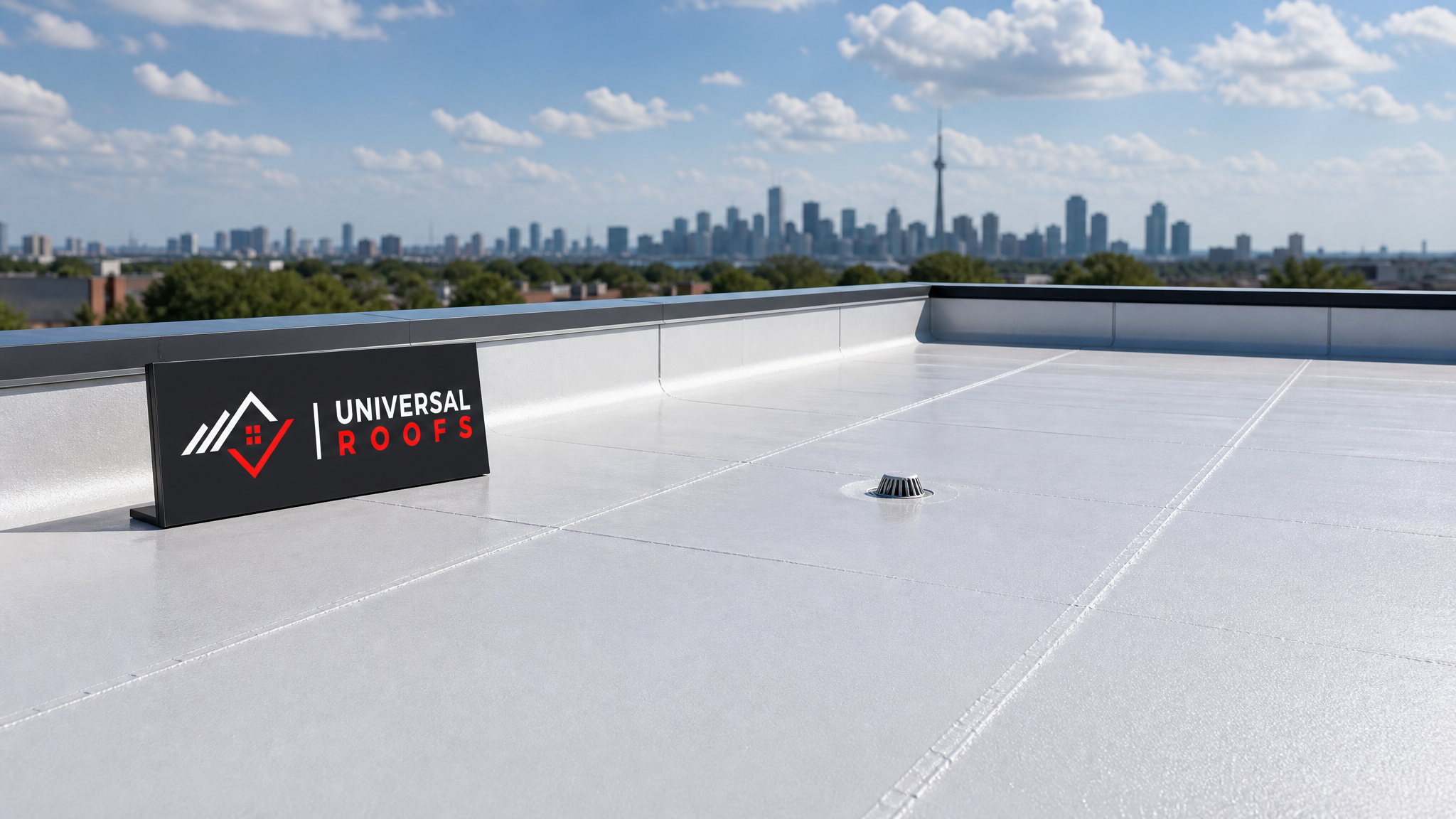
Why Flat Roof Waterproofing Fails in Toronto Homes and Buildings
Before getting into solutions, it helps to understand why flat roofs in our climate are so unforgiving. Toronto sees roughly 120 freeze-thaw cycles per year. Water that gets under a membrane, even in the smallest pinhole seam, expands when it freezes and forces the opening wider. By the third or fourth freeze-thaw cycle, a hairline gap has become a running leak. Add in intense summer UV exposure that dries out and cracks unprotected membranes, plus heavy spring rain and rapid snowmelt overwhelming poorly sloped drains, and you have a recipe for failure unless the waterproofing was done correctly from the start.
The most common failure points we see on service calls across Toronto, Mississauga, Brampton, Vaughan, Markham and Oakville are:
- Ponding water that never drains within the 48 hours required by the Ontario Building Code
- Membrane seams that were heat-welded or adhered incorrectly and separate under thermal movement
- Flashing at parapet walls, curbs and penetrations that was undersized or improperly lapped
- Drains and scuppers clogged with debris, causing water to back up under the membrane edge
- UV-degraded membrane surfaces that have become brittle and crack-prone
- Missing or failed skylight curb flashing where the roof plane meets a raised opening
Fixing these issues after the fact is always more expensive than getting the waterproofing right during installation or a scheduled resurfacing. If your roof is more than 15 years old and has never been resurfaced, it is worth having a contractor evaluate whether a roof repair is still viable or whether it makes more financial sense to plan a full replacement before a major leak forces the issue.
Choosing the Right Waterproofing Membrane System
Not all flat roof membranes waterproof the same way, and the right choice depends on your building type, budget, roof traffic and how long you want the system to last. The four systems we install most often on flat roofing projects in the GTA each have distinct waterproofing characteristics.
TPO (thermoplastic polyolefin) is heat-welded at the seams, creating a genuinely monolithic waterproof surface rather than a glued lap joint. It reflects UV light well, which reduces thermal cycling stress on the membrane, and it performs well in our cold winters provided installation temperatures were within manufacturer specifications.
EPDM (rubber membrane) is a single-ply system that has been used in Ontario for decades. It is flexible in cold temperatures, which matters for a roof that will see -20°C in January, but the seams are adhered rather than welded, meaning seam quality depends heavily on installer skill and primer application.
Modified bitumen is a multi-layer system, often torch-applied or self-adhered, that builds waterproofing redundancy into the roof through overlapping plies. It is a proven, durable choice for buildings with moderate roof traffic.
Fluid-applied (liquid) membranes are sprayed or rolled on to create a fully seamless waterproof coating. They excel at detailing complex roofs with many penetrations, drains and curbs, since there are no seams at all to fail — but surface preparation and cure conditions have to be tightly controlled.
| Membrane Type | Seam Method | Typical Lifespan | Best For |
|---|---|---|---|
| TPO single-ply | Hot-air welded | 20-25 years | Commercial roofs, reflective/cool-roof goals |
| EPDM rubber | Adhered lap seam | 20-30 years | Cold-climate flexibility, low-slope residential additions |
| Modified bitumen | Torch-welded or self-adhered plies | 15-20 years | Multi-layer redundancy, moderate foot traffic |
| Fluid-applied coating | Seamless spray/roll | 10-15 years (recoatable) | Complex roofs with many penetrations and curbs |
There is no single “best” membrane for every building — the right system depends on your roof’s slope, traffic level, existing structure and budget. A roofing contractor who inspects the roof in person, rather than quoting from a phone call, will steer you toward the system that actually solves your specific waterproofing problem.
Slope and Drainage: The Foundation of Any Waterproofing Plan
No membrane, however good, will waterproof a roof that holds standing water indefinitely. The Ontario Building Code requires flat roofs to drain within 48 hours of a rain event, and for good reason: ponding water adds enormous dead-load weight, accelerates membrane UV degradation at the pond edges, and finds every microscopic weakness in a seam through sheer hydrostatic pressure over time.
Before any waterproofing membrane goes down, the deck below it needs positive slope toward the drains — typically a minimum of 2% (about 1/4 inch per foot). On older Toronto buildings that were built dead-level, this usually means installing tapered insulation panels to create the slope, rather than relying on the structural deck itself. Skipping this step to save money is the single most common reason a “new” flat roof still ponds water and leaks within a few years.
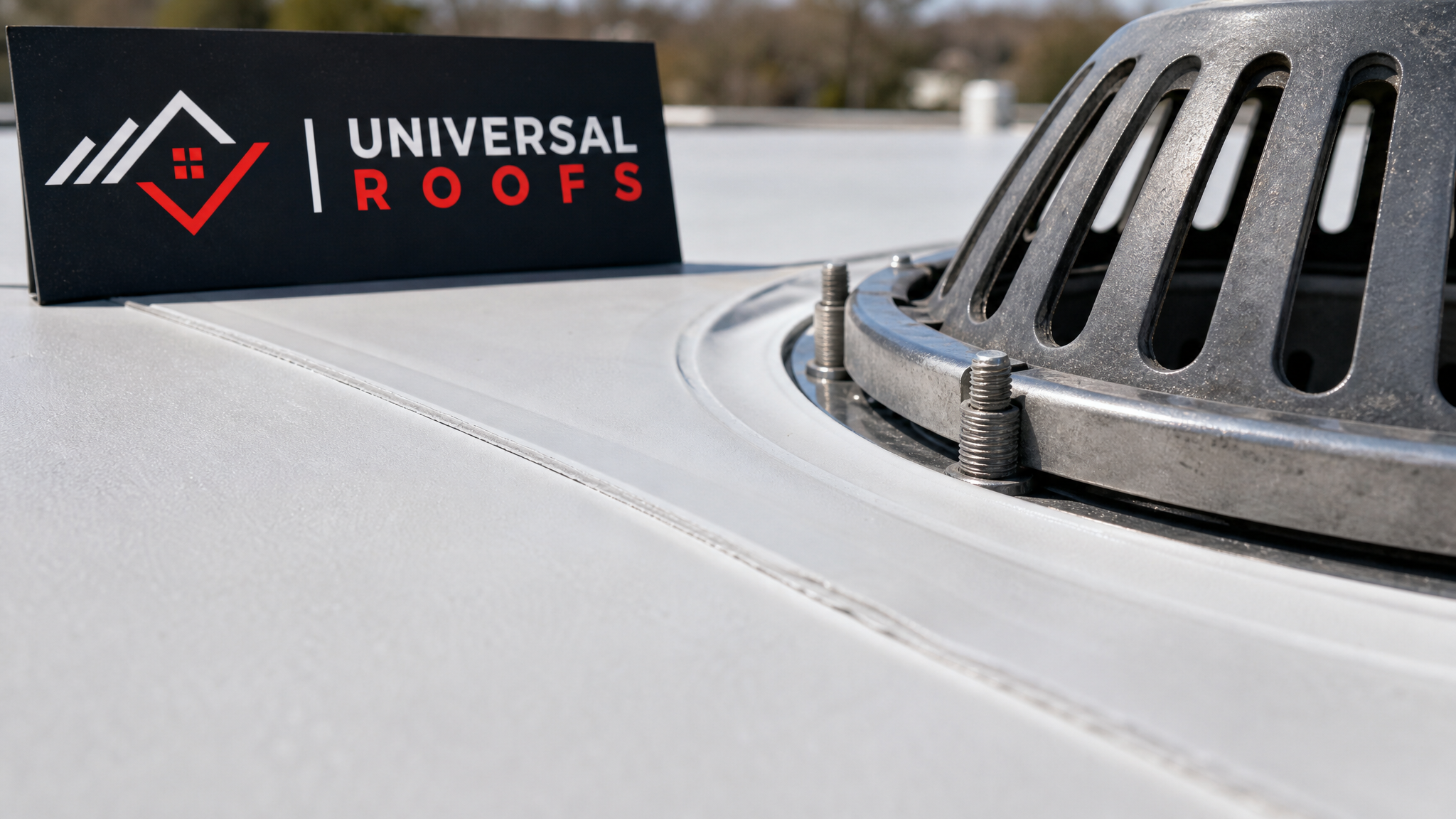
Drains themselves need just as much attention as the membrane. Internal drains require a properly flashed drain bowl with a clamping ring that compresses the membrane tightly against the drain body — a loose or missing clamping ring is an open invitation for water to travel beneath the membrane. Scuppers and overflow drains need to be kept clear of leaves, gravel and roofing debris, especially through the fall and after any nearby construction.
| Drainage Issue | Warning Sign | Recommended Fix |
|---|---|---|
| Insufficient slope | Water pools for 3+ days after rain | Install tapered insulation to restore 2% minimum slope |
| Clogged drain strainer | Water backs up around drain bowl | Clean strainer basket quarterly, more often near trees |
| Missing clamping ring | Wet insulation felt near drain during inspection | Re-flash drain with proper compression ring |
| Undersized scuppers | Overflow during heavy summer storms | Enlarge or add secondary overflow scupper |
| Ice damming at low points | Ice buildup visible in late winter | Improve attic insulation and ventilation to reduce heat loss |
Interestingly, drainage problems on a flat roof often trace back to what is happening below the roof deck, not on top of it. Uneven heat loss from a poorly insulated attic space can melt snow unevenly, refreeze it at the roof edge, and create ice dams that block drains exactly when you need them most — one more reason attic insulation and roof waterproofing should be evaluated together rather than in isolation.
Detailing Seams, Flashings and Penetrations Correctly
If slope and drainage are the foundation, seams and flashings are where waterproofing projects actually succeed or fail in the field. A flat roof membrane is only as waterproof as its weakest detail, and the vast majority of leaks we diagnose on service calls originate at a seam, flashing or penetration — almost never in the middle of an open membrane field.
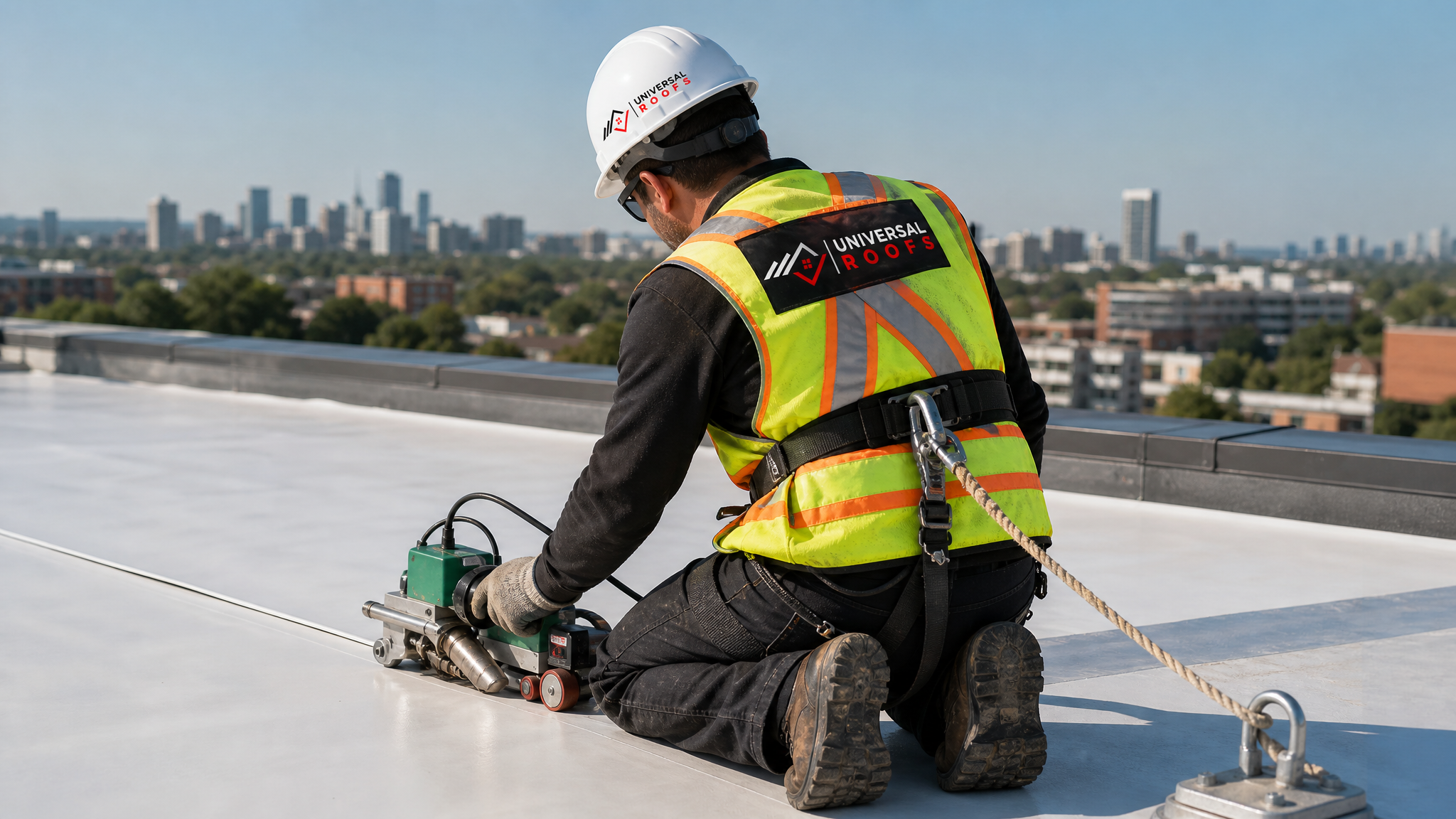
Seams need consistent, full-width welds or adhesion with no cold spots, fish-mouths or wrinkles. On a TPO or PVC membrane, this means the hot-air welder is run at the correct temperature and speed for ambient conditions — too cold and the weld doesn’t fully fuse, too hot and the membrane scorches and weakens. Every seam should be probed with a seam tester after installation, not just visually inspected.
Parapet walls require the membrane to run up the wall face and terminate under a properly fastened counterflashing or coping cap, never just glued to brick and left exposed. Water travelling down a parapet wall face during wind-driven rain will find any gap in this termination within a season or two.
Roof penetrations — vent stacks, HVAC curbs, conduit supports, and especially skylight curbs — need pre-formed pipe boots or field-fabricated flashing that laps correctly with the field membrane, sealed with compatible primer and sealant. Skylight curb flashing in particular deserves a second look during any waterproofing project, since a skylight that was watertight when installed can start leaking years later if the surrounding membrane has moved or degraded; this is a common trigger for homeowners scheduling skylight replacement when the actual root cause was failed roof flashing around the curb, not the skylight unit itself.
Expansion joints on larger commercial roofs need dedicated flexible covers rather than being bridged with standard membrane, since thermal movement across the joint will tear a rigid membrane over time.
| Detail Area | Common Failure | Correct Practice |
|---|---|---|
| Field seams | Cold weld, fish-mouth gap | Probe-test every seam; re-weld any failure immediately |
| Parapet termination | Membrane glued to brick, no counterflashing | Run membrane up and under a mechanically fastened coping cap |
| Pipe penetrations | Generic boot not sized to pipe diameter | Use properly sized pipe boot, sealed with compatible primer |
| Skylight curbs | Sealant-only termination with no flashing lap | Metal counterflashing lapped into field membrane |
| Expansion joints | Standard membrane stretched across the joint | Dedicated flexible expansion joint cover |
Coatings, Sealants and When Resurfacing Makes Sense
Not every flat roof needs a full membrane tear-off to restore its waterproofing. If the existing membrane is structurally sound but has aged, chalked or developed minor surface cracking from UV exposure, a reflective roof coating can extend its service life by 10 years or more at a fraction of the cost of replacement. Silicone and acrylic coatings are the two most common choices for Toronto’s climate — silicone handles ponding water and UV exposure exceptionally well, while acrylic coatings offer strong reflectivity and lower cost but perform less well where water tends to sit.
Coatings are not a fix for a roof with structural or slope problems. If water is ponding for days at a time, or if the deck below the membrane is already wet and deteriorating, a coating will simply seal moisture inside the assembly rather than solving the underlying issue. A proper inspection — including a moisture scan in some cases — should always precede a decision to coat rather than replace.
Sealants and mastics have their place too, but only as a targeted repair at a specific flashing detail or penetration, not as a substitute for correct membrane installation across the field of the roof. We regularly get called to buildings where a previous contractor “waterproofed” an entire seam run with a bead of caulking rather than properly welding or re-lapping it — this buys a few months at best before the sealant shrinks, cracks and the leak returns, usually during the next heavy rain.
Seasonal Maintenance That Protects Your Waterproofing Investment
Waterproofing is not a one-time event — it is a system that needs seasonal attention to keep performing. Summer is actually the best time of year to schedule a flat roof inspection in Toronto, since warm, dry conditions let a contractor properly evaluate membrane condition, test seams, and complete any repairs or resurfacing before fall rains and winter freeze-thaw cycles arrive.
A practical seasonal maintenance routine for any flat-roofed building includes:
- Clearing drains, scuppers and gutters of leaves and debris at least twice a year, and more often near mature trees
- Walking the roof after major storms to check for new ponding, membrane movement or debris damage
- Inspecting parapet caps and counterflashing annually for loose fasteners or sealant failure
- Checking skylight and vent curb flashing for cracking or separation each spring
- Scheduling a professional inspection every 12-24 months, with more frequent checks on roofs older than 15 years
- Removing standing snow loads promptly after heavy accumulation to reduce structural stress and ice-damming risk
| Season | Priority Task | Why It Matters |
|---|---|---|
| Spring | Inspect for winter freeze-thaw cracking | Catches small seam separations before spring rains exploit them |
| Summer | Schedule membrane inspection and any resurfacing | Warm, dry conditions are ideal for welding and coating work |
| Fall | Clear drains and gutters of leaves | Prevents backed-up water from sitting under membrane edges |
| Winter | Monitor for ice damming and remove excess snow load | Reduces structural stress and freeze-thaw membrane damage |
Keeping a simple log of inspections and repairs also pays off — it gives you (or a future buyer) a clear maintenance history, and it helps any contractor you call quickly identify whether a new leak is a fresh problem or a recurrence of something previously patched.
DIY Waterproofing vs. Hiring a Licensed Roofing Contractor
Homeowners and property managers often ask whether basic flat roof waterproofing — patching a small crack, applying a sealant, clearing a drain — is something they can safely do themselves. Routine drain clearing and visual inspections are perfectly reasonable DIY tasks. Anything involving membrane welding, flashing replacement, tear-off or coating application should go to a licensed, insured roofing contractor, for a few concrete reasons.
First, working at height on a flat roof carries real fall risk, and proper fall-protection equipment and training are not optional extras — they are the law in Ontario for most commercial and multi-storey residential work. Second, membrane compatibility matters: mixing an incompatible sealant, primer or coating with your existing membrane type can actually accelerate failure rather than prevent it. Third, most manufacturer warranties on TPO, EPDM and modified bitumen systems require installation and repair by a certified applicator — a DIY patch can void coverage on the rest of the roof, even where you didn’t touch it.
If you are unsure whether your roof needs a small repair or a full system evaluation, reading through real customer experiences on our reviews page or checking our FAQ page is a good starting point before booking an inspection.
What a Professional Waterproofing Assessment Includes
When our team is called out to evaluate a flat roof’s waterproofing condition anywhere from Toronto to Peel Region, York Region, Halton Region or Durham Region, the process is the same regardless of building type. We walk the entire roof surface documenting ponding areas, membrane condition, seam integrity and flashing condition. We check every drain, scupper and penetration individually rather than assuming they are all in similar shape. Where there is any doubt about hidden moisture, we use a moisture meter or infrared scan to check whether the insulation beneath the membrane has already absorbed water — a critical factor in deciding between repair and replacement.
From there, we provide a written assessment that separates urgent items (active leaks, failed flashing, structural ponding) from planning-stage items (aging membrane that will need resurfacing within a few years). This lets building owners budget appropriately rather than being surprised by an emergency repair bill. If the existing system has reached the end of its service life, we walk through roof replacement options with the same level of detail, matching the membrane system to the building’s specific slope, traffic and budget requirements.
Common Waterproofing Mistakes to Avoid
After two decades of service calls across the GTA, a few mistakes show up again and again, and avoiding them will save most building owners significant money over the life of a flat roof.
Do not assume a membrane that looks intact from the ground is actually watertight — most flat roof leaks begin as invisible pinholes at seams or flashing laps long before any interior staining appears. Do not use incompatible patch materials, such as asphalt-based sealants on a TPO or PVC membrane, since the plasticizers in asphalt products can actively degrade thermoplastic membranes. Do not ignore small ponding areas because “it dries out eventually” — repeated wet-dry cycling at the same spot is exactly what accelerates membrane fatigue. Do not delay flashing repairs at parapets or curbs, since these areas fail faster than the open membrane field and are usually the cheapest element to fix before they cause bigger damage. And do not choose a contractor based on price alone without checking their experience with your specific membrane type — a beautifully welded TPO roof and a poorly welded one can look identical on installation day and only reveal the difference two winters later.
Frequently Asked Questions About Waterproofing Flat Roofs
What are the most essential tips for waterproofing flat roofs in Toronto’s climate?
How often should a flat roof be inspected for waterproofing issues?
Can a flat roof be waterproofed without a full tear-off?
What membrane type offers the best waterproofing performance for cold climates?
Why does my flat roof still leak after waterproofing repairs?
Is DIY flat roof waterproofing safe and effective?
Need Help With Essential Tips for Waterproofing?
Getting flat roof waterproofing right the first time saves thousands of dollars in avoided water damage, and the team at Universal Roofs has been solving exactly these problems for GTA building owners since 2005.
Call us today at (416) 732-2421 or request a free inspection to get started.
Universal Roofs proudly serves Toronto, Mississauga, Brampton, Vaughan, Markham, Oakville and the GTA since 2005.