
Ask ten Toronto homeowners how often they have their roof inspected, and you will likely get ten different answers — ranging from “never, until it leaks” to “every spring, like clockwork.” Neither extreme serves you well. The ideal frequency for roof inspections depends on a mix of roof age, material, local climate exposure, and how the roof has performed historically, but for the vast majority of GTA properties the answer settles into a predictable pattern: twice a year for routine checks, plus additional inspections after major weather events.
At Universal Roofs, we have been inspecting, repairing, and replacing roofs across Toronto, Mississauga, Brampton, Vaughan, Markham, Oakville and the wider GTA since 2005. In that time we have seen exactly what happens when inspections are skipped for “just one more year” — a small flashing gap becomes a soaked attic deck, and a $250 inspection turns into a $9,000 repair. This guide walks through how often you actually need a roof inspection, what changes that frequency, how the seasons factor in, and when a homeowner can reasonably do a visual check themselves versus when a licensed professional needs to get on the roof.
Why Roof Inspection Frequency Matters More Than Most Homeowners Think
A roof is the single largest waterproofing system on your home, and it is also the component most homeowners interact with the least. Unlike a furnace filter or a leaky faucet, roof damage is invisible from inside the house until water has already found its way through the underlayment, the sheathing, and often the insulation before a stain appears on a ceiling. By the time you notice a problem from the living room, the roofing system has usually been compromised for months, sometimes years.
Regular inspections shift the entire cost structure of roof ownership. A missing shingle found in October costs perhaps $150 to fix. That same missing shingle, ignored through a Toronto winter of freeze-thaw cycles and ice damming, can lead to soaked insulation, mould growth, and damaged drywall that runs into the thousands. Insurance adjusters increasingly ask homeowners for proof of maintenance history when processing water damage claims, and a documented inspection record from a company like Universal Roofs can be the difference between a claim being approved smoothly and being denied for “lack of maintenance.”
Beyond cost avoidance, consistent inspections extend the usable life of the roof. Asphalt shingle roofs rated for 25 to 30 years routinely fail at 15 to 18 years when neglected, while well-maintained roofs regularly outlast their rated lifespan. The inspection itself does not add life to the shingles, but catching small issues — a lifted tab, a cracked pipe boot, a clogged valley — before they cascade into structural problems absolutely does.
The Baseline Answer: How Often Should You Schedule a Roof Inspection?
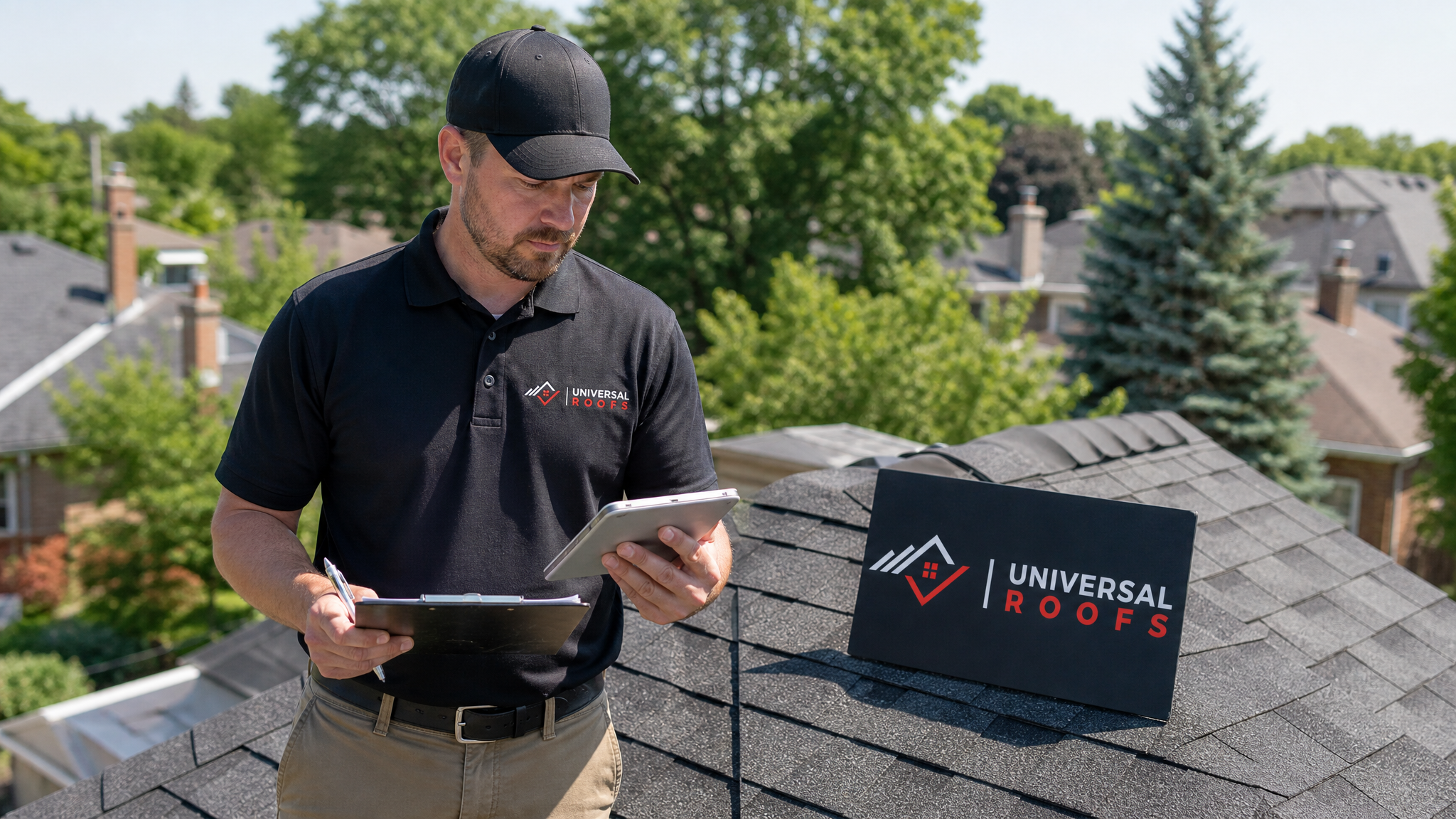
For most residential properties in the Toronto area, the ideal frequency for roof inspections is twice per year — once in spring and once in fall — supplemented by additional checks after any severe weather event. This baseline applies to asphalt shingle roofs, the most common roofing material in the GTA, under normal conditions with no known history of damage.
Commercial and flat roof properties generally need more frequent attention because flat and low-slope systems handle water differently than sloped shingle roofs, and because commercial buildings often carry more rooftop equipment that can create new penetration points. We recommend quarterly inspections for most commercial flat roofs, which you can arrange through our flat roofing services.
The table below breaks down our recommended baseline frequency by roof type and age, which is the starting point before adjusting for the property-specific factors covered in the next section.
| Roof Type | Age Bracket | Recommended Inspection Frequency | Best Inspection Months |
|---|---|---|---|
| Asphalt shingle (residential) | 0-10 years | Twice yearly | May and October |
| Asphalt shingle (residential) | 11-20 years | Twice yearly, plus post-storm | May and October |
| Asphalt shingle (residential) | 20+ years | Three to four times yearly | April, July, October, January |
| Flat/low-slope (residential or commercial) | Any age | Quarterly | Every 3 months, plus after heavy snow |
| Metal roofing | 0-15 years | Once yearly, plus post-storm | October |
| Cedar shake or slate | Any age | Twice yearly | May and October |
Notice that the frequency climbs as roofs age. A 22-year-old asphalt shingle roof approaching the end of its expected service life needs more eyes on it than a roof installed five years ago, because granule loss, sealant failure, and flashing corrosion all accelerate in the final years before roof replacement becomes necessary.
Factors That Push Your Ideal Inspection Frequency Higher
The twice-yearly baseline is a starting point, not a rule that applies identically to every property. Several factors specific to your roof, your lot, and your home’s history can and should push the ideal frequency for roof inspections higher than the standard schedule.
Roof age. As shown in the table above, roofs past the two-thirds mark of their expected lifespan degrade faster and more unpredictably. An 18-year-old shingle roof rated for 25 years is not simply “70% used up” in a linear way — the last several years often see accelerated granule loss and brittle sealant, which is exactly why we recommend stepping up to three or four inspections annually in that window.
Tree coverage and overhanging branches. Properties in mature neighbourhoods across North Toronto, Oakville, and parts of Markham often sit under significant tree canopy. Overhanging branches drop debris that clogs valleys and gutters, scrape shingle granules loose during wind, and provide a highway for squirrels and raccoons to access the roof deck. Homes with heavy tree cover should add a post-autumn inspection specifically to clear debris before winter.
Roof complexity and penetrations. A simple gable roof with one chimney has far fewer failure points than a roof with multiple dormers, skylights, HVAC penetrations, and valleys. Every penetration is a potential leak source. If your home has skylights installed, the flashing around each unit needs to be checked at every inspection, since skylight flashing is one of the most common leak origins we find in the GTA.
Previous repair history. A roof with a documented history of leaks, patch repairs, or prior storm damage needs closer monitoring than a roof with a clean record, even if both are the same age. Repaired sections are often the first to fail again, particularly if the original repair addressed a symptom rather than the underlying cause.
Attic ventilation and insulation condition. Poor attic ventilation causes heat and moisture to build up under the roof deck, accelerating shingle deterioration from underneath — a problem that is invisible from a ground-level visual check. If you have never had your attic ventilation assessed alongside your roof, this is worth adding to your inspection routine, since ventilation problems often show up as premature shingle curling long before any visible leak appears.
Proximity to Lake Ontario and wind exposure. Properties closer to the lakeshore experience stronger, more consistent wind loading, which accelerates shingle lifting and seal-strip fatigue. Homes in exposed locations, on hilltops, or in wind corridors between taller buildings should treat storm-season inspections as mandatory rather than optional.
Seasonal Timing: When Inspections Matter Most in the GTA
Toronto’s climate is genuinely rough on roofing systems. We get deep winter cold, dramatic freeze-thaw cycling, spring rain, humid summers, and increasingly frequent severe wind and hail events. Timing your inspections around this cycle matters as much as the raw frequency.
Spring (April to May) is the most important inspection window of the year. This is when winter damage becomes visible — ice dam damage, shingles cracked by freeze-thaw expansion, flashing loosened by snow load, and granule accumulation in gutters from winter shingle stress. A spring inspection catches this damage before spring rains exploit it.
Fall (September to October) is about preparation rather than diagnosis. This inspection checks that the roof, flashing, and gutters are ready to handle snow load and ice damming before temperatures drop. It is also the ideal time to clear leaves and debris from valleys and gutters, since clogged gutters are a leading cause of ice dams.
Summer inspections are less about the roof surface itself and more about attic heat and ventilation performance, plus checking for damage after any severe summer thunderstorms or hailstorms, which have become more frequent across the GTA in recent years.
Winter is generally not a time for full physical inspections, since ice and snow make roof access dangerous and can hide damage rather than reveal it. However, a visual check from the ground after any major snowstorm, ice storm, or high-wind event is worthwhile at any time of year, including winter.
| Season | Primary Purpose | Key Things to Check | Urgency Level |
|---|---|---|---|
| Spring | Diagnose winter damage | Ice dam damage, cracked shingles, loosened flashing | High – schedule promptly |
| Summer | Storm damage check, ventilation review | Hail bruising, wind lift, attic heat buildup | Moderate |
| Fall | Winterization | Gutter clearing, flashing seal, valley debris | High – before first snowfall |
| Winter | Ground-level visual only | Ice damming, snow load, visible sagging | Reactive, after storms only |
What a Professional Roof Inspection Actually Covers
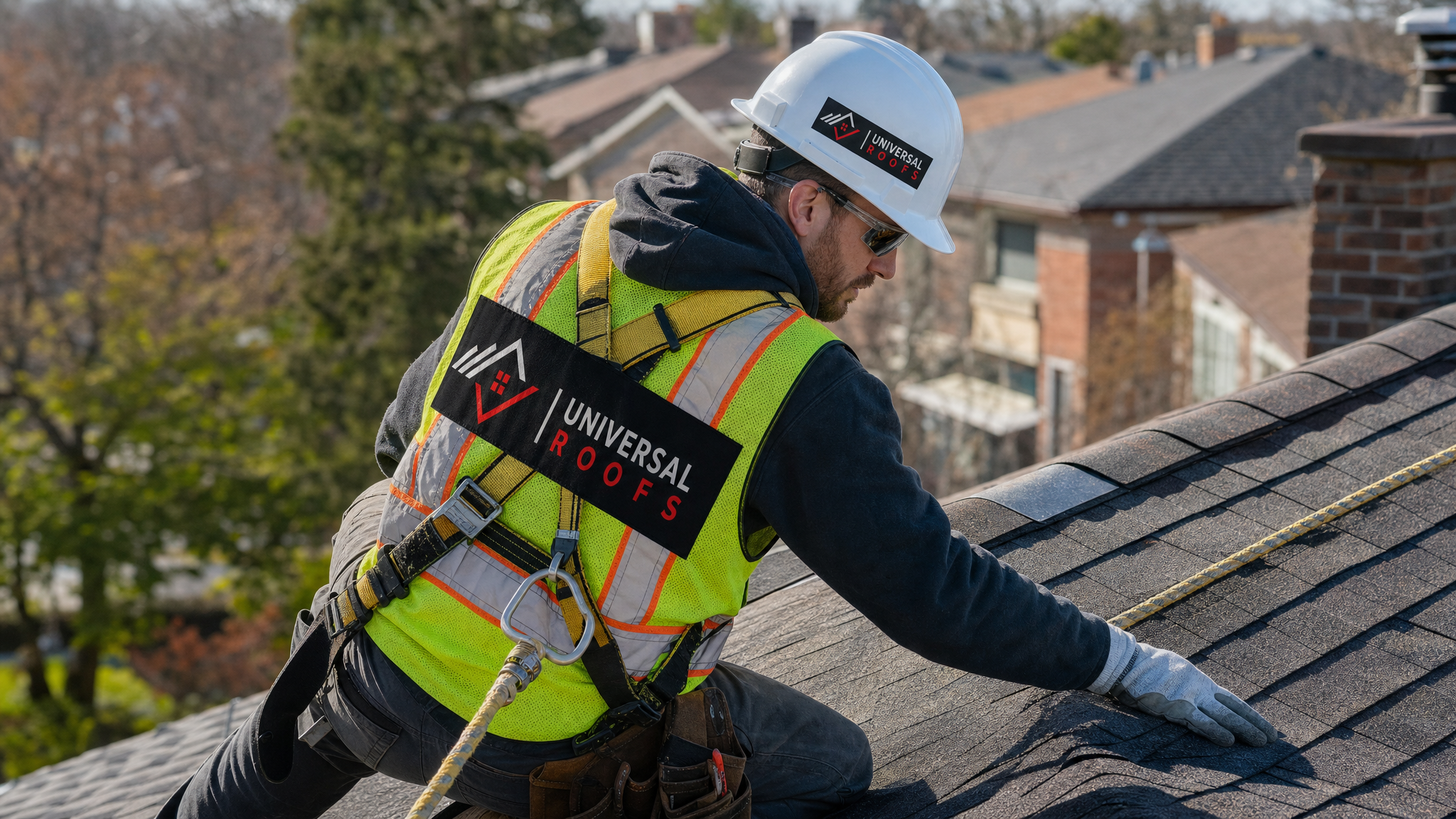
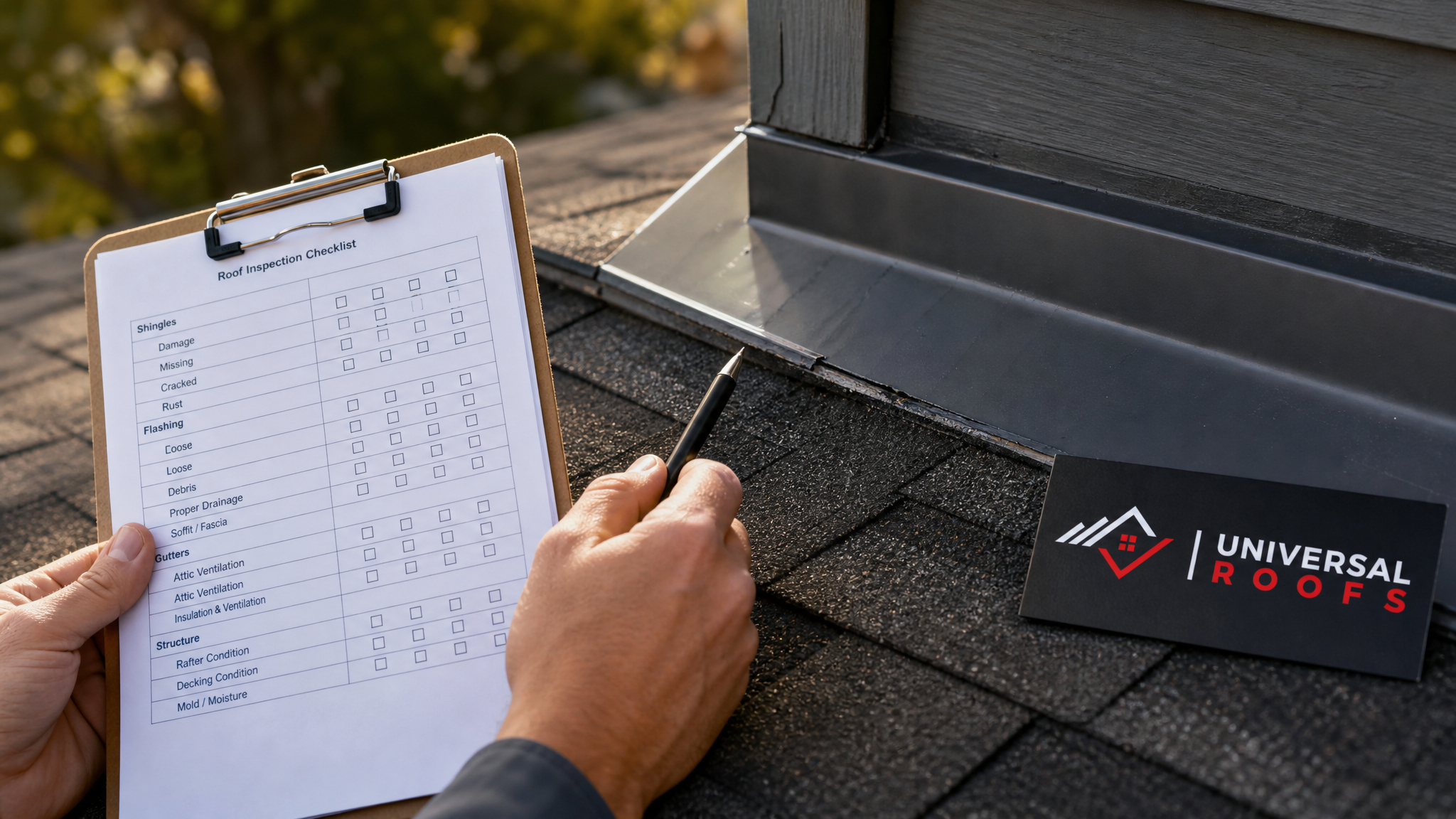
Not all inspections are created equal. A thorough professional inspection goes well beyond glancing up from the driveway. Here is what our team checks during a standard Universal Roofs inspection, whether the property is in downtown Toronto or out toward Vaughan or Markham.
| Inspection Area | What We Check | Common Issues Found | Typical Fix |
|---|---|---|---|
| Shingles/surface | Cracking, curling, granule loss, missing tabs | Wind lift, UV degradation, hail bruising | Spot repair or section replacement |
| Flashing | Chimney, wall, valley, and skylight flashing seals | Rust, separation, cracked sealant | Re-seal or re-flash |
| Gutters and drainage | Debris blockage, sagging, pitch | Clogged valleys, standing water | Clear, re-pitch, or replace sections |
| Attic and ventilation | Insulation moisture, soffit/ridge vent airflow | Condensation, mould, ice dam risk | Ventilation upgrade or insulation top-up |
| Structural deck | Sagging, soft spots, rot | Long-term water intrusion | Deck sheathing repair or replacement |
| Penetrations | Vent boots, skylight seals, pipe collars | Cracked rubber boots, failed sealant | Boot or collar replacement |
A written report with photos should follow every professional inspection. This documentation matters for two reasons: it gives you a baseline to compare against next time, and it becomes valuable evidence for insurance purposes if storm damage is ever disputed. Every inspection we complete across the GTA includes photo documentation and a plain-language summary of what was found and what, if anything, needs attention.
DIY Visual Checks vs. Professional Inspections: Where the Line Belongs
Homeowners often ask whether they can save money by doing their own roof inspections. The honest answer is that a homeowner can and should do ground-level visual checks regularly, but a full inspection that includes getting on the roof requires training, safety equipment, and experience most homeowners simply do not have.
Ground-level checks you can safely do yourself, ideally once a season, include: walking the perimeter of your home and looking up at the roofline for obviously missing or curling shingles, checking gutters from a ladder set on stable ground (not while leaning out over the roof edge), inspecting the attic from inside for daylight coming through the roof deck, watery stains, or musty odours, and looking at downspouts after rain to confirm water is draining properly rather than backing up.
What you should not attempt yourself: walking on the roof surface itself, especially on steep slopes or during or after wet weather, inspecting flashing details up close, which requires being on the roof safely tied off, diagnosing whether a stain is an active leak or old damage, which requires moisture-meter testing that professionals carry, and any work at height without a harness, rope, and anchor point, which is exactly the fall-protection setup our crews use on every job.
The professional/DIY line exists for a simple reason: falls from residential roofs are a leading cause of serious injury in the trades, and the visual cues that look “fine” from the ground — a slightly lifted shingle tab, a hairline crack in a pipe boot — are often the exact details that predict a leak six months out. If you can see a problem from the ground, it has usually already progressed past the early stage where a $150 fix would have solved it.
| Task | Homeowner DIY? | Recommended Frequency | Notes |
|---|---|---|---|
| Visual check from ground/windows | Yes | Monthly | Look for missing, curling, or discoloured shingles |
| Gutter check from stable ladder | Yes, with caution | Seasonally | Never lean out over the roof edge |
| Attic interior check | Yes | Twice yearly | Look for daylight, stains, or odours |
| On-roof physical inspection | No – professional only | Twice yearly (or as recommended) | Requires harness, rope, and training |
| Flashing and skylight seal check | No – professional only | Every inspection | Common leak point, needs close-up access |
Special Considerations for Flat Roofs and Skylights
Flat and low-slope roofs, common on additions, garages, and commercial buildings throughout the GTA, follow different inspection rules than sloped shingle roofs. Water does not run off a flat roof the way it does off a pitched one, so ponding water, membrane seams, and drain function all need dedicated attention. We generally recommend quarterly inspections for flat roofing systems, with an additional check after any heavy snowfall since accumulated snow load and subsequent melt are the leading causes of flat roof leaks we see across Toronto and Mississauga.
Skylights deserve their own mention regardless of the roof type they are installed in. The flashing kit around a skylight is a manufactured seal designed to shed water around a hole cut into your roof deck — and any gap, however small, sends water directly into the room below rather than running off harmlessly. Homes with skylights should have that flashing specifically checked at every seasonal inspection, not just glanced at. If your skylights are original to a roof that is now 15 or more years old, it is worth having them assessed even if there is no visible leak yet, since flashing seals do degrade on a similar timeline to the shingles around them.
What Happens After the Inspection: Repair, Monitor, or Replace
An inspection is only useful if it leads to a clear decision. After every Universal Roofs inspection, the roof falls into one of three categories.
Monitor. The roof shows normal wear for its age with no active issues. We note any minor observations for the next scheduled inspection and recommend no immediate action. This is the outcome for most inspections on roofs under 15 years old with no history of problems.
Repair. Specific, localized issues were found — a lifted section of shingles, a failing pipe boot, a small area of flashing separation. These are addressed through targeted roof repair rather than full replacement, and a competent repair on a roof that is otherwise sound can extend its useful life by years for a fraction of replacement cost.
Replace. The inspection reveals widespread granule loss, multiple failed penetrations, structural deck concerns, or a roof that has simply reached the end of its realistic service life. In these cases we walk homeowners through roof replacement options rather than continuing to invest in a system that is fundamentally at end of life, since repeated patch repairs on a worn-out roof eventually cost more than a single planned replacement.
Knowing which category your roof falls into only comes from an actual inspection — guessing based on age alone misses roofs that fail early due to poor ventilation or installation defects, and it also leads homeowners to replace roofs years before necessary simply because a number on a calendar suggested it was “time.”
Building an Inspection Schedule That Actually Gets Followed
The best inspection frequency in the world does not help if it is not actually followed. The homeowners we see with the fewest surprise repairs are the ones who treat roof inspections like any other recurring home maintenance task — tied to a fixed calendar date rather than “whenever I remember.”
A practical approach: book your spring inspection for the same week every April, and your fall inspection for the same week every October, regardless of whether anything seems wrong. Add a rule that any hailstorm, windstorm with gusts over 90 km/h, or heavy snow load event triggers an extra check within a few weeks. If your roof is over 15 years old, add a mid-summer check as a third annual visit. This turns “the ideal frequency for roof inspections” from an abstract recommendation into an actual habit, which is where the real value comes from.
Many homeowners also find it useful to keep a simple maintenance log — dates of each inspection, what was found, and what was repaired. Over a decade of ownership, this record becomes genuinely valuable, both for insurance purposes and for informing the eventual replacement decision with real data instead of guesswork. You can read about how other GTA homeowners have approached their roof maintenance on our reviews page, and browse more detail on our process on the about and FAQ pages.
Universal Roofs’ Approach to Inspections Across the GTA
Every inspection we perform in Toronto and the surrounding region follows the same structured process regardless of roof size or type: a full walk of the roof surface where safely possible, close inspection of every flashing point and penetration, an attic check for ventilation and moisture signs, gutter and drainage assessment, and photo documentation with a written summary delivered to the homeowner. We do not push unnecessary replacements — if a roof is sound, we say so, and we schedule the next check rather than recommending work that is not needed.
Since 2005 we have inspected and maintained roofs across every housing type common to the GTA, from century homes in older Toronto neighbourhoods to new-build subdivisions in Vaughan and Markham to commercial flat roofs in Mississauga and Brampton. That range of experience means we recognize the specific failure patterns tied to each roof age, material, and neighbourhood microclimate, rather than applying a one-size-fits-all checklist.
What is the ideal frequency for roof inspections on a typical Toronto home?
Does the ideal frequency for roof inspections change for flat roofs?
Should I inspect my roof after every storm, or just on a fixed schedule?
Can I do a roof inspection myself instead of hiring a professional?
How does roof age affect the ideal inspection frequency?
What does a professional roof inspection from Universal Roofs include?
Need Help With Your Roof?
Getting the timing right on roof inspections is one of the simplest ways to protect your home and avoid costly surprise repairs, and Universal Roofs has been helping GTA homeowners and property managers stay ahead of roof problems since 2005.
Call us today at (416) 732-2421 or request a free inspection to get started.
Universal Roofs proudly serves Toronto, Mississauga, Brampton, Vaughan, Markham, Oakville and the GTA since 2005.