
Metal roofing has become one of the most popular upgrades for homeowners across the Greater Toronto Area, and for good reason. It shrugs off hail, sheds heavy snow, resists wind uplift, and can last 40 to 70 years with proper care. But metal roofs are not maintenance-free, and when something does go wrong, homeowners often ask the same question: what are the best solutions for metal roof repair, and how do you know which fix actually applies to your situation?
The honest answer is that “metal roof repair” is not one repair. It is a family of distinct solutions, each matched to a specific failure mode. A hairline seam leak needs a different fix than a hail-dented panel, and a hail-dented panel needs a different fix than a rusted-through valley or a fastener that has backed out and stripped its hole. Applying the wrong solution, or applying the right solution with the wrong materials, is how a small leak becomes a full panel replacement two winters later.
This guide walks through every major metal roof repair solution used by professional roofers in Ontario, explains when each one is appropriate, and gives you the cost, durability, and skill-level context you need to make an informed decision. We will also cover the freeze-thaw realities of a Toronto winter, the warning signs that mean you should stop patching and start planning a larger repair, and how to tell a genuinely durable fix from a short-term cover-up.
Why Metal Roofs Fail: The Root Causes Behind Most Repairs
Before choosing a repair method, it helps to understand why metal roofs develop problems in the first place. Metal panels themselves are extremely durable, but the weak points are almost always at the connections: seams, fasteners, flashing transitions, and penetrations for vents, skylights, and chimneys. Toronto’s climate makes these weak points worse than they would be in a milder region.
The GTA experiences dozens of freeze-thaw cycles every winter. Water that gets under a panel or into a fastener hole expands as it freezes, widening the gap slightly. The next thaw lets more water in, and the cycle repeats until a pinhole becomes a visible leak. Add in the thermal expansion and contraction that metal panels undergo between a -15 degree Celsius January night and a +30 degree Celsius July afternoon, and you have a system that is constantly moving, however slightly, at every seam and fastener.
The most common root causes we see on service calls include:
- Exposed fasteners that have backed out or whose rubber washers have hardened and cracked with age and UV exposure
- Sealant at seams, laps, and penetrations that has dried out, shrunk, or lost adhesion
- Hail or debris impacts that dent panels or chip protective coatings, exposing bare metal to moisture
- Flashing around chimneys, skylights, and vent stacks that was improperly installed or has corroded
- Galvanic corrosion where dissimilar metals (for example, aluminum flashing against steel fasteners) are in contact and accelerate rust
- Ice damming at eaves and valleys that forces meltwater backward, underneath panels
Identifying which of these is actually happening on your roof is the first step. Many homeowners jump straight to a general sealant application without addressing the underlying fastener or flashing issue, which explains why some repairs fail again within a season.
Solution 1: Fastener Replacement and Re-Torquing
Exposed-fastener metal roofing systems, common on many GTA garages, workshops, and some residential roofs, rely on screws with neoprene washers to keep water out at every penetration. Over 10 to 15 years of Ontario sun and freeze-thaw cycling, those washers harden, crack, and shrink, and the screws themselves can back out slightly due to thermal movement in the panel.
The fix is straightforward in concept but requires care in execution. A roofer walks the entire field of the roof, identifies every backed-out, stripped, or leaking fastener, and replaces it with a new, properly sized fastener with an intact washer. Where the original hole has stripped out (meaning the screw spins without biting), the repair calls for an oversized fastener or a fastener paired with a sealant plug rather than simply driving a new screw into the same worn hole, which will fail again quickly.
This is one of the most cost-effective roof repair solutions available for metal roofing, and it is often the single highest-impact fix on an aging exposed-fastener roof, since a roof can have hundreds of fasteners and even a handful of failed ones is enough to cause interior water staining.
Solution 2: Seam and Lap Sealant Renewal
Standing-seam metal roofs are engineered to shed water without exposed fasteners, but the end laps, side laps, and terminations still rely on butyl tape or high-grade sealant to stay watertight. Over time, especially on south- and west-facing slopes that see the most UV exposure, these sealants can dry out, shrink away from the metal, or lose their bond entirely.
The proper repair is not simply squeezing a bead of generic caulk over the old sealant. A thorough seam repair involves removing the failed sealant, cleaning the metal surfaces with an appropriate solvent to remove oxidation and residue, and applying a compatible, roof-grade polyurethane or butyl sealant rated for the specific metal coating on the panel (galvanized steel, Galvalume, or painted aluminum each have slightly different compatibility requirements).
For larger seam failures or where panels have separated slightly, a roofer may also install a matching metal flashing strip under the seam before resealing, giving the repair a mechanical backup in addition to the sealant. This belt-and-suspenders approach is what separates a repair that lasts 10+ years from one that needs redoing in 18 months.
Solution 3: Panel Patching for Rust and Corrosion
Small areas of surface rust, usually caused by a scratched coating, a fastener failure that let water sit against the metal, or contact with dissimilar metals, can often be repaired without replacing the entire panel. The process involves grinding back the corroded area to clean, sound metal, treating it with a rust-inhibiting primer, and applying a matching colour-coated patch or a fibreglass-reinforced roofing membrane patch sized to fully overlap the damaged area.
Where corrosion has progressed further and created a hole through the panel, a proper patch requires a new piece of matching-gauge metal, cut and formed to overlap the damaged section by at least 100 millimetres on all sides, fastened and sealed at every edge. This is a solution best left to an experienced metal roofing crew, because an undersized or poorly sealed patch will trap moisture underneath and accelerate the very corrosion it was meant to stop.
If corrosion is widespread across multiple panels rather than isolated to one or two spots, patching is usually a temporary measure, and it is worth discussing a broader roof replacement timeline with your contractor rather than repeating patches every year.
Solution 4: Flashing Repair and Replacement
Flashing failures around chimneys, skylights, vent stacks, and roof-to-wall transitions are among the most common sources of leaks on any roof type, metal included. Metal panels themselves rarely leak in the open field; nearly every leak we trace back on a service call originates at a penetration or a transition where flashing was undersized, poorly lapped, or has simply corroded through after 15 to 20 years.
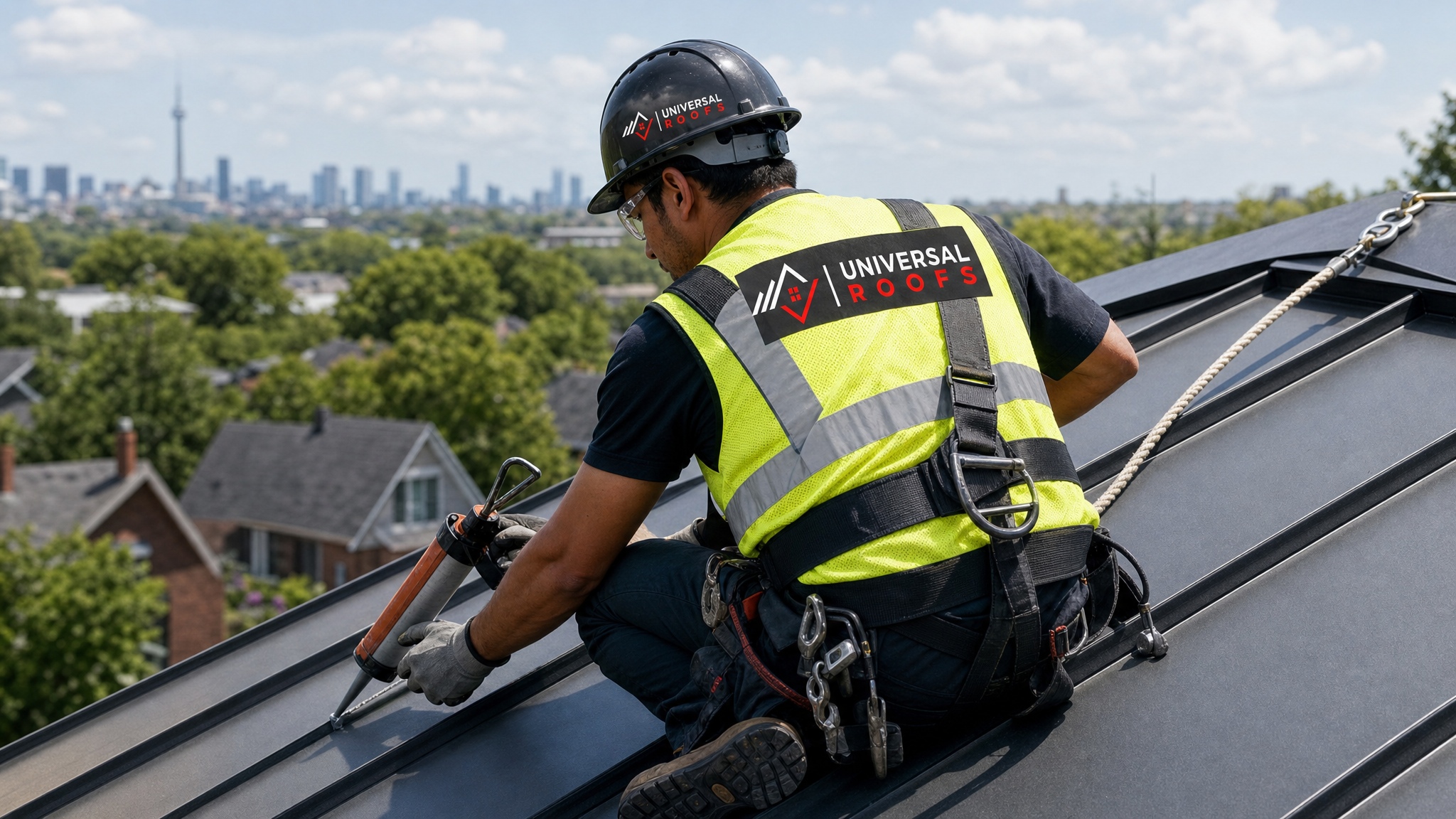
The repair solution depends on the severity. Minor flashing issues, such as a lifted edge or a small gap at a termination bar, can sometimes be resolved by re-securing the flashing and applying fresh sealant. More significant issues, such as corroded step flashing along a chimney or a cracked pipe boot, require full removal and replacement of the flashing component with new material matched to the surrounding panel profile and finish.
Skylight curbs deserve particular attention on metal roofs, since the transition between a rigid curb and a metal panel roof is a common leak point if the original flashing kit was not designed for metal roofing specifically. If your leak is originating at a skylight rather than the open roof field, it is worth having that penetration inspected separately through our skylights service, and in some cases a skylight replacement with a properly metal-compatible flashing kit resolves a recurring leak permanently rather than repeatedly resealing an incompatible curb.
Solution 5: Coating and Recoating for Aging Panels
Metal roofs are typically finished with a factory paint system, most commonly a Kynar 500 (PVDF) or a polyester-based coating, that protects the substrate from UV degradation and moisture. After 20 to 30 years, or sooner in roofs with lower-grade coatings, that finish can chalk, fade, or develop small cracks that allow moisture to reach the bare metal underneath.
For roofs that are structurally sound but showing widespread coating wear rather than isolated leaks, a professional recoating can extend service life significantly at a fraction of replacement cost. This involves pressure washing the roof to remove chalking residue and debris, treating any spot rust, and applying an elastomeric or silicone roof coating rated for metal substrates in two coats to achieve proper film thickness.
Recoating is not a substitute for fastener or flashing repair. It is most effective as a finishing solution applied after mechanical issues have already been addressed, since a coating applied over an active leak or a loose fastener will not stop water intrusion.
Comparing Metal Roof Repair Solutions
| Repair Solution | Best For | Typical Lifespan of Fix | Approx. Cost Range (CAD) |
|---|---|---|---|
| Fastener replacement | Backed-out screws, cracked washers | 10-15 years | $300 – $900 |
| Seam/lap resealing | Dried or shrunk sealant at joints | 8-12 years | $400 – $1,200 |
| Panel patching | Isolated rust or small punctures | 10-20 years | $500 – $1,800 |
| Flashing repair/replacement | Chimney, skylight, vent leaks | 15-25 years | $600 – $2,500 |
| Full recoating | Widespread coating chalk/fade | 10-15 years | $3 – $6 per sq. ft. |
| Section replacement | Extensive corrosion or storm damage | 30-50 years | $8 – $14 per sq. ft. |
These figures are general GTA market ranges as of 2026 and vary based on roof pitch, accessibility, panel profile, and the extent of underlying deck damage discovered once a repair begins. A detailed, on-site assessment is the only reliable way to price a specific job, which is why we recommend starting with a free inspection rather than estimating from photos alone.
DIY Repair vs. Professional Repair: What You Can (and Cannot) Safely Do
Many homeowners ask whether metal roof repair is a reasonable DIY project. The honest answer depends heavily on the specific problem, the roof pitch, and your comfort working at height. Some minor tasks are within reach for a handy homeowner; others carry real safety risk and are best left to a licensed, insured contractor.
| Task | DIY Feasibility | Key Risk if Done Incorrectly |
|---|---|---|
| Tightening a visible loose fastener | Possible on low-pitch, single-storey roofs with proper fall protection | Overdriving strips the hole, worsening the leak |
| Applying sealant to a seam | Low – requires correct product and surface prep | Wrong sealant type fails within one season |
| Patching a corroded panel | Not recommended | Poor overlap or fastening traps moisture underneath |
| Flashing replacement at a chimney | Not recommended | Requires removing surrounding panels and re-lapping correctly |
| Working on steep-slope or 2nd storey+ metal roofs | Not recommended | Metal panels are extremely slick; fall risk is severe |
Metal roofing surfaces, particularly when wet, dewy, or coated with pollen, are significantly more slippery than asphalt shingles. Professional crews use fall-arrest harnesses, roof anchors, and rubber-soled footwear specifically rated for metal, along with roof jacks and staging for steep slopes. If your roof has any pitch beyond a gentle slope, or if the repair is anywhere near a roof edge, chimney, or valley, it is worth having a professional handle it rather than risking a fall.
Signs You Need More Than a Repair
Repairs are appropriate when damage is isolated and the underlying structure and majority of panels are sound. But there comes a point where continuing to patch a metal roof costs more over time than addressing the root problem. Watch for these signs that a repair conversation should shift toward a fuller assessment:
- You have called for the same leak location more than twice in three years
- Corrosion is visible across multiple panels rather than one isolated area
- Panels have visibly separated or lifted at multiple seams, suggesting fastener or clip failure across a wider area
- The roof deck underneath shows signs of rot or sagging when accessed from the attic
- The roof is approaching or has passed the expected service life of its coating system (20-30 years for standard finishes)
If any of these apply, a full roof assessment is worthwhile before committing to another round of patchwork. Our Universal Roofs team can walk you through whether targeted repair or a phased replacement makes more financial sense for your specific roof.
Seasonal Timing: Why Summer Is the Best Window for Metal Roof Repairs
Ontario’s climate makes timing a real factor in how well a metal roof repair performs. Sealants and coatings need a minimum ambient and surface temperature to cure properly, typically above 10 degrees Celsius, and most products perform best when applied in dry, moderate conditions rather than the extreme heat of a July afternoon or the damp cold of late autumn.
Early to mid-summer, like right now, tends to offer the most reliable stretch of dry, moderate-temperature days in the GTA, which is exactly the window sealants and coatings need to bond and cure fully before the next freeze-thaw cycle tests them in the fall and winter. Scheduling seam resealing, recoating, or flashing work during these months gives the materials the best possible chance to reach full cure strength before winter arrives.
Waiting until late fall or attempting repairs in freezing conditions is one of the most common reasons a metal roof repair fails prematurely. If you have noticed a leak or damage now, addressing it this summer, rather than waiting, gives the repair the best chance of a long service life.
Maintaining a Metal Roof After Repair
Once a repair is complete, a small amount of ongoing maintenance dramatically extends the life of both the repair and the surrounding roof system. We recommend:
- A visual inspection twice a year (spring and fall) to catch loose fasteners or lifted sealant before they become leaks
- Keeping gutters and valleys clear of leaves and debris that trap moisture against panel edges
- Trimming overhanging branches that can scratch protective coatings during wind events
- Checking attic insulation and ventilation, since poor ventilation increases condensation risk against the underside of metal panels; our attic services cover insulation and ventilation assessments if you are unsure whether yours is adequate
- Scheduling a professional inspection after any major hailstorm or windstorm, even if no leak is immediately visible
Choosing the Right Metal Roof Repair Contractor in the GTA
Metal roofing is a specialized trade distinct from asphalt shingle work, and not every roofing contractor has the tools, fastener stock, or panel-forming equipment to do a proper metal repair. When evaluating a contractor for metal roof repair, look for:
- Documented experience specifically with metal panel systems, not just general roofing
- Use of manufacturer-matched or manufacturer-approved sealants, fasteners, and coatings rather than generic hardware-store products
- A written scope of work identifying the specific repair method, not a vague “we’ll seal it up”
- Proper fall-protection equipment and WSIB coverage for crews working at height
- Willingness to provide a written warranty on the repair itself, not just the materials
Reading feedback from other homeowners in your area is one of the fastest ways to gauge a contractor’s track record on metal roofing specifically. You can browse verified feedback from GTA homeowners on our reviews page, and check common questions on our FAQ page before booking an assessment.
Universal Roofs has served homeowners across the Toronto, Peel Region, York Region, Halton Region, and Durham Region areas since 2005, and metal roof repair is one of our most frequently requested services during the summer months when the weather cooperates best for lasting repairs.
Cost Factors That Change Your Metal Roof Repair Price
| Factor | Impact on Price | Why It Matters |
|---|---|---|
| Roof pitch and height | Increases labour cost | Steeper or taller roofs need more safety equipment and time |
| Panel profile availability | Can increase material cost | Discontinued or custom profiles may require special ordering |
| Extent of deck damage found | Increases scope mid-job | Rotted decking under a leak must be replaced before repair |
| Number of penetrations affected | Increases linear feet of flashing work | Each chimney, vent, and skylight adds separate flashing detail |
| Access and staging needs | Adds equipment rental cost | Tall or steep roofs may require scaffolding or lifts |
What are the best solutions for metal roof repair on an older roof?
Can a metal roof be repaired instead of replaced?
How much does metal roof repair cost in the GTA?
What is the most common reason metal roofs leak?
Is it safe to repair a metal roof myself?
When is the best time of year to repair a metal roof in Toronto?
Need Help With What Are the Best?
Whatever is causing your metal roof issue, from a stubborn seam leak to hail-dented panels, the team at Universal Roofs has the specialized tools and experience to apply the right fix the first time rather than a short-term patch.
Call us today at (416) 732-2421 or request a free inspection to get started.
Universal Roofs proudly serves Toronto, Mississauga, Brampton, Vaughan, Markham, Oakville and the GTA since 2005.