
Every July, Toronto homeowners notice the same thing: the upstairs bedrooms turn into ovens by mid-afternoon, the air conditioner runs almost continuously, and the roof deck stays hot well into the evening. A dark asphalt shingle or aging flat roof membrane can reach surface temperatures of 65 to 80 degrees Celsius on a sunny summer day, and much of that heat radiates directly into the attic and living space below. Heat reflective roof coatings are one of the most practical, cost-effective ways to break that cycle without a full roof replacement.
A heat reflective coating is a liquid-applied membrane, usually acrylic, silicone, or elastomeric in formulation, that is rolled, sprayed, or brushed over an existing roof surface. Once cured, it forms a seamless, reflective layer that bounces solar radiation away from the building instead of absorbing it. The technology has been used on commercial flat roofs for decades and has become increasingly popular on residential sloped and low-slope roofs across the Greater Toronto Area as homeowners look for ways to lower cooling costs, extend roof lifespan, and reduce their environmental footprint.
In this guide, we will walk through exactly what heat reflective coatings do, the measurable benefits homeowners and building owners can expect, how they compare to other roofing upgrades, what the installation process looks like, and how to decide whether coating your existing roof makes more sense than repair or full replacement. As a Toronto-area roofing contractor that has served the GTA since 2005, Universal Roofs has applied reflective coatings on everything from bungalow shingle roofs to large commercial flat roof systems, and we will share what we have learned along the way.
What Are Heat Reflective Roof Coatings?
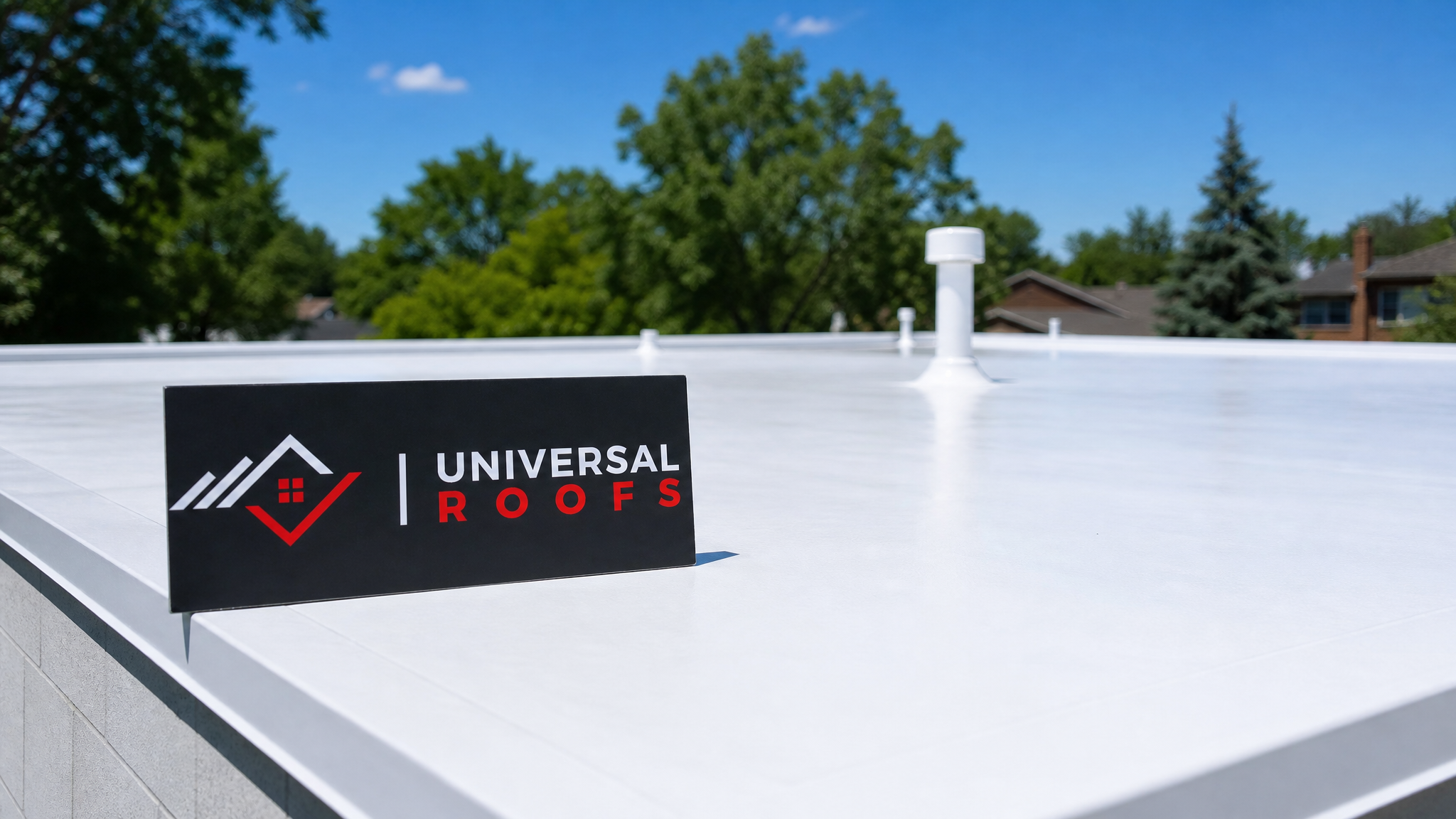
Heat reflective roof coatings, sometimes called “cool roof coatings,” are engineered liquid membranes formulated with high solar reflectance and thermal emittance properties. Solar reflectance measures how much of the sun’s energy a surface bounces back into the atmosphere rather than absorbing. Thermal emittance measures how efficiently a surface releases any absorbed heat rather than transferring it downward into the building. Together, these two properties determine a coating’s overall cooling performance, which is often expressed as a Solar Reflectance Index, or SRI.
Most reflective coatings are white or light-coloured because pale surfaces naturally reflect more visible light than dark ones, though tinted and even darker “cool colour” formulations using reflective pigments are now available for homeowners who want the performance without a stark white roof. The coating is applied directly over an existing roof substrate, whether that is a modified bitumen flat roof, an EPDM rubber membrane, a metal roof, or in some cases asphalt shingles, after the surface has been cleaned, primed, and any damaged areas repaired.
The three most common formulations used across the GTA are:
- Acrylic coatings — water-based, cost-effective, and excellent for reflectivity in most climates, though they perform best where ponding water is not a chronic issue.
- Silicone coatings — highly resistant to ponding water and UV degradation, making them a strong choice for Toronto’s flat roofs where drainage can be imperfect.
- Elastomeric coatings — prized for flexibility, allowing the membrane to expand and contract through our freeze-thaw cycles without cracking.
If you are unsure which coating type suits your roof, our roof repair team can inspect the existing membrane and recommend a system matched to your roof’s material, slope, and drainage.
The Core Benefits of Heat Reflective Roof Coatings
The benefits of heat reflective roof coatings extend well beyond a cooler attic. Homeowners and property managers across Toronto, Mississauga, and Vaughan have reported measurable improvements in comfort, energy costs, and roof longevity after coating projects. Here is what the data and our field experience show.
1. Lower Cooling Costs
A reflective coating can reduce roof surface temperatures by 30 to 50 degrees Celsius compared to an uncoated dark roof on a hot summer day. Because less heat is transferred through the roof deck and into the attic, air conditioners cycle less frequently. Independent studies from cool roof research programmes have found reductions in air conditioning energy use of 10 to 30 percent, depending on attic insulation levels, roof colour before coating, and climate zone. For a typical Toronto home, that can translate into real savings over a cooling season that now regularly stretches from May through September.
2. Extended Roof Lifespan
Ultraviolet radiation and thermal cycling — the daily expansion and contraction of roofing materials as temperatures swing — are two of the biggest contributors to premature roof failure. A reflective coating acts as a protective, UV-resistant skin over the existing membrane, slowing the degradation of the material underneath. Many roofing manufacturers now offer extended warranties on coated systems specifically because the coating reduces thermal stress and shields the substrate from direct sun exposure. It is common to add 10 or more years of service life to an otherwise ageing flat roof.
3. Reduced Urban Heat Island Effect
Dark, heat-absorbing roofs across dense urban neighbourhoods like downtown Toronto and parts of Mississauga contribute meaningfully to the “urban heat island” effect, where cities run several degrees warmer than surrounding rural areas. Reflective roofing, applied at scale, helps lower ambient outdoor temperatures, reduce smog formation, and ease strain on the municipal power grid during peak summer demand.
4. Improved Indoor Comfort
Homeowners frequently tell us that upper-floor bedrooms feel noticeably more comfortable after a coating is applied, even before the air conditioner kicks in. This matters most in homes with limited attic insulation or ductwork running through the attic space, where roof deck heat radiates directly into living areas. Pairing a reflective coating with proper attic ventilation, which our attic specialists can assess, produces the best comfort results.
5. Waterproofing and Leak Prevention
Beyond thermal performance, most reflective coatings are also fully waterproof and seamless once cured, sealing minor cracks, seams, and fastener penetrations. This makes coatings especially valuable on flat and low-slope roofs, where ponding water and seam failure are the leading causes of leaks. Combining a coating with a proper flat roofing inspection can address small vulnerabilities before they become active leaks.
6. Environmental and Cost-of-Ownership Benefits
Coating an existing roof diverts far less material to landfill than a full tear-off and replacement, and it requires fewer new raw materials to manufacture. For property owners focused on sustainability reporting or LEED-style building performance targets, cool roof coatings are one of the most accessible upgrades available. They are also typically far less expensive than full roof replacement, which we cover in more detail below.
| Benefit | Typical Impact | Best Suited For | Notes |
|---|---|---|---|
| Lower cooling costs | 10-30% reduction in AC energy use | Flat roofs, dark shingle roofs | Greatest savings on poorly insulated attics |
| Extended roof lifespan | +10 years or more | Ageing membranes, metal roofs | Slows UV and thermal degradation |
| Reduced surface temperature | 30-50°C cooler surface | All roof types | Most dramatic on south and west exposures |
| Waterproofing | Seals minor seams and cracks | Flat and low-slope roofs | Not a substitute for structural repair |
| Reduced urban heat island effect | Community-wide cooling benefit | Dense urban and suburban areas | Greater impact at neighbourhood scale |
| Lower environmental footprint | Less landfill waste vs. tear-off | Roofs in fair-to-good condition | Supports sustainability goals |
How Heat Reflective Coatings Compare to Other Roofing Materials
It helps to see reflective coatings in context alongside other common roofing surfaces used across the GTA. Reflectivity and long-term thermal performance vary considerably by material, which is one reason coatings have become popular as a retrofit rather than only a factory-applied finish.
| Roof Surface | Typical Solar Reflectance | Surface Temp on a Hot Day | Coating Compatible? |
|---|---|---|---|
| Standard dark asphalt shingles | 0.05 – 0.15 | 70-80°C | Limited — specialty shingle coatings only |
| Uncoated dark modified bitumen | 0.06 – 0.20 | 65-75°C | Yes — ideal candidate |
| Uncoated EPDM (black rubber) | 0.06 | 75-80°C | Yes — with proper primer |
| Coated white acrylic/silicone roof | 0.70 – 0.85 | 30-45°C | N/A — this is the coated result |
| Standing seam metal roof (uncoated) | 0.25 – 0.40 | 50-60°C | Yes — excellent adhesion |
| Light-coloured tile or concrete | 0.35 – 0.50 | 45-55°C | Rarely needed |
The Application Process, Step by Step
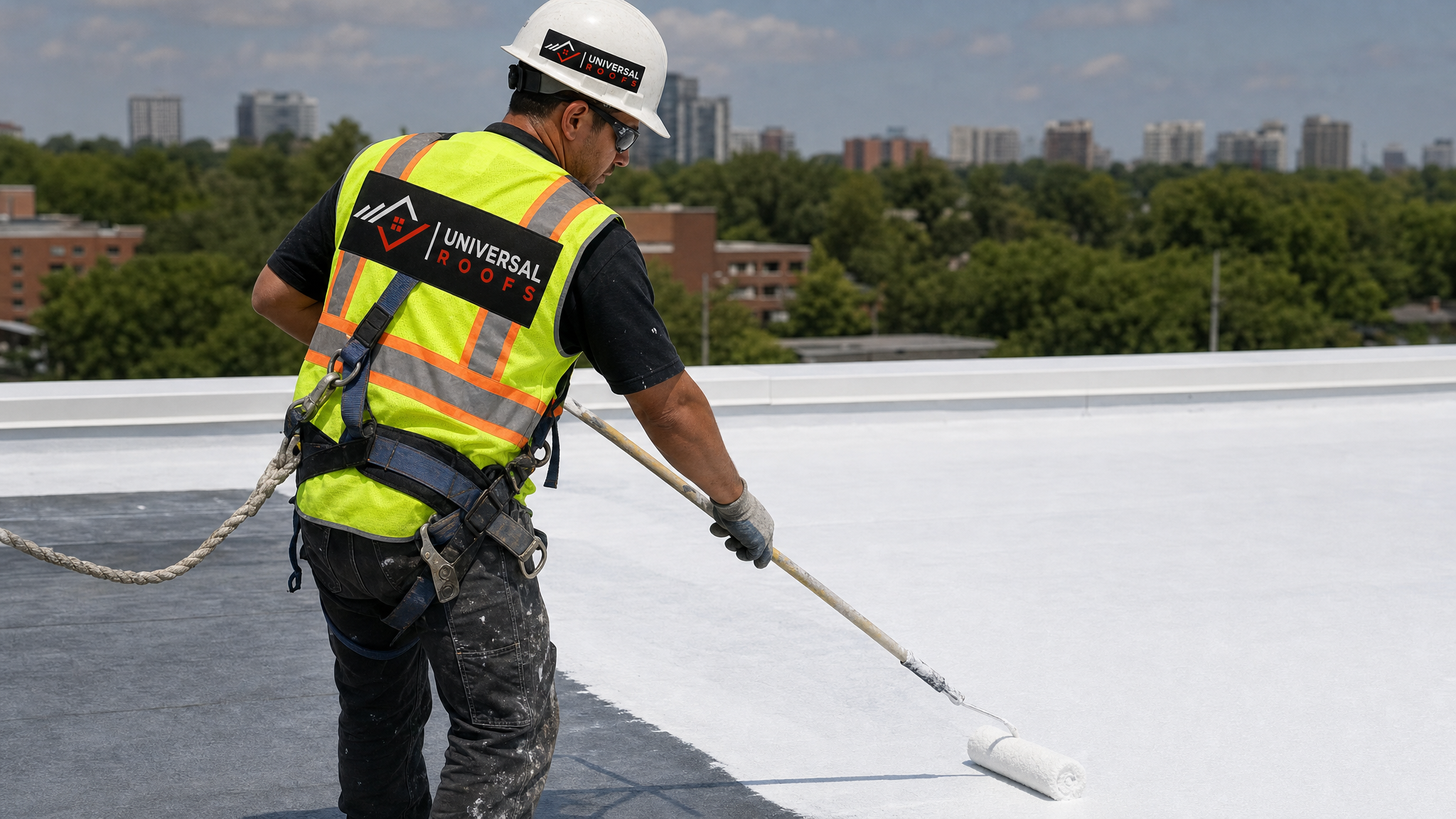
A properly installed reflective coating is a multi-step process, not a single coat of paint. Skipping steps is the most common reason coatings fail prematurely, so it is worth understanding what a thorough installation actually involves.
Step 1: Roof Inspection and Repair
Before any coating goes down, the existing roof surface must be inspected for active leaks, blistering, ponding water, and membrane damage. Any deficiencies are repaired first, because a coating will not fix structural problems underneath — it will only seal the surface on top of them. This is where a proper roof repair assessment pays for itself before committing to a coating budget.
Step 2: Cleaning and Surface Preparation
The roof is pressure washed or manually cleaned to remove dirt, moss, chalking residue, and loose debris. Adhesion is everything with a coating system, and a dirty substrate is the number one cause of premature peeling or blistering.
Step 3: Priming
Depending on the substrate, a bonding primer is applied to help the coating adhere properly, particularly on metal, granulated cap sheet, or previously coated surfaces.
Step 4: Base Coat Application
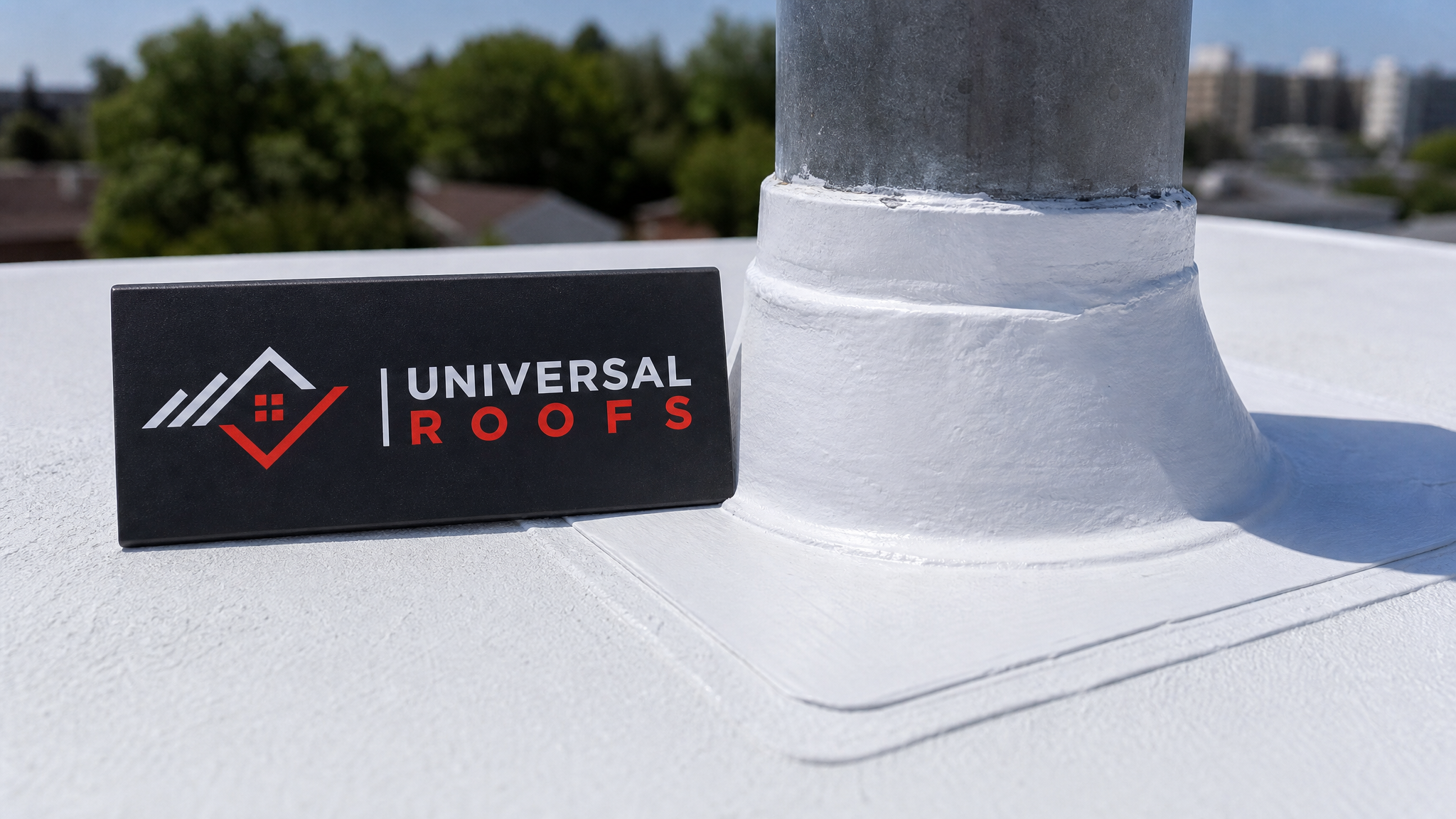
The first coat is applied at the manufacturer’s specified thickness, often reinforced with a polyester fabric at seams, penetrations, and flashing details where movement and stress are highest.
Step 5: Top Coat Application
A second, finishing coat is applied once the base coat has cured, building the coating up to its full rated thickness, measured in dry mils. Most quality systems require a minimum of two coats to achieve proper reflectivity and waterproofing performance.
Step 6: Cure Time and Final Inspection
Coatings typically need 24 to 72 hours of dry weather to cure fully, which is why late spring through early autumn is the optimal application window in the Toronto climate. Once cured, the contractor performs a final walkthrough to confirm full coverage and check flashing details.
| Stage | Typical Duration | Weather Requirement | Common Mistake to Avoid |
|---|---|---|---|
| Inspection and repair | 1-2 days | Dry conditions | Coating over unrepaired leaks |
| Cleaning and prep | 1 day | Dry surface required | Insufficient drying time before coating |
| Priming | Several hours | Above 10°C, low humidity | Skipping primer on metal or cap sheet |
| Base coat | 1 day | No rain for 4-6 hours minimum | Applying too thin a coat |
| Top coat | 1 day | No rain for 4-6 hours minimum | Applying before base coat fully cures |
| Full cure | 24-72 hours | Dry, moderate temperatures | Foot traffic before cure completes |
Is a Coating Right for Your Roof, or Do You Need Something More?
Reflective coatings are best suited to roofs that are structurally sound but ageing, or roofs with cosmetic and minor surface issues that need protection and a performance upgrade. They are not a fix for roofs with widespread membrane failure, extensive rot in the decking, or repeated structural leaks. In those cases, a coating simply delays an inevitable, and often more expensive, replacement.
A good rule of thumb: if your roof is past 60 percent of its expected service life, has more than a few isolated repair areas, or shows signs of deck-level moisture damage, it is worth getting an honest opinion on roof replacement before investing in a coating. If the roof is structurally healthy with only surface wear, sun damage, or minor seam issues, coating is usually the more economical and less disruptive choice.
Homes with skylights present a particular consideration, since flashing details around skylight curbs are common failure points that a coating alone cannot correct if the flashing itself has failed. Our skylights and skylight replacement teams frequently coordinate with our coating crews to ensure flashing is sound before a coating is applied around these penetrations.
Cost Considerations and Return on Investment
Reflective coating projects are priced by roof area, substrate condition, and coating system selected, but as a general guide, coatings cost a fraction of full replacement while extending the service life of the existing roof substantially. The savings come from three directions: avoided replacement costs pushed years into the future, lower summer cooling bills, and in some cases reduced maintenance and repair calls because the coating seals minor vulnerabilities across the whole roof surface rather than patching them individually.
| Roofing Option | Relative Cost | Added Lifespan | Energy Savings Potential |
|---|---|---|---|
| Reflective coating (recoat existing roof) | Low | 10-15 years | Moderate to high |
| Localized roof repair only | Very low | 2-5 years | Minimal |
| Partial re-roof / overlay | Moderate | 15-20 years | Moderate |
| Full roof replacement | High | 25-40+ years | High (with new insulation) |
For most homeowners considering this upgrade in mid-summer, the calculation is straightforward: if the roof structure and membrane are sound, a reflective coating delivers cooling relief this season and protection for many seasons to come, at a cost well below tear-off and replacement.
Maintenance After Coating Application
One of the underrated benefits of a reflective coating is how little maintenance it demands afterward. A simple annual visual inspection — checking for any wear at seams, flashing, and high-traffic areas such as around rooftop equipment — is usually sufficient. Debris such as leaves and branches should be cleared periodically, particularly around drains on flat roofs, to preserve both drainage and reflectivity, since a layer of grime will gradually reduce a coating’s reflective performance over several years. Most manufacturers recommend a maintenance recoat every 10 to 15 years, well before the underlying membrane would need full replacement, which keeps the protective cycle going indefinitely on a sound roof deck.
Why Toronto and GTA Homeowners Are Choosing Reflective Coatings
Toronto’s climate presents a particular challenge for roofing: hot, humid summers that push surface temperatures well past 60 degrees Celsius, followed by freeze-thaw winters that stress every seam and fastener on the roof. A well-installed reflective coating addresses both ends of that cycle — reflecting summer heat while remaining flexible enough to handle winter contraction. Homeowners in Toronto, Mississauga, Brampton, Vaughan, Markham, and Oakville have increasingly requested reflective coatings as utility costs climb and as more people work from home, making daytime indoor comfort a higher priority than it once was.
We serve all of these communities directly, with dedicated crews covering Toronto, Peel Region, York Region, Halton Region, and Durham Region. Every coating project starts with the same inspection process regardless of neighbourhood, ensuring the roof underneath is genuinely ready for a coating rather than masking a problem that needs a repair or replacement instead.
If you would like to see how past coating and roofing projects have turned out, our reviews page includes feedback directly from homeowners we have worked with across the region, and our FAQ page answers many of the most common questions we get about coatings, repairs, and replacement timelines. You can also learn more about our history and licencing on our about page.
What are the main benefits of heat reflective roof coatings?
How long do heat reflective roof coatings last?
Can a heat reflective coating be applied over any roof type?
Do heat reflective roof coatings actually lower cooling costs?
Is a heat reflective coating cheaper than a full roof replacement?
When is the best time to apply a heat reflective roof coating in Toronto?
Need Help With What Are the Benefits?
Whether your roof is ready for a reflective coating or needs a closer look first, Universal Roofs can assess the condition of your existing membrane and recommend the right path forward, whether that means a coating, targeted repair, or replacement.
Call us today at (416) 732-2421 or request a free inspection to get started.
Universal Roofs proudly serves Toronto, Mississauga, Brampton, Vaughan, Markham, Oakville and the GTA since 2005.