
When water finds its way through a commercial roof membrane, the damage rarely stops at a ceiling stain. Insulation saturates, steel decking rusts, mould takes hold in wall cavities, and tenants start calling property management with complaints. For building owners and facility managers across the GTA, commercial roof waterproofing is one of the few maintenance investments that pays for itself many times over by preventing exactly this chain reaction.
Toronto’s climate makes this more than a theoretical concern. Freeze-thaw cycles through the winter, heavy spring rain, summer UV exposure, and ponding water on low-slope roofs all combine to stress commercial membranes in ways that residential shingle roofs never experience. A commercial roof is typically flat or low-slope, which means water has to be actively managed and shed rather than simply running off a steep pitch. Waterproofing is not a one-time coating job — it is a system of materials, detailing, and drainage design working together.
At Universal Roofs, we have been waterproofing commercial roofs across the Greater Toronto Area since 2005, and this guide walks through the best waterproofing solutions available today, how they compare, what they cost, and how to know when it is time to act.
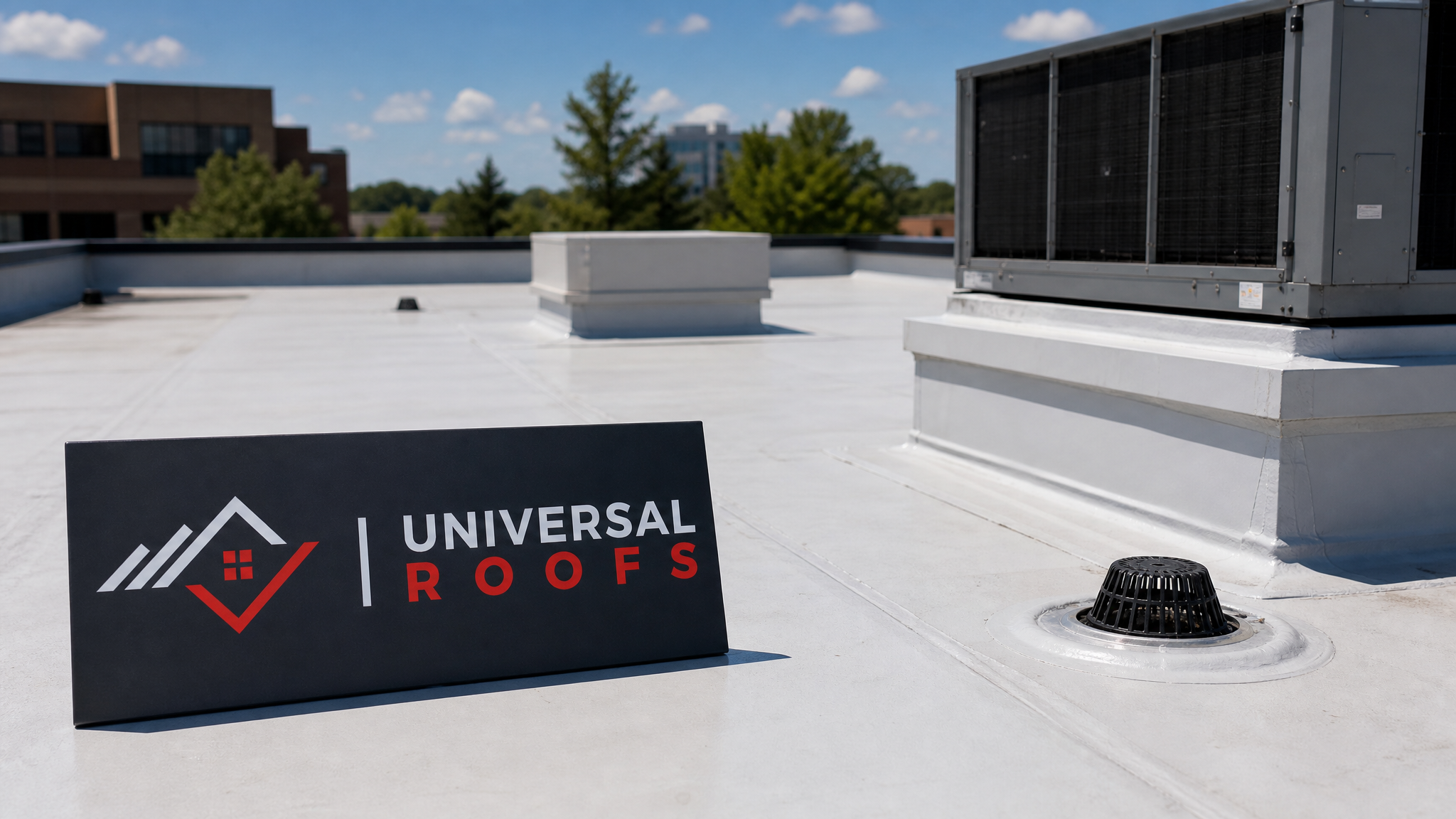
Why Commercial Roofs Need a Dedicated Waterproofing Strategy
Commercial buildings are built differently than houses, and that difference drives everything about how water intrusion happens and how it must be stopped. Most commercial roofs are low-slope or completely flat, built over large steel or concrete decks with dozens of penetrations for HVAC units, drains, vents, skylights, and conduit. Every one of those penetrations is a potential entry point for water, and every seam in the membrane is a potential failure point.
Unlike a sloped residential roof where gravity does most of the work, a flat commercial roof relies on the membrane itself, plus a network of internal or scupper drains, to move water off the surface before it can pond and work its way through minor imperfections. When that system is neglected, even a small pinhole or a lifted seam can allow gallons of water to migrate laterally across the deck before it ever shows up as a ceiling stain — which is why commercial leaks are often far more extensive than they first appear.
A proper waterproofing strategy for a commercial roof considers the membrane material, the seam and flashing details, the drainage design, and a maintenance schedule together. Skipping any one of those pieces is how buildings end up with recurring leaks that keep getting patched but never actually resolved. Our roof repair team sees this pattern constantly: a property has paid for three or four “quick fixes” over several years, when what the roof actually needed was a proper waterproofing system addressing the root cause.
The Best Commercial Roof Waterproofing Membrane Options
There is no single “best” waterproofing membrane for every commercial building — the right choice depends on the roof’s slope, existing structure, budget, and how the building is used. Below are the systems we install most often on GTA commercial and multi-residential properties, each with genuine strengths and trade-offs.
TPO (Thermoplastic Polyolefin) Membrane
TPO is currently the most widely installed commercial roofing membrane in North America, and for good reason. It is a single-ply membrane that is heat-welded at the seams, creating a continuous, monolithic waterproof barrier rather than relying on adhesives or tape alone. The white reflective surface also helps reduce cooling costs in summer, which matters for large flat-roofed retail, industrial, and office buildings across Toronto, Mississauga, and Brampton.
TPO performs well against UV exposure and resists most chemicals and greases, making it a strong choice for restaurants and food service buildings where roof-mounted exhaust can otherwise degrade lesser materials over time.
EPDM (Rubber) Membrane
EPDM has been a commercial roofing standard for decades because of its flexibility and durability in freeze-thaw climates like ours. The rubber membrane expands and contracts with temperature swings without cracking, which is valuable given how wide our seasonal temperature range is in the GTA — from summer heat to deep winter cold. EPDM is typically installed in large sheets with fewer seams than older built-up systems, reducing the number of potential failure points.
The trade-off is that EPDM is usually black, which absorbs heat rather than reflecting it, though white EPDM variants exist for buildings prioritizing energy efficiency.
PVC Membrane
PVC membranes share TPO’s heat-welded seam technology but bring superior resistance to oils, greases, and chemical exposure. This makes PVC the preferred choice for restaurants, industrial facilities, and any building with rooftop equipment that vents oils or solvents. PVC is a premium option and typically costs more than TPO or EPDM, but for the right application, the added chemical resistance pays for itself by preventing membrane degradation that would otherwise shorten the roof’s service life.
Modified Bitumen
Modified bitumen is an evolution of traditional built-up roofing, using asphalt reinforced with rubber or plastic polymers and applied in torch-down or self-adhered sheets. It remains popular for its proven track record, ease of repair, and lower material cost. Multi-layer modified bitumen systems provide redundancy — if the top layer is compromised, the layer beneath still provides a waterproof barrier, buying time before a leak reaches the interior.
Liquid-Applied Waterproofing Membranes
Liquid-applied systems (acrylic, silicone, or polyurethane coatings) are sprayed or rolled on to create a fully adhered, seamless membrane over an existing roof surface. These are especially useful for roofs with complex geometry, numerous penetrations, or existing membranes that are still structurally sound but showing wear. Because there are no seams at all, liquid membranes eliminate the most common failure point in commercial roofing — the seam itself.
Built-Up Roofing (BUR) with Waterproof Cap Sheet
The traditional “tar and gravel” system is still specified on some commercial projects, particularly where a heavy ballast is desired for wind resistance or where the building owner wants multiple redundant plies. Modern BUR systems finish with a waterproof cap sheet or coating to extend service life and simplify future maintenance.
| Membrane Type | Typical Lifespan | Best For | Relative Cost |
|---|---|---|---|
| TPO (heat-welded) | 20–25 years | Large flat roofs wanting energy savings | $$ |
| EPDM (rubber) | 20–30 years | Freeze-thaw climates, fewer seams | $$ |
| PVC (heat-welded) | 20–25 years | Restaurants, oil/grease exposure | $$$ |
| Modified bitumen | 15–20 years | Budget-conscious, proven redundancy | $ |
| Liquid-applied membrane | 10–20 years (recoatable) | Complex roofs, many penetrations | $$ |
| Built-up roofing (BUR) | 15–25 years | Wind resistance, multi-ply redundancy | $$ |
Waterproofing Details That Matter As Much As the Membrane
Even the best membrane will fail prematurely if the details around it are neglected. Roofing failures on commercial buildings overwhelmingly happen at transitions and penetrations rather than in the middle of open membrane fields, so any serious waterproofing plan pays special attention to these areas.
Flashing at parapet walls and roof edges needs to be properly lapped, sealed, and mechanically fastened where the membrane meets a vertical surface. This is one of the single most common failure points on flat commercial roofs.
Penetration seals around HVAC curbs, pipes, and conduit require pre-formed boots or properly detailed field seals — generic caulk is not a long-term waterproofing solution and typically fails within a year or two of exposure to UV and temperature cycling.
Drain assemblies including internal roof drains, scuppers, and overflow drains must be properly clamped into the membrane and kept clear of debris. A clogged drain during a heavy summer storm can cause ponding depths that stress the membrane far beyond its design tolerance within hours.
Skylight curbs are another common trouble spot on commercial roofs with daylighting features. If your building has rooftop skylights, our skylights and skylight replacement teams coordinate directly with roofing waterproofing work so the curb flashing and roof membrane tie together as one continuous system rather than two separate scopes that leave a gap.
Expansion joints in larger buildings need flexible, waterproof covers that can move with the structure without tearing — a rigid patch across an expansion joint is almost guaranteed to fail within a season or two.
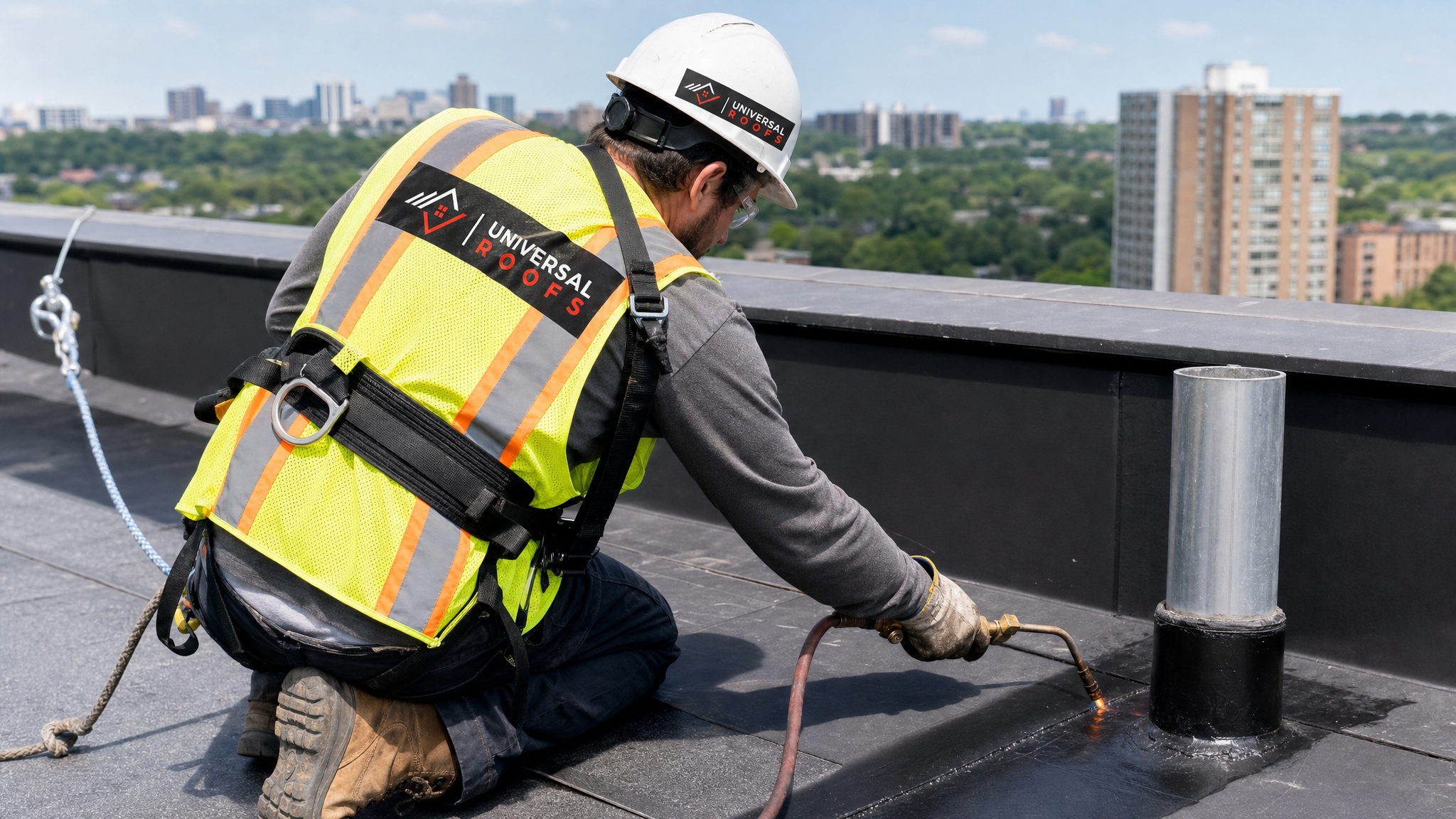
Signs Your Commercial Roof Needs Waterproofing Attention
Commercial roof problems rarely announce themselves loudly until they are already expensive. Knowing the early warning signs lets a property manager act while a repair is still inexpensive rather than waiting until it becomes a full membrane replacement.
- Ponding water that stays on the roof surface more than 48 hours after rain
- Visible seam separation, bubbling, or blistering in the membrane
- Interior ceiling stains, especially near HVAC units, drains, or wall penetrations
- Rising utility bills, which can indicate wet insulation losing its R-value
- Cracking or brittleness in flashing around parapets and equipment curbs
- Visible rust streaking below metal flashing or roof-mounted equipment
- Musty odours or visible mould in top-floor units below the roof deck
If any of these are present, an inspection through our roof repair service can identify whether targeted repair, spot waterproofing, or a full membrane replacement makes the most financial sense.
Cost Considerations for Commercial Roof Waterproofing
Commercial waterproofing costs vary widely depending on the roof’s size, existing condition, accessibility, and the membrane system selected. Rather than quote a single number, it helps to understand the general cost bands and what drives them, since a 3,000 square foot retail roof and an 80,000 square foot warehouse roof face very different economics.
| Approach | Relative Cost per Square Foot | Typical Lifespan Added | Best Timing |
|---|---|---|---|
| Liquid-applied recoat over sound membrane | Low | 10–15 years | Membrane intact but aging or chalking |
| Spot repair and reflashing | Low | 2–5 years | Isolated leaks, otherwise sound roof |
| Full membrane replacement (TPO/EPDM) | Moderate to High | 20–25 years | Widespread failure or membrane past service life |
| Full tear-off and BUR/PVC replacement | High | 20–25 years | Deck damage or multiple failed layers |
| Drainage upgrade (new scuppers/drains) | Moderate | Extends life of any membrane | Chronic ponding regardless of membrane age |
It is worth stressing that the cheapest option in the short term is rarely the cheapest option over the roof’s lifetime. A liquid-applied recoat can be an excellent investment when the underlying membrane is still structurally sound, but applying a coating over a membrane that has already failed structurally is essentially throwing money at a problem that will resurface within a year. A proper inspection should always precede the decision, not follow it.
Waterproofing Timeline: What a Commercial Project Actually Looks Like
Property managers often ask how much roof downtime and disruption to expect. The answer depends heavily on scope, but the general phases are consistent across most commercial waterproofing projects in the GTA.
| Phase | What Happens | Typical Duration | Tenant Impact |
|---|---|---|---|
| Inspection and assessment | Roof survey, moisture scan, drainage evaluation | 1 day | None |
| Proposal and material selection | Membrane comparison, cost breakdown, scheduling | 3–7 days | None |
| Mobilization | Material delivery, staging, safety setup | 1 day | Minimal — deliveries only |
| Membrane installation or recoat | Surface prep, membrane application, seam welding | 3 days to 3 weeks (by size) | Some noise; occupancy usually maintained |
| Detailing and quality check | Flashing, penetrations, drains, final walk-through | 1–2 days | None |
Most commercial waterproofing work is scheduled to minimize disruption to tenants and business operations, and much of it can proceed with the building fully occupied. Larger membrane replacements on multi-building complexes are often phased section by section so that only a portion of the roof is exposed at any given time.
Maintaining a Waterproofed Commercial Roof Through the Seasons
Waterproofing is not a “set it and forget it” investment. A membrane that is properly installed but never inspected again will still degrade faster than one that receives routine attention, particularly given how much our climate swings between seasons.
In summer, UV exposure is at its peak and is the leading cause of membrane embrittlement over time — a mid-summer inspection is actually one of the best times to catch chalking, blistering, or seam lifting before autumn rains arrive. It is also the ideal season to schedule liquid-applied recoating work, since most coatings cure best in warm, dry conditions.
Heading into autumn, clearing leaves and debris from drains and scuppers prevents the ponding that causes so many winter and spring leaks. Come winter, ice damming at parapet walls and around rooftop equipment can force water backward under flashing details — a risk that is far lower when flashing has been properly maintained. Spring is typically when hidden winter damage becomes visible as interior staining, making it the busiest season for our roof repair crews addressing issues that formed months earlier.
A simple biannual inspection schedule — once in late spring and once in early autumn — catches the vast majority of developing problems while they are still inexpensive to correct. Many of our commercial clients across Toronto, Peel Region, and York Region now have us on a standing maintenance schedule for exactly this reason.
Waterproofing New Construction vs. Retrofitting an Existing Roof
The waterproofing approach differs meaningfully depending on whether a roof is new construction or an existing structure being upgraded. On new builds, waterproofing can be designed into the roof assembly from the start — proper slope-to-drain design, correctly sized drains and scuppers, and a membrane chosen to match the building’s long-term use.
Retrofitting an existing commercial roof is more common and requires a careful assessment of what is salvageable. In many cases, an existing membrane that is structurally sound but aging can be recoated with a liquid-applied system rather than torn off entirely, saving substantial cost and avoiding the disruption of a full roof replacement. Where the deck itself has sustained water damage, however, a full tear-off becomes necessary since no waterproofing membrane can compensate for a compromised substrate underneath it.
Flat and low-slope commercial roofs are also frequently combined with other roof systems on the same building — a portion may be a traditional low-slope membrane while another section uses our flat roofing systems over a mechanical penthouse or rooftop addition. Waterproofing strategy needs to account for how these different sections interact at their transitions, since that boundary is often where leaks originate.
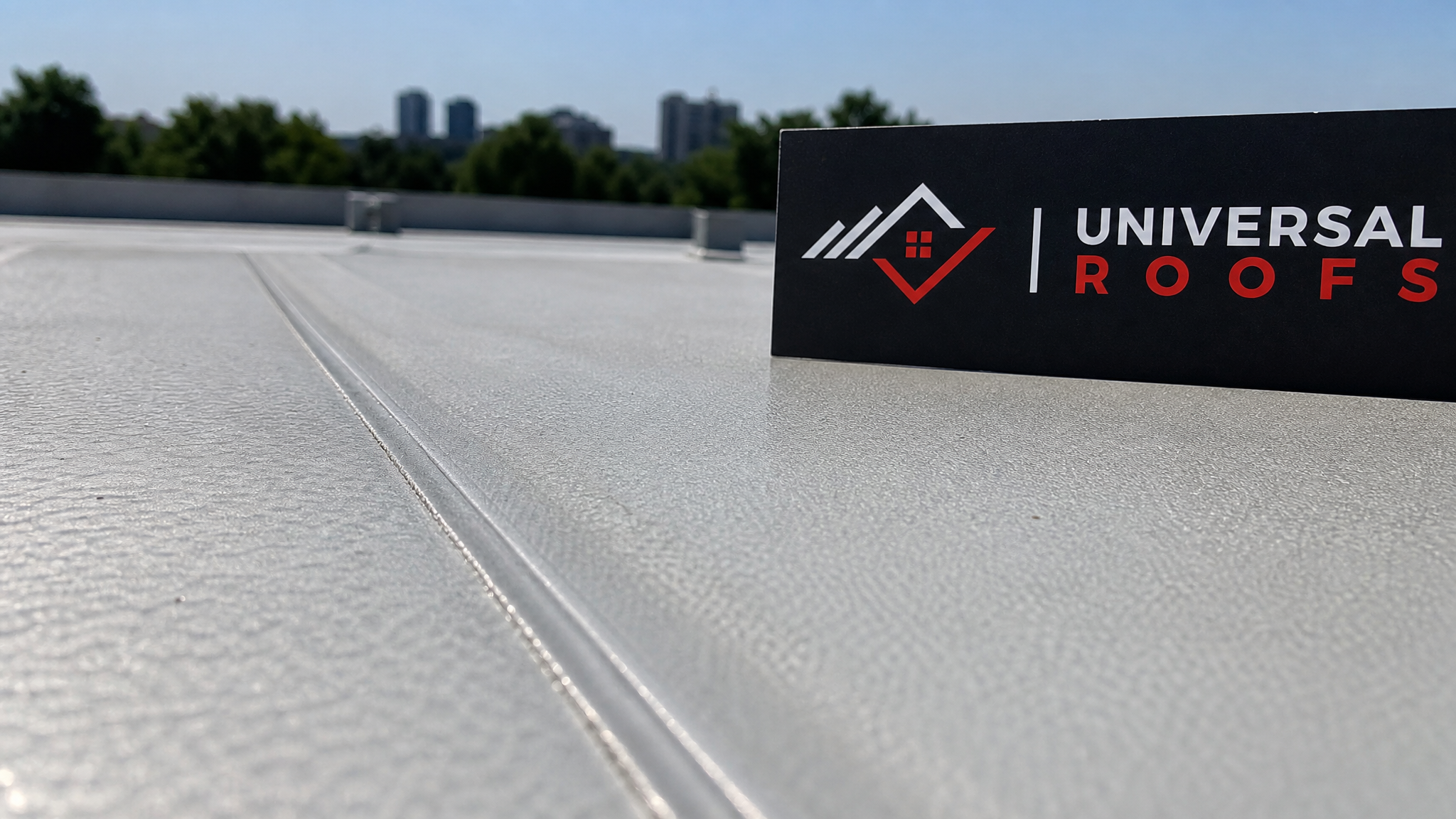
Choosing the Right Contractor for Commercial Waterproofing
Commercial roof waterproofing is specialized work, and not every residential roofing contractor has the training, insurance, or equipment to do it properly. When evaluating a contractor for this kind of project, look for manufacturer certifications on the specific membrane system being proposed, a documented safety program for work at height, and — critically — references from other commercial properties of a similar size and use.
Ask for a written scope of work that specifies the membrane manufacturer, thickness (measured in mils), warranty terms, and a detailing plan for every penetration and transition on the roof. A vague quote that says only “waterproof the roof” without these specifics is a warning sign that the contractor has not actually assessed the roof in detail.
Our team’s project history and client feedback are available on our reviews page, and our about page outlines our history serving commercial and residential properties across the GTA since 2005. We also maintain a detailed FAQ page addressing many of the more technical questions property managers ask before committing to a waterproofing project.
Attic and Interior Considerations During Waterproofing Projects
While waterproofing focuses on the exterior membrane, commercial roof leaks often have consequences that extend into the building’s interior spaces, particularly insulation and attic or plenum areas directly below the deck. Wet insulation loses much of its thermal performance and can become a mould risk if not addressed promptly after a leak is repaired.
When we complete a commercial waterproofing project, we routinely coordinate with our attic team to assess whether insulation beneath the affected area needs replacement, since leaving saturated insulation in place undermines both the building’s energy performance and indoor air quality even after the roof itself is fully sealed.
Serving Commercial Properties Across the Greater Toronto Area
Universal Roofs has completed commercial waterproofing projects on retail plazas, industrial warehouses, multi-residential buildings, and office properties throughout the region. Our crews regularly work across Toronto, Peel Region (Mississauga and Brampton), York Region (Vaughan and Markham), Halton Region (Oakville and Burlington), and Durham Region, giving us a wide-ranging perspective on how different microclimates, building ages, and municipal drainage bylaws affect commercial roofing decisions across the GTA.
That regional experience matters because waterproofing recommendations are not one-size-fits-all — a warehouse roof in an industrial park faces different wind exposure and mechanical loading than a retail plaza roof downtown, and the right waterproofing system accounts for those differences rather than defaulting to whatever is easiest to install.
What is the best commercial roof waterproofing solution for a flat roof?
How long does commercial roof waterproofing last?
How much does commercial roof waterproofing cost?
Can you waterproof a commercial roof without a full tear-off?
What causes most commercial roof waterproofing failures?
How often should a commercial roof be inspected for waterproofing issues?
Need Help With What Are the Best?
Choosing the right commercial roof waterproofing solution comes down to matching the membrane, detailing, and drainage design to your specific building — and that starts with a proper inspection by a team that works on commercial roofs across the GTA every week. Universal Roofs has been solving exactly these problems for property managers and building owners since 2005.
Call us today at (416) 732-2421 or request a free inspection to get started.
Universal Roofs proudly serves Toronto, Mississauga, Brampton, Vaughan, Markham, Oakville and the GTA since 2005.