
When homeowners think of a roofing emergency, they usually picture a torn-off shingle in a windstorm or a sudden leak dripping through the ceiling. Few people think about their gutters at all — until the day water starts pouring over the edge of the eavestrough during a summer downpour, or a section of gutter tears away from the fascia board under the weight of soaked leaves and debris. At that point, the truth becomes obvious: clogged gutters are a roofing emergency, not a minor housekeeping chore to get to “someday.”
At Universal Roofs, we have been repairing roofs, fascia, soffits and attic systems across the Greater Toronto Area since 2005, and clogged-gutter damage is one of the most common — and most preventable — reasons homeowners call us for emergency service. A blocked gutter does not just mean a messy overflow. It means standing water sitting directly against your roof edge, fascia board, and foundation, and in a region like the GTA where freeze-thaw cycles, summer thunderstorms, and heavy tree cover are all part of daily life, that stagnant water finds every weakness in a home’s exterior.
This guide explains exactly why clogged gutters escalate from a nuisance to a genuine roofing emergency, what warning signs to watch for, how the damage actually spreads through a roof system, and what homeowners in Toronto and the surrounding regions can do about it before a small blockage becomes a five-figure repair bill.
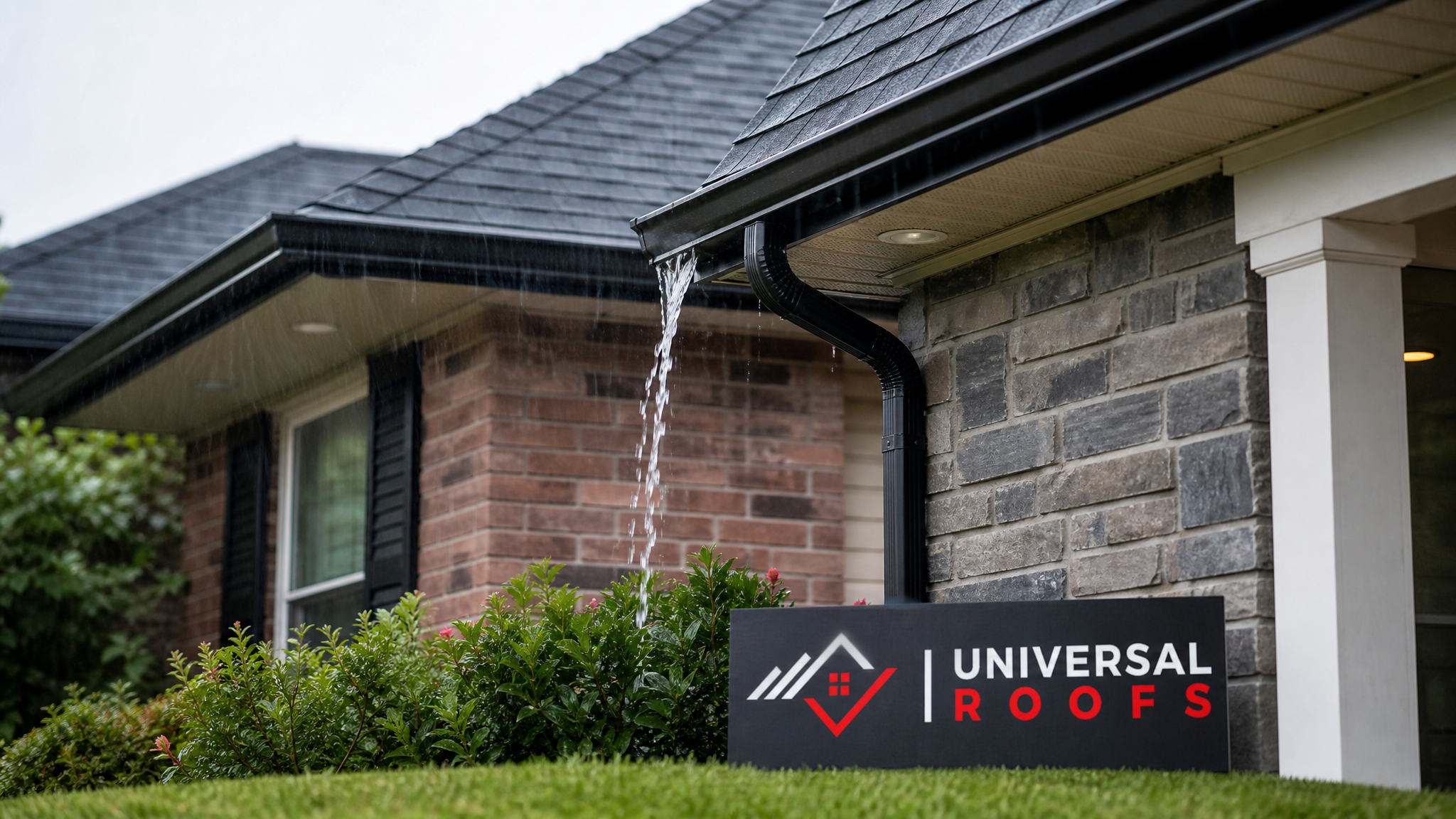
How a Clogged Gutter Becomes a Roofing Emergency
Gutters exist to do one job: move water off the roof and away from the building as fast as possible. When leaves, shingle grit, pine needles, seed pods, and airborne debris pack into the trough, that water has nowhere to go. It backs up, and once it backs up, it starts working against the very structure it was designed to protect.
Here is the chain reaction that turns a “clean the gutters” task into an urgent roofing issue:
- Water backs up under the shingles. When a gutter overflows during a heavy rain, water can climb back up under the first course of shingles at the roof edge, soaking the underlayment and decking beneath.
- The fascia board absorbs moisture. Wood fascia sitting behind a full gutter stays wet for days after a storm, which leads to rot, paint failure, and eventually a board too soft to hold gutter hangers.
- Gutters pull away from the roofline. A gutter full of wet leaves and standing water can weigh several times more than an empty one. That extra weight stresses the hangers and spikes, and in the GTA’s freeze-thaw winters, ice adds even more weight until brackets bend or rip out entirely.
- Ice dams form in winter. Clogged gutters are one of the leading causes of ice dams, because they hold meltwater at the eaves where it refreezes overnight, forcing water back under the shingles.
- Foundation and basement damage follows. Overflowing water pools right at the foundation line, saturating soil and increasing the risk of basement seepage — a costly problem that starts at the roofline but ends up in the basement.
Any one of these outcomes can escalate quickly. Combined, they explain why a blocked gutter is treated as an urgent repair item rather than routine maintenance on any professional roof repair checklist.
Warning Signs Your Gutters Have Become a Real Problem
Most gutter emergencies do not appear overnight. They build slowly, and homeowners often miss the early clues because they are not looking at the roofline closely enough. Watch for these signs:
- Water sheeting over the gutter edge during rain instead of flowing through the downspout.
- Visible plant growth or moss sprouting from the trough — a sure sign of trapped organic debris and standing water.
- Sagging or pulling-away sections where the gutter no longer sits tight against the fascia.
- Staining or streaking on the siding below the gutter line, which indicates repeated overflow.
- Peeling paint or soft, spongy fascia boards when pressed with a hand or screwdriver tip.
- Pooling water near the foundation after rainfall, especially near downspout outlets.
- Interior ceiling stains near exterior walls, which can indicate water has already worked its way behind the fascia and into the roof deck.
If you notice two or more of these signs at once, treat it as an active issue rather than something to schedule for next season. A quick inspection now is far cheaper than a full roof replacement later.
Why Toronto’s Climate Makes Gutter Blockages Worse
The Greater Toronto Area’s climate is particularly unforgiving toward neglected gutters. Summer brings sudden, heavy thunderstorms that can dump significant rainfall in under an hour — exactly the kind of downpour that overwhelms a partially blocked system. Autumn brings a steady stream of leaves, seed pods, and needles from mature trees common in neighbourhoods across Toronto, Mississauga, and the surrounding suburbs. Winter brings freeze-thaw cycles that turn trapped water into ice, expanding it with enough force to bend hangers, crack sealant joints, and split seams.
Because most homes in the GTA experience all four of these conditions within a single year, gutters here take on more abuse than in many other regions. A gutter that goes uncleaned through one autumn can enter winter already compromised, then face spring melt with reduced capacity, and by the time summer thunderstorms arrive, it may already be failing. This is why we recommend gutter checks as a standard part of seasonal roof maintenance for homeowners across our Toronto, Peel Region, York Region, Halton Region, and Durham Region service areas.
Where Clogged Gutter Damage Actually Spreads
One of the most misunderstood aspects of gutter blockages is how far the resulting damage can travel from the original clog. Homeowners often assume the worst-case outcome is a stained gutter or a bit of peeling paint. In reality, standing water at the roofline is connected to nearly every major system on the exterior of a home. The table below breaks down where the damage typically shows up, roughly how long it takes to develop, and how serious it becomes if left unaddressed.
| Affected Area | How the Damage Develops | Typical Time to Develop | Severity if Ignored |
|---|---|---|---|
| Fascia board | Constant moisture contact causes wood rot and paint failure | 1-3 seasons | Moderate — replacement needed, gutters may detach |
| Roof deck & underlayment | Overflow backs up under shingles at the roof edge | 1-2 seasons | High — leads to interior leaks and rot |
| Soffit & attic ventilation | Trapped moisture wicks into soffit vents, raising attic humidity | 1-2 seasons | High — encourages mould and reduces insulation performance |
| Foundation & basement | Overflow saturates soil next to the foundation wall | 2-4 seasons | Severe — cracking, seepage, costly waterproofing repairs |
| Landscaping & hardscaping | Repeated overflow erodes soil and stains walkways or siding | Ongoing | Low to moderate — cosmetic and drainage issues |
| Siding & exterior trim | Splashback and sheeting water stain and warp siding panels | 1-2 seasons | Moderate — repainting or panel replacement needed |
Notice that several of the fastest-developing problems — roof deck saturation and soffit moisture — are also the ones most connected to your home’s attic ventilation and insulation performance. A wet attic does more than smell musty; it can shorten the lifespan of insulation and encourage mould growth in a space most homeowners rarely inspect.
DIY Gutter Clearing vs. Calling a Professional
Many homeowners reasonably want to try clearing gutters themselves before calling in help, and for a single-storey home with easy ladder access, that can be a safe and effective option. But there are situations where a professional inspection is the smarter — and safer — choice. The comparison below outlines when each approach makes sense.
| Factor | DIY Gutter Clearing | Professional Gutter & Roof Inspection |
|---|---|---|
| Best suited for | Single-storey homes, light seasonal buildup | Two-storey+ homes, steep rooflines, heavy debris |
| Safety equipment needed | Sturdy ladder, gloves, eye protection | Fall-protection harness, roof anchors, professional ladders |
| Typical time required | 1-3 hours depending on home size | 1-2 hours with a trained crew |
| Detects hidden fascia rot | Rarely — visible surface only | Yes — includes probing and moisture checks |
| Detects roof deck or underlayment damage | No | Yes — full roof edge inspection included |
| Approximate cost | Cost of tools/time only | Varies by home size and scope of inspection |
If your gutters are only lightly dusted with debris and your roofline is a straightforward single storey, a careful DIY clean-out is perfectly reasonable. But once you notice sagging sections, soft fascia, or any sign that water has already breached the roof edge, it is time for a trained eye. Our teams handle everything from simple gutter clearing to full roof repair when water intrusion has already reached the deck.
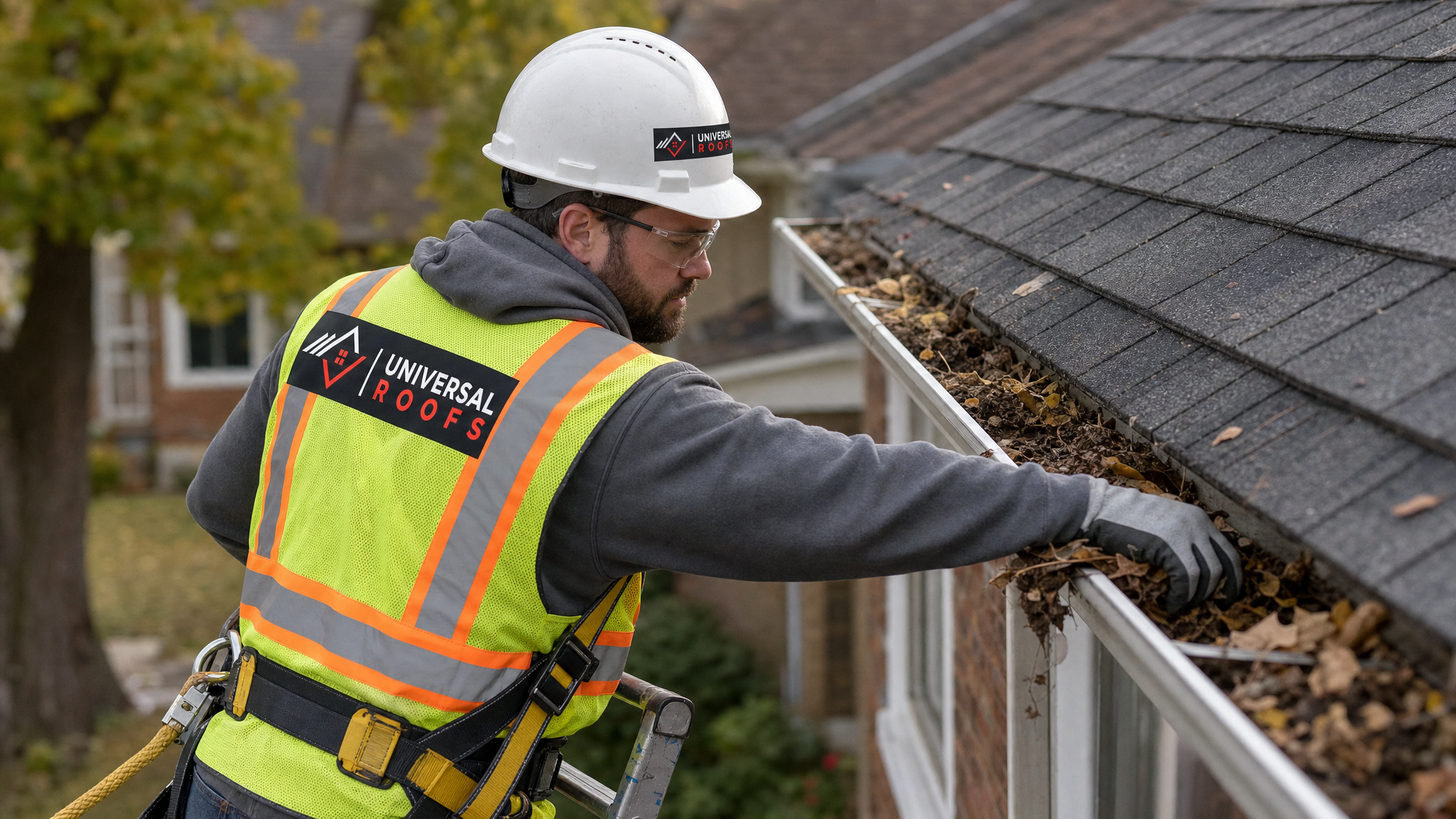
What a Professional Gutter and Roof-Edge Inspection Covers
When our crews respond to a clogged-gutter call, we do not simply scoop out leaves and move on. A proper inspection addresses the whole system, because a blockage is rarely an isolated event — it is usually a symptom of a gutter system that needs attention in several places at once. Our process typically includes:
- Full debris removal from the trough, corners, and downspout openings, where the heaviest clogs usually form.
- Downspout flow testing using water to confirm the full run is clear, not just the visible top section.
- Hanger and bracket inspection to check for bent, rusted, or pulled-out fasteners caused by excess weight.
- Fascia probing at multiple points to identify soft or rotted wood before it becomes a structural issue.
- Roof edge and drip-edge check to look for lifted shingles or granule loss caused by backed-up water.
- Slope verification to confirm the gutter still pitches correctly toward the downspouts — a common issue after age or storm damage.
- Sealant and seam inspection at joints and end caps, where leaks most often begin.
This level of detail matters because a gutter that looks “fine” from the ground can still be hiding a cracked seam, a sagging hanger, or a rotted fascia section directly behind it. Catching these issues during a routine visit is far less disruptive — and less expensive — than discovering them after a storm has already caused a leak.
Gutter Guards, Cleaning Frequency, and Prevention
Prevention is almost always cheaper than emergency repair, and for GTA homeowners surrounded by mature trees, a proactive gutter strategy pays for itself quickly. Here is what we recommend based on two decades of service calls across the region.
Cleaning frequency depends heavily on tree cover. Homes under or near large deciduous trees typically need gutters cleared at least twice a year — once in late spring after seed pods and blossoms drop, and again in late autumn after leaf fall. Homes with heavy year-round tree cover, including conifers that shed needles continuously, may need quarterly attention.
Gutter guards can meaningfully reduce — though not eliminate — the frequency of clogs. Mesh and micro-mesh guards keep out larger leaves and debris while still allowing water through, though fine grit and shingle granules can still accumulate underneath over time. Guards work best as a maintenance-reduction tool, not a “never clean again” solution.
Downspout extensions that carry water at least a metre or two away from the foundation reduce the risk of basement seepage even when a temporary clog does occur upstream.
Trimming overhanging branches reduces the volume of leaf and needle debris landing directly in the gutter trough, which is often the single most effective prevention step for tree-heavy properties.
Seasonal Gutter Maintenance Timeline
Because Toronto experiences all four seasons with real intensity, gutter maintenance is not a once-a-year task — it is a rolling seasonal responsibility. The table below outlines what to check and when, so you can stay ahead of blockages rather than reacting to them.
| Season | Primary Risk | Recommended Action | Priority Level |
|---|---|---|---|
| Spring | Winter debris buildup, ice-damaged hangers | Full clean-out and hanger inspection after snow melt | High |
| Summer | Heavy thunderstorm overflow, sudden downpours | Flow test and mid-season debris check | Medium |
| Autumn | Leaf and seed pod accumulation | Clean-out after peak leaf fall, ideally twice | High |
| Winter | Ice dam formation from trapped meltwater | Pre-freeze inspection and clearing before first hard freeze | Critical |
The critical window is late autumn through the first hard freeze. Gutters left clogged going into winter are far more likely to develop ice dams, and once ice forms, clearing a gutter safely becomes much more difficult and higher-risk for a homeowner attempting it without proper equipment.
When a Clogged Gutter Signals a Bigger Roofing Problem
Sometimes a gutter clog is simply a gutter clog — leaves accumulated, nothing more. But repeated or rapid clogging can also be a symptom of a larger issue elsewhere on the roof. Excessive granule loss from ageing asphalt shingles, for example, washes directly into the gutter and can clog downspouts even when there is no organic debris at all. Similarly, a roof with poor drainage design, insufficient slope, or a valley that channels an unusually large volume of water into one section of gutter will overwhelm that section faster than the rest of the system.
If you find yourself clearing the same section of gutter repeatedly within a single season, it is worth having that area inspected alongside the shingles, flashing, and — where applicable — skylights or ageing skylight seals nearby, since failing flashing around roof penetrations can also direct extra water toward a single gutter run. On homes with a low-slope section, our flat roofing team checks drain placement and scupper function as part of the same visit, since flat roof drainage issues often present as gutter overflow at ground level.
Cost Ranges for Addressing Clogged Gutter Damage
Homeowners often ask what it actually costs to fix problems caused by neglected gutters, and the honest answer is that it depends entirely on how early the issue is caught. The table below gives a general sense of scale — not exact pricing, since every home and situation differs — to help homeowners understand why early action saves money.
| Issue Stage | Description | Relative Cost Level | Urgency |
|---|---|---|---|
| Routine clean-out | Debris removal, no existing damage | Low | Scheduled maintenance |
| Hanger & bracket repair | Re-securing sagging or detached sections | Low to moderate | Should be addressed same season |
| Fascia board replacement | Rotted wood behind gutter requires new board | Moderate | Address before next wet season |
| Roof edge / deck repair | Water has reached underlayment or decking | Moderate to high | Urgent — active leak risk |
| Foundation or basement remediation | Long-term overflow has caused seepage | High | Urgent — structural and water damage risk |
As the table shows, the jump in cost between “clean the gutters” and “repair the foundation” is dramatic. This is exactly why we describe clogged gutters as a roofing emergency rather than a cosmetic issue — the cost of ignoring it does not rise gradually, it accelerates.
How Universal Roofs Handles Clogged Gutter Emergencies
When a homeowner calls us about overflowing gutters, our first priority is understanding whether active water intrusion is already occurring. We ask about interior stains, basement moisture, and how long the overflow has been happening, because that context shapes how urgently we respond. From there, our crews arrive with full safety equipment — harnesses, roof anchors, and proper ladders — because gutter work at height carries real fall risk regardless of how routine the task looks from the ground.
We clear the blockage first, then move immediately into the inspection process described earlier: checking hangers, probing fascia, testing downspout flow, and examining the roof edge for lifted shingles or granule loss. If we find deeper damage — a soft fascia board, a compromised roof deck, or flashing that needs attention — we explain exactly what we found, why it matters, and what options exist to fix it properly, whether that is a targeted repair or, in cases of significant deterioration, a broader conversation about roof replacement timing.
You can read what other GTA homeowners have said about our work on our reviews page, and if you have general questions before booking a visit, our FAQ page covers many of the most common ones. You can also learn more about our team’s background on our about page.
Why are clogged gutters a roofing emergency and not just a cleaning task?
How quickly can clogged gutters cause real damage to a roof?
What are the first signs that clogged gutters have become a roofing emergency?
Can clogged gutters cause ice dams in Toronto winters?
How often should gutters be cleaned to avoid an emergency callout?
Should I clear clogged gutters myself or call a professional?
Need Help With Why Are Clogged Gutters?
Clogged gutters rarely stay a small problem for long, and the earlier they are addressed, the less they cost to fix. The team at Universal Roofs has been helping GTA homeowners protect their roofs, fascia, and foundations from exactly this kind of water damage since 2005.
Call us today at (416) 732-2421 or request a free inspection to get started.
Universal Roofs proudly serves Toronto, Mississauga, Brampton, Vaughan, Markham, Oakville and the GTA since 2005.