
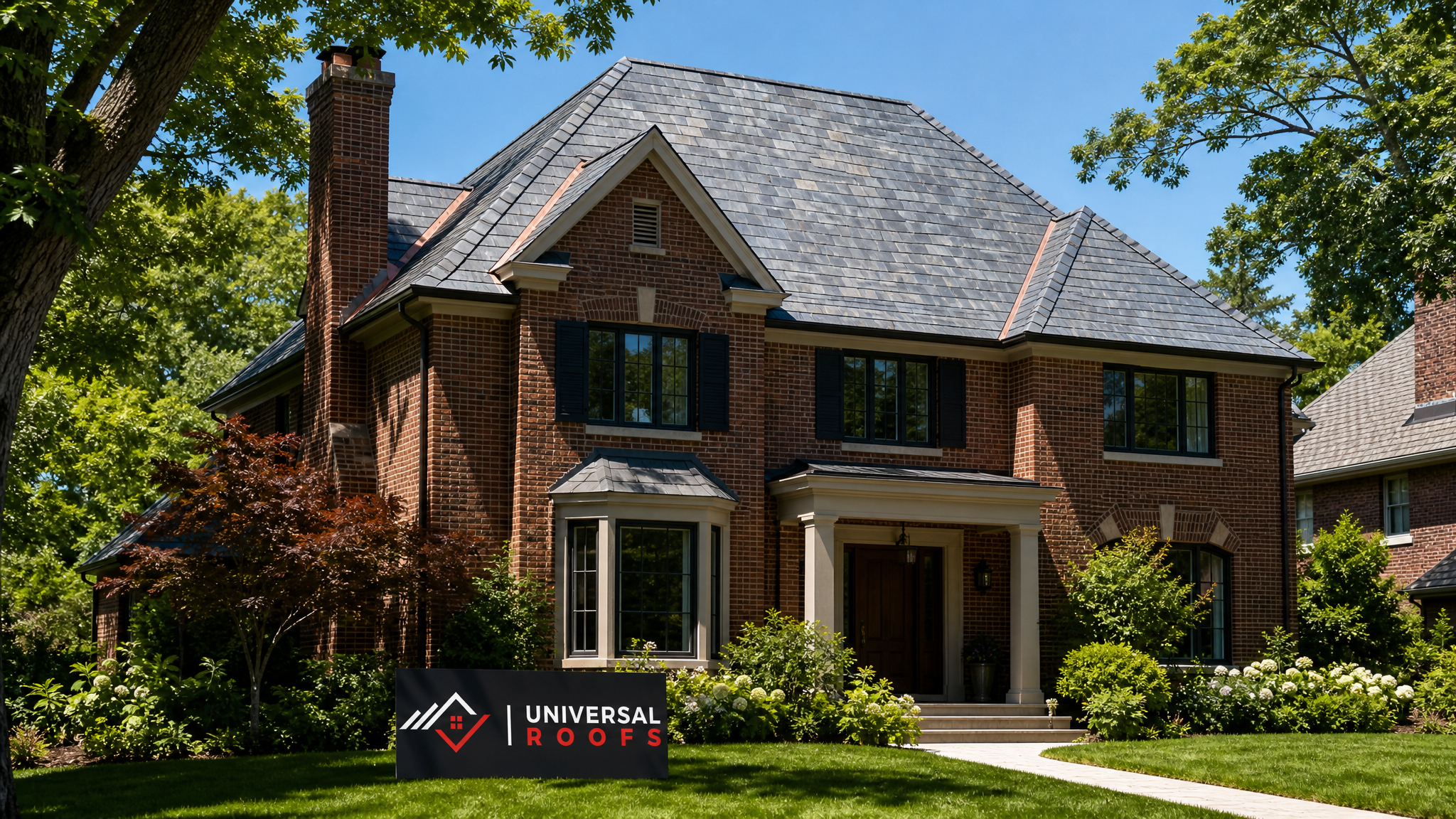
Few roofing materials carry the prestige of natural slate. Walk through the older, tree-lined neighbourhoods of Rosedale, Forest Hill, or old Oakville and you’ll spot original slate roofs still performing decades after installation, their subtle colour variations and slightly irregular texture giving these homes a character that no modern shingle can fully replicate. For homeowners weighing a full roof replacement and wondering whether slate roofing is worth the investment, this guide breaks down everything you need to know, from cost and lifespan to installation methods, maintenance, and how slate performs under the freeze-thaw cycles that define a Toronto winter.
Slate roofing is not a decision to make lightly. It is one of the most expensive roofing systems available, but it is also one of the longest-lasting, with some installations exceeding 100 years of service life. Before committing, homeowners need a clear-eyed understanding of the trade-offs: upfront cost versus long-term value, structural requirements versus the age of the home, and the realities of sourcing skilled slate installers in the Greater Toronto Area, where the trade is far less common than asphalt shingle work.
We’ll walk through what slate roofing actually is, how it compares to synthetic alternatives, what installation and repair involve, and how to maintain a slate roof so it lives up to its reputation. Whether you’ve inherited a century home with an original slate roof or you’re considering slate for a new build, this article will give you the practical, Canadian-specific information you need to make an informed decision.
What Is Slate Roofing, Exactly?
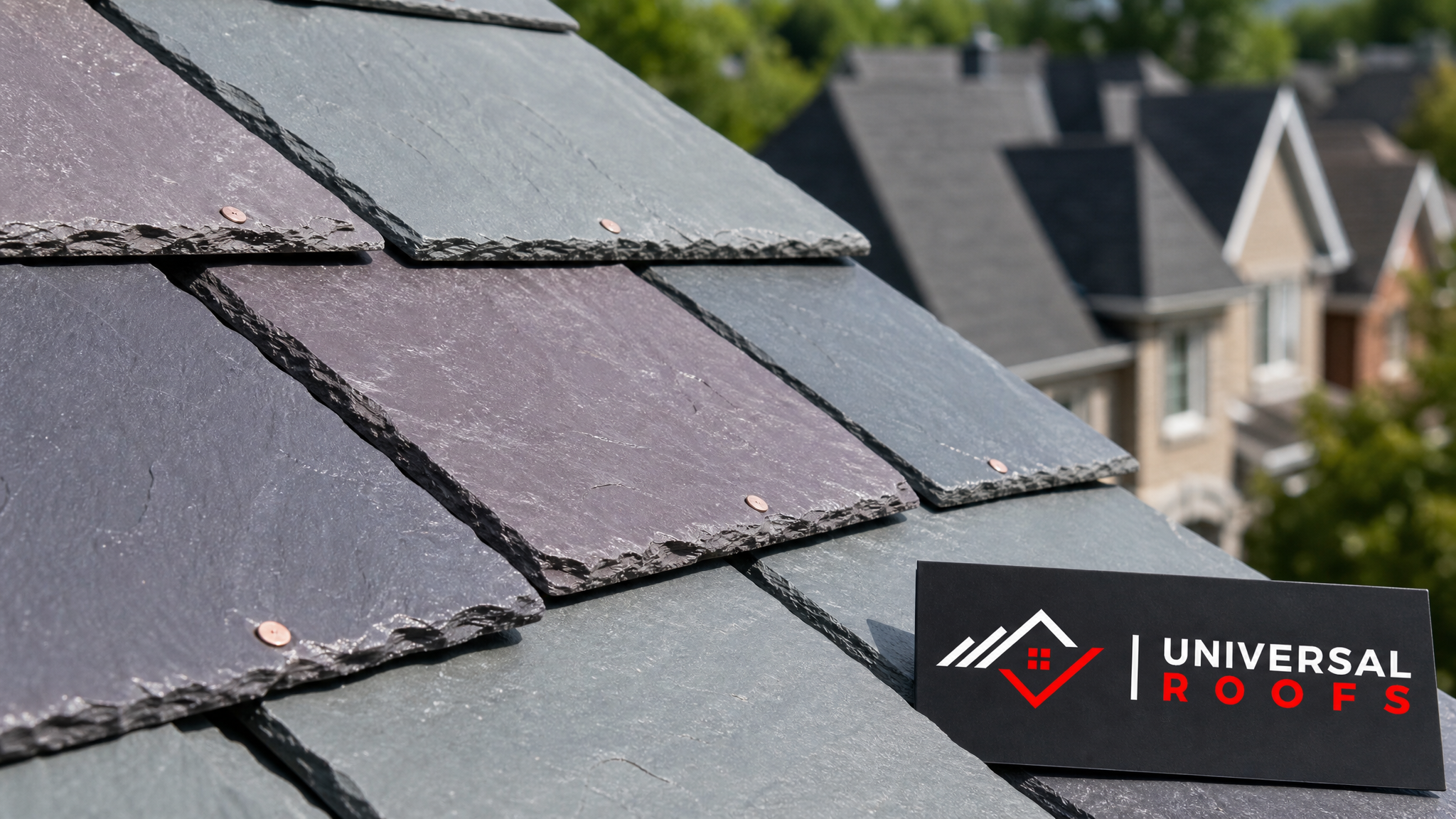
Slate is a natural, fine-grained metamorphic rock that splits cleanly into thin, flat sheets. Roofing slate is quarried, then split and trimmed into individual tiles, typically between 4.5 and 9 millimetres thick, and installed in overlapping courses much like a very heavy, very durable shingle. The stone’s natural cleavage plane is what makes it possible to produce roofing tiles at all; without that property, cutting stone this thin would be impractical.
Three qualities set slate apart from every other residential roofing material. First is its durability: quarried slate is essentially inert stone, meaning it does not rot, does not support moss or algae growth the way organic-based shingles can, and resists UV degradation almost entirely. Second is its fire resistance, since slate is Class A fire-rated with zero combustible content. Third is its aesthetic permanence: because slate is a natural material, its colour does not fade the way pigmented asphalt granules do, so a slate roof installed in 2026 will look essentially the same in 2076.
Not all slate is created equal, however. Roofing slate is graded by hardness, water absorption rate, and expected service life, which typically falls into three broad categories: standard slate (rated for roughly 75-100 years), hard slate (100+ years), and premium hard slate (125-200 years, sometimes longer). The specific quarry the slate comes from matters enormously here. Slate from Vermont, Quebec, Wales, and Spain each has distinct mineral composition and weathering characteristics, and a qualified roofer should be able to tell you exactly where your slate is sourced and what warranty backs it.
Slate Roofing Costs in the Greater Toronto Area
Cost is usually the first question homeowners ask, and it’s an important one, because slate roofing sits at the very top of the residential roofing cost spectrum. The material itself is expensive, but the larger cost driver in the GTA is labour: very few roofing crews in Ontario are trained in traditional slate installation, and the work is slow, physically demanding, and unforgiving of mistakes. A single misplaced nail hole can crack an expensive tile.
The table below gives a realistic per-square-metre range for common Toronto-area roofing materials, so you can see where slate sits relative to more familiar options.
| Roofing Material | Installed Cost (per m²) | Typical Lifespan | Best Suited For |
|---|---|---|---|
| Asphalt shingles (architectural) | $65 – $110 | 20 – 30 years | Most residential homes, budget-conscious replacement |
| Synthetic slate/composite | $140 – $220 | 40 – 50 years | Homeowners wanting the slate look without the weight/cost |
| Standing seam metal | $150 – $260 | 50 – 75 years | Modern homes, steep or complex rooflines |
| Natural slate (standard grade) | $280 – $450 | 75 – 100 years | Heritage homes, character properties |
| Natural slate (premium/hard) | $450 – $700+ | 100 – 200 years | Estate homes, historic restorations, legacy properties |
For an average GTA detached home with a roof footprint of roughly 200-250 square metres, that translates into a full natural slate installation typically landing somewhere between $65,000 and $175,000, depending on slate grade, roof complexity, and the condition of the underlying structure. This is why many homeowners in Toronto, Mississauga, and Vaughan who love the look of slate but not the price tag opt for synthetic slate tiles instead, which we cover in detail further down.
It’s worth noting that slate roofing cost is front-loaded but the lifetime cost story flips dramatically in slate’s favour. An asphalt roof will need full replacement two, three, or even four times over the same period a single slate roof lasts, and each of those replacements carries its own labour and disposal costs, plus the accumulated risk of leaks during the material’s declining years. When homeowners run the numbers over an 80-100 year horizon, slate frequently comes out as cost-competitive or cheaper per year of service than repeated shingle replacements, even though the upfront number looks intimidating.
Does Your Home’s Structure Support a Slate Roof?
This is the single most important technical question before pursuing slate, and it’s one that gets skipped far too often. Natural slate is heavy: roughly 40-50 kg per square metre, compared to about 10-13 kg per square metre for asphalt shingles. A typical slate roof adds three to five times the dead load of an asphalt roof to the structure below.
Older homes built before the mid-20th century, particularly in established Toronto neighbourhoods, were sometimes framed with slate’s weight in mind, especially if they had slate originally. But a raised bungalow from the 1970s or a newer build framed for lightweight asphalt shingles will almost certainly need structural reinforcement before slate can go on safely. This is not optional; an under-engineered roof deck carrying slate is a genuine safety hazard, particularly under the added weight of wet snow accumulation in a Toronto winter.
A qualified assessment should include a structural engineer’s review of the rafters, trusses, and roof deck, calculating the total dead load (slate plus underlayment, battens, and fasteners) against the framing’s rated capacity, and factoring in Ontario Building Code snow load requirements for the region. If reinforcement is needed, it typically involves sistering rafters, adding collar ties, or in more significant cases, installing additional support posts or beams in the attic space. This adds real cost to the project, so it should be priced out before you commit to slate rather than discovered mid-installation.
Natural Slate vs. Synthetic Slate: An Honest Comparison
Because natural slate is so expensive and heavy, synthetic slate has become a popular middle ground for GTA homeowners. These are typically engineered composite tiles made from recycled rubber and plastic polymers, moulded and coloured to mimic the look, texture, and even the subtle shadow lines of real slate.
| Factor | Natural Slate | Synthetic Slate |
|---|---|---|
| Weight | 40 – 50 kg/m² (often needs structural reinforcement) | 8 – 12 kg/m² (compatible with standard framing) |
| Lifespan | 75 – 200+ years | 40 – 50 years |
| Upfront cost | Very high | Moderate |
| Fire rating | Class A, fully non-combustible | Class A when tested (varies by product) |
| Colour consistency | Natural variation, never fades | Uniform, may fade slightly over decades |
| Repairability | Individual tiles replaceable by a specialist | Individual tiles replaceable, more forgiving to install |
| Resale/heritage value | Highest, especially for period-appropriate restorations | Good aesthetic value, lower resale premium than natural slate |
Neither option is objectively “better” in every case. If you own a heritage home where matching original slate is a preservation priority, or you’re planning to own the property for multiple generations, natural slate is usually the right call despite the cost. If you want the visual character of slate without the structural upgrade and premium price tag, a quality synthetic product installed by an experienced crew can deliver 80-90% of the aesthetic with a fraction of the weight and cost. We walk homeowners through this decision regularly and can advise honestly on which direction suits your specific home and goals; it’s a conversation worth having before any contract is signed.
Installing a Slate Roof: What the Process Actually Involves
Slate installation is a specialized trade, and it is genuinely different from asphalt shingle work in almost every respect. Here’s what a properly executed installation looks like from start to finish.
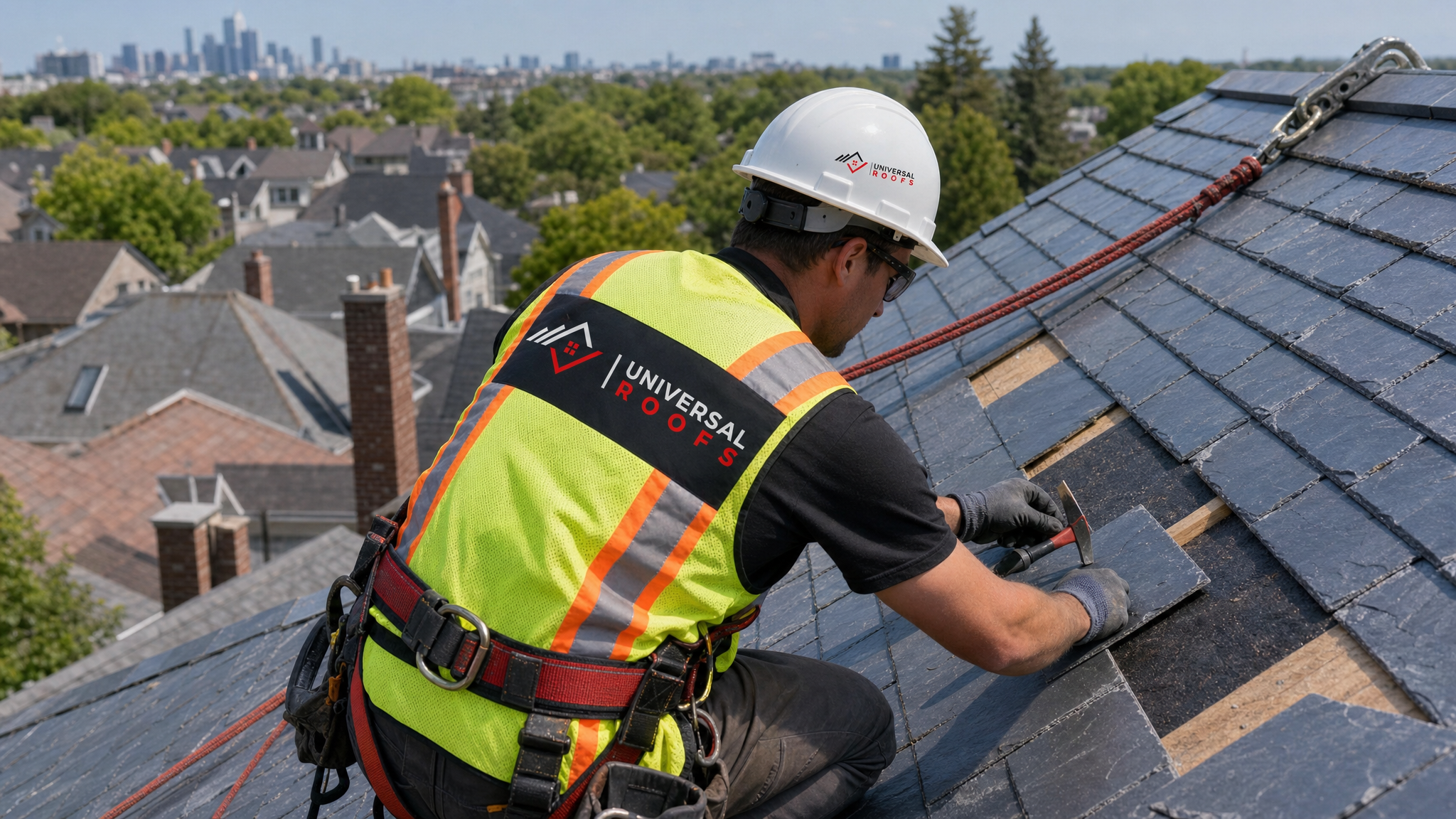
The process begins with tearing off the existing roofing down to the deck, followed by a structural assessment (or reinforcement, if the earlier engineering review flagged it as necessary). A high-quality synthetic or self-adhering underlayment is then installed across the full deck, since slate roofs rely entirely on that underlayment as the true waterproofing layer in the event any water works its way past the stone. Copper or stainless steel flashing is installed at every valley, chimney, and penetration point, because slate roofs are built to last a century and cheaper flashing materials will fail long before the stone does.
Each slate tile is then hung individually using two nails (copper or stainless steel, never galvanized, which corrodes) driven through pre-punched holes, with each course overlapping the one below by a specified amount to ensure full weather protection even in wind-driven rain. Ridge caps, hip caps, and any decorative slate patterns (staggered, graduated, or diamond-cut, for example) are installed last. A skilled two-person crew can typically install somewhere between 5 and 10 square metres of slate per day, which is why timelines run considerably longer than an asphalt reroof.
| Project Phase | Typical Duration | Key Considerations |
|---|---|---|
| Structural assessment & engineering | 1 – 3 weeks | May require permit review for reinforcement work |
| Tear-off and deck preparation | 2 – 4 days | Deck repairs addressed before underlayment goes down |
| Underlayment and flashing | 3 – 5 days | Copper flashing preferred for century-long service life |
| Slate tile installation | 3 – 8 weeks | Weather-dependent; slate should not be installed in freezing rain or high wind |
| Ridge, hip, and detail work | 3 – 6 days | Final quality inspection and warranty documentation |
Timing matters in our climate. Late spring through early autumn is the ideal installation window in the GTA, giving crews stable, dry conditions to work in. Installing slate through a Toronto winter is possible but adds real risk, since brittle cold slate is more prone to cracking during handling, and ice on a steep slate roof pitch is a serious safety hazard for the crew.
Common Slate Roof Problems and How Repairs Work
Even the best slate roof will need occasional attention, and it’s worth understanding what typical issues look like so you can catch them early. The most common problem by far is individual cracked or slipped tiles, usually caused by impact (a falling branch, for example) or nail sickness, where the original fasteners have corroded after many decades and no longer hold the tile securely. Because slate itself doesn’t degrade the way asphalt does, a well-maintained slate roof rarely fails as a whole system; it fails one tile at a time.
Flashing failure is the second most common issue, particularly around chimneys, valleys, and skylights, since flashing materials generally have a shorter service life than the slate itself. If you’re dealing with a slate roof that also has an ageing skylight, it’s worth having both assessed together. Our skylights and skylight replacement pages cover what to look for when a skylight reaches the end of its service life, which often coincides with flashing repairs on a slate roof of similar age.
| Symptom | Likely Cause | Recommended Action |
|---|---|---|
| Single cracked or missing tile | Impact damage or brittle ageing slate | Individual tile replacement by a slate specialist |
| Tile slipping out of course alignment | Nail sickness (corroded original fasteners) | Re-secure with copper/stainless hooks or nails |
| Water staining near chimney or valley | Deteriorated flashing | Flashing replacement, ideally with copper |
| Granular debris or slate “shale” in gutters | Delamination on lower-grade or very old slate | Full roof assessment; may signal end of service life |
| Widespread cracking across many tiles | Age-related brittleness or incorrect original grade for climate | Section or full re-roof evaluation |
A crucial point for homeowners: never let a general roofer or handyman walk on a slate roof without slate-specific experience. Improper foot placement cracks tiles that would otherwise have lasted decades longer, and repeated foot traffic from inexperienced crews is one of the leading causes of premature slate roof damage in older Toronto homes. If your roof needs attention, our roof repair team can assess whether you’re dealing with isolated tile damage or a broader issue that needs a specialist’s approach.
Slate Roofing and the Toronto Climate
Slate performs exceptionally well in our climate for one simple reason: it doesn’t absorb and hold water the way organic materials do, so it isn’t degraded by the freeze-thaw cycles that are so hard on lesser roofing materials. When water gets into asphalt shingles or wood shakes and then freezes, that expansion breaks down the material’s structure over time. Slate’s extremely low water absorption rate (often under 0.4%) means freeze-thaw has minimal effect on the stone itself.
That said, a few climate-specific considerations matter for GTA installations. Ice damming can still occur at eaves regardless of roofing material, so proper attic insulation and ventilation are essential companions to any slate installation; a poorly insulated attic will melt roof snow unevenly and create ice dams that back water up under any roofing material, slate included. If you’re investing in a premium roof, it’s worth having your attic insulation and ventilation checked at the same time, since the two systems work together to protect the home.
Summer heat is comparatively easy on slate, since the stone handles thermal expansion well and doesn’t soften or degrade under UV exposure the way asphalt granules can over a hot Ontario summer. Wind resistance is also excellent, provided the tiles are properly nailed and each course is correctly overlapped, since the tile’s mass alone resists uplift far better than lighter materials.
Maintaining a Slate Roof for Maximum Lifespan
One of slate’s underappreciated advantages is how little ongoing maintenance it actually needs compared to organic roofing materials. There’s no algae or moss treatment required the way there often is with wood shakes, and there’s no granule loss to monitor the way there is with asphalt. That said, a slate roof still benefits from a defined maintenance routine to reach the upper end of its potential lifespan.
We recommend a professional visual inspection every two to three years, focusing on flashing condition, individual tile integrity, and any signs of slipped or cracked tiles near valleys and eaves where water concentration is highest. Gutters should be kept clear, since granular slate debris combined with leaf litter can create blockages that force water backward under the lowest courses of tile. After any major storm with high winds or hail, a spot inspection is worthwhile, since even durable slate can crack under a direct hail strike or falling debris.
Homeowners in Toronto, Mississauga, Brampton, Vaughan, Markham, and Oakville considering slate for a heritage restoration or a new premium build should also factor in regional service coverage; our teams work across the Toronto, Peel Region, York Region, Halton Region, and Durham Region areas, and slate roof assessments benefit enormously from a contractor who has actually walked comparable roofs nearby and understands the regional building stock.
Slate vs. Flat Roofing: Which Sections of Your Home Need What
It’s worth noting that slate is exclusively a steep-slope material; it cannot be installed on low-slope or flat roof sections, which are common on additions, garages, and rear extensions of many GTA homes, including older houses that originally had a full slate main roof. If your home has a mixed roofline, that flat or low-slope section needs an entirely different system, typically a modified bitumen or single-ply membrane designed for minimal pitch. Our flat roofing page covers those systems in detail if your project involves a combination roof, which is common on century homes with rear additions.
Getting this distinction right at the planning stage avoids a common and expensive mistake: applying slate tiles to a pitch too shallow to shed water properly. As a rule of thumb, slate requires a minimum roof pitch of around 4:12 (roughly 18 degrees), and ideally steeper, to perform as intended.
How to Choose a Slate Roofing Contractor
Because slate work is a specialized trade, the contractor selection process matters more here than with almost any other roofing decision. Ask any prospective contractor how many slate roofs they’ve installed or repaired in the past five years, and ask to see photos or references from those specific projects rather than their general portfolio. Confirm they use copper or stainless steel fasteners and flashing rather than galvanized materials, since this single detail determines whether the flashing will last as long as the slate itself or fail decades early.
It’s also worth checking that the contractor carries adequate insurance for working at height on steep slate pitches, and that they can walk you through their approach to protecting existing landscaping and gutters during tear-off, since slate debris is heavier and sharper than asphalt debris. Reading independent reviews from homeowners who’ve had comparable work done gives you a much clearer picture than a sales pitch alone, and our FAQ page answers many of the most common questions we get about specialty roofing systems like slate. You can also learn more about our team’s background and licencing on our about page.
How long does slate roofing actually last?
Is slate roofing too heavy for my house?
What does slate roofing cost in the Toronto area?
Can a single cracked slate tile be repaired without replacing the whole roof?
Is synthetic slate a good alternative to natural slate roofing?
How does slate roofing perform in Toronto winters?
Need Help With Slate Roofing?
Whether you’re restoring a heritage slate roof, exploring synthetic alternatives, or simply need an honest structural assessment before committing to a project this significant, Universal Roofs has the experience to guide you through it. We’ve spent nearly two decades working on roofs across the GTA, and we’ll always tell you plainly whether slate is the right fit for your home.
Call us today at (416) 732-2421 or request a free inspection to get started.
Universal Roofs proudly serves Toronto, Mississauga, Brampton, Vaughan, Markham, Oakville and the GTA since 2005.