
When a flat roof starts leaking, most Toronto homeowners assume the whole membrane needs to be torn off and replaced. In reality, a properly diagnosed flat roof problem can usually be solved with one of a handful of proven repair techniques, and choosing the right one can save thousands of dollars and extend the life of the existing roof by five, ten, or even fifteen years.
The trouble is that not every technique suits every problem. A patch that works beautifully on a small blister will fail within a season if it is used to cover a wide area of ponding water. A liquid-applied coating that performs well on a sound, dry membrane can peel off within weeks if it is applied over a roof with trapped moisture underneath. Choosing wrong does not just waste money, it can hide a bigger problem until it causes interior damage.
This guide breaks down the four best techniques for flat roof repair that Toronto-area roofing contractors actually rely on, what each one is genuinely suited for, how long it should last, and the situations where none of them will do and a full roof replacement is the more honest answer. We have installed and repaired flat roofs across the GTA since 2005, through brutal freeze-thaw winters and humid, storm-heavy summers, and this article reflects what actually holds up here rather than generic advice written for a warmer climate.
Why Flat Roofs Fail Differently Than Sloped Roofs
Before comparing techniques for flat roof repair, it helps to understand why flat roofs develop problems in the first place. Unlike a sloped shingle roof, a flat or low-slope roof does not shed water quickly by gravity alone. Water sits on the surface for hours, sometimes days, after a storm, which means the membrane, the flashing details, and every seam and penetration have to work far harder to stay watertight.
In the GTA, this challenge is compounded by our climate. We get roughly 50 to 60 freeze-thaw cycles every winter. Water that pools on a flat roof seeps into even hairline cracks, freezes overnight, expands, and widens the crack. By spring, a pinhole leak from November can be a running leak. Add in summer UV exposure that dries out and embrittles membranes, and heavy summer thunderstorms that stress-test every seam, and you can see why flat roofs in Toronto need more frequent inspection than sloped roofs in milder climates.
The four techniques below represent a spectrum, from quick, inexpensive spot fixes through to whole-surface renewal, and understanding where your roof’s damage falls on that spectrum is the first step to choosing correctly. If you are not sure which category your roof falls into, a professional roof repair assessment is the fastest way to find out before you spend money on the wrong fix.
Technique 1: Patch Repair for Localized Damage
Patch repair is the most common and most cost-effective of all flat roof repair techniques, and it is the right call for the majority of leak calls we respond to across Toronto. A patch repair targets a specific area of damage rather than the whole roof, which keeps material and labour costs low and the job finishable in a single day.
The process starts with locating the source of the leak, which is not always directly above the interior stain, since water can travel along the roof deck before dripping through. Once the source is confirmed, the damaged section of membrane is cut out, the substrate underneath is inspected and dried if needed, and a new section of matching membrane is welded, torched, or adhered into place with overlapping seams sealed on all sides.
Patch repair works best on:
- Small punctures from foot traffic, dropped tools, or wildlife
- Isolated blisters or splits under 1 metre in length
- Seam failures at a single joint rather than throughout the roof
- Flashing separation around a single vent pipe, drain, or wall termination
The limitation is durability relative to the surrounding roof. A patch is only as good as the membrane it is bonded to, so if the rest of the roof is nearing the end of its service life, a patch may only buy you a season or two before a different section fails. A qualified technician will tell you honestly whether a patch makes sense or whether you are patching a roof that needs broader attention.
| Damage Type | Patch Suitability | Typical Repair Time | Expected Added Life |
|---|---|---|---|
| Single puncture or tear | Excellent | 1-2 hours | 5-8 years |
| Isolated seam failure | Excellent | 2-3 hours | 5-10 years |
| Localized blistering | Good | 2-4 hours | 4-6 years |
| Flashing separation at one penetration | Good | 2-3 hours | 5-8 years |
| Widespread membrane cracking | Poor, coating or replacement preferred | N/A | N/A |
Technique 2: Liquid-Applied Membrane Coating
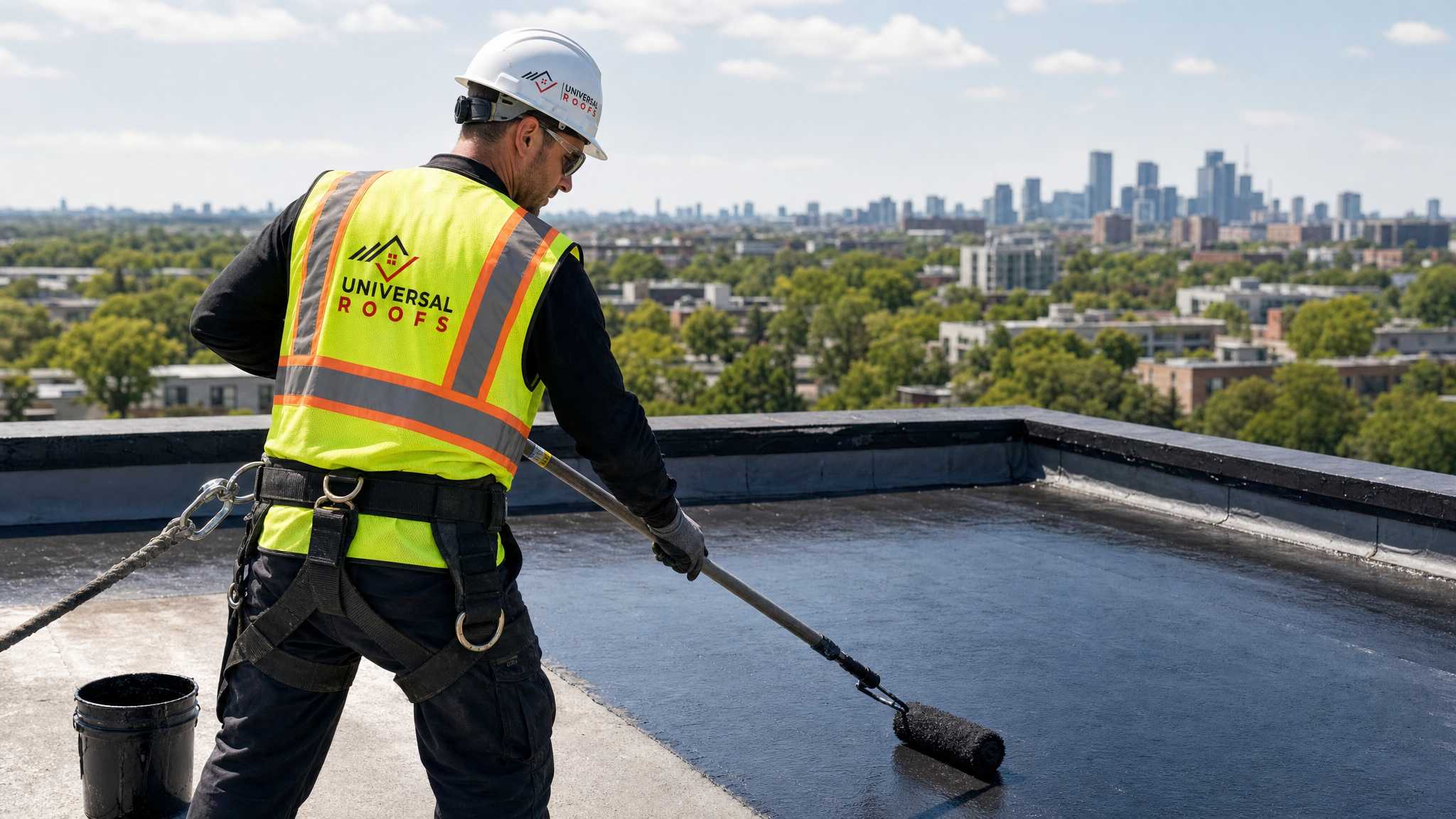
When a flat roof is structurally sound but showing its age across a wide area, a liquid-applied membrane coating is often the smartest technique for flat roof repair. Rather than replacing sections of membrane, a coating renews the entire surface with a seamless, monolithic layer that seals hairline cracks, restores UV resistance, and can extend the roof’s remaining life significantly.
Coatings used on Toronto flat roofs typically fall into three categories: acrylic, silicone, and polyurethane. Acrylic coatings are the most affordable and reflect heat well, which helps with summer cooling costs, but they perform poorly in areas of standing water. Silicone coatings resist ponding water far better, making them a strong choice for roofs with drainage challenges, though they cost more and can attract dirt over time, which affects their reflectivity. Polyurethane coatings offer the best resistance to foot traffic and mechanical damage and are often used on roofs that see regular maintenance access.
Before any coating goes down, the existing membrane must be clean, dry, and free of trapped moisture. This is the step that gets skipped by less careful contractors and causes coating failures within a single season. A proper job includes a moisture scan of the existing roof deck, repair of any active leaks first, and a primer coat suited to the existing membrane material before the topcoat is applied.
Coatings are not a fix for a roof with structural deck damage, saturated insulation, or membrane that has already reached the end of its useful life. In those cases the coating will simply seal in moisture that is already causing rot, and the problem worsens out of sight. This is one of the most common mistakes we see homeowners make after getting a quote from a coating-only company that skipped the moisture inspection.
Technique 3: Seam and Flashing Reinforcement
Seams and flashing details, not the flat expanses of membrane, are where the overwhelming majority of flat roof leaks originate. Every joint between two membrane sheets, every point where the roof meets a wall, chimney, vent stack, or parapet, and every drain opening is a potential entry point for water if the seal has degraded.
Seam and flashing reinforcement is a targeted technique that focuses entirely on these vulnerable transition points rather than the field of the roof. It typically involves stripping back the existing sealant or cover strip, cleaning the substrate thoroughly, and installing new reinforced flashing tape or a liquid-applied flashing detail that is compatible with the existing membrane type.
This technique is particularly relevant to skylight curbs, which take on additional stress from thermal movement and are a frequent leak point on Toronto flat roofs. If your flat roof includes a skylight installation, the flashing around the curb deserves its own dedicated inspection separate from the rest of the roof, since a skylight leak is often misdiagnosed as a general roof leak when the actual cause is a failed flashing seal.
Reinforcement work is usually combined with either a patch repair or a full coating application, since addressing seams alone on an otherwise deteriorating roof only solves part of the problem. But on a roof that is structurally sound with a membrane that still has years of life left, seam and flashing reinforcement alone can resolve the leak completely and is far less invasive and expensive than a full section replacement.
| Flashing Location | Common Failure Cause | Reinforcement Method | Recommended Inspection Frequency |
|---|---|---|---|
| Parapet wall termination | UV embrittlement, movement cracking | Reinforced flashing tape + sealant | Annually |
| Drain and scupper openings | Debris buildup, seal separation | Cleaned, re-sealed, clamp ring reset | Twice yearly |
| Skylight curb | Thermal movement, aged sealant | Liquid-applied flashing detail | Annually |
| Vent pipe boots | Rubber degradation from UV/cold | Boot replacement + reinforced collar | Every 2-3 years |
| Roof-to-wall step transitions | Building settlement, seam separation | New membrane cover strip | Annually |
Technique 4: Section Replacement (Tear-Off and Re-Membrane)
When damage is too extensive for a patch, or when the underlying insulation has absorbed water and lost its ability to insulate, section replacement is the appropriate technique for flat roof repair. This involves removing a defined area of the existing membrane and insulation down to the roof deck, drying and inspecting the deck itself, installing new insulation board, and welding or adhering new membrane that ties into the surrounding existing roof.
This is a more involved job than a simple patch, both in labour and material cost, but it addresses problems that surface-level fixes cannot: saturated insulation, which stays wet and continues to promote deck rot even after the surface leak is sealed; deck damage from long-term moisture exposure; and membrane that has shrunk, hardened, or lost adhesion across a wide section rather than at a single point.
The key skill in section replacement is tying the new membrane seamlessly into the old, so that the transition seam is as durable as the rest of the roof. This requires matching membrane type, whether that is modified bitumen, TPO, EPDM, or another system, and using compatible adhesives and welding techniques. Mixing incompatible membrane systems at a transition seam is one of the fastest ways to create a brand new leak point right where two repairs meet.
How to Tell Which Technique Your Roof Actually Needs
The right technique depends on three things: the extent of the damage, the age and condition of the surrounding membrane, and whether moisture has already reached the insulation or deck. A homeowner cannot always tell the difference between a surface stain and a saturated deck from the ground, which is why a hands-on roof repair inspection matters more than a guess based on visible symptoms alone.
As a general rule of thumb:
- If the leak is a single, recent occurrence and the rest of the roof looks sound, a patch repair is usually sufficient.
- If the roof is showing widespread surface wear, chalking, or fine cracking but no active leaks, a liquid-applied coating can renew it before problems start.
- If leaks keep recurring near the same wall, drain, or skylight, seam and flashing reinforcement at that specific detail is likely the fix.
- If you can feel a soft or spongy area underfoot, or interior water stains have been growing for more than a season, section replacement is probably necessary because water has likely reached the insulation.
There is also a point at which repair, of any kind, is no longer the economical choice. If a flat roof is past 20 years old, has had multiple prior repairs, and is now showing damage across more than 25 to 30 percent of its surface, a full roof replacement typically costs less over a five-year horizon than a string of repeated repairs, and it resets the clock on the roof’s full warranty.
| Roof Condition | Best Technique | Estimated Cost Range (CAD) | Typical Timeline |
|---|---|---|---|
| Small isolated leak, roof under 10 years old | Patch repair | $300 – $900 | Same day |
| Widespread surface wear, no active leaks | Liquid-applied coating | $3 – $7 per sq. ft. | 1-2 days |
| Recurring leak at a specific detail | Seam/flashing reinforcement | $500 – $1,800 | 1 day |
| Saturated insulation or deck damage | Section replacement | $8 – $14 per sq. ft. | 2-4 days |
| Roof over 20 years old, damage over 25% of surface | Full roof replacement | $10 – $18 per sq. ft. | 3-6 days |
Seasonal Timing for Flat Roof Repairs in the GTA
Summer is genuinely the best window for most flat roof repair techniques in Toronto, and July is a strong month to schedule work. Membrane materials, adhesives, and coatings all cure and bond best in warm, dry conditions, and the extended daylight hours give crews more working time per visit. Liquid-applied coatings in particular need a stretch of dry weather to cure properly, since rain within the first 24 to 48 hours of application can compromise the finish.
That said, patch repairs and flashing reinforcement can be performed responsibly in almost any season if there is an active leak causing interior damage, since a temporary or permanent patch beats an ongoing leak regardless of outside temperature. Section replacement work is more weather-dependent because it exposes the roof deck and insulation, so contractors will generally avoid scheduling it during periods of forecast rain.
If your roof has a known issue that is not yet actively leaking, addressing it now, while the weather is cooperative, rather than waiting until autumn storms or winter freeze-thaw cycles make it worse, is the more cost-effective approach. Waiting until a small problem becomes an emergency call during a February thaw rarely saves money.
Preventing the Need for Repeat Repairs
Whichever technique resolves your current issue, the roof will last longer if a few maintenance habits are kept up afterward. Keep drains and scuppers clear of leaves and debris, especially after autumn leaf drop, since blocked drainage is one of the single biggest contributors to premature membrane failure through prolonged ponding. Walk the roof, or have it inspected, after any major wind or hail event, since flying debris and ice can cause punctures that are not visible from the ground.
Have the roof professionally inspected at least once a year, ideally in spring after the freeze-thaw season and again in autumn before winter sets in. Small issues caught during a routine inspection almost always cost less to fix than the same issue caught after it has caused interior damage. If your flat roof also has a attic space beneath it, keep an eye on attic humidity and insulation condition too, since poor attic ventilation can accelerate condensation-related deck problems that mimic exterior leaks.
Homeowners across Toronto, the Peel Region, York Region, Halton Region, and the Durham Region all deal with the same freeze-thaw and storm patterns, so the maintenance schedule above applies broadly across the GTA regardless of which municipality you are in.
What a Professional Flat Roof Repair Visit Actually Involves
A thorough repair visit starts before anyone steps onto the roof. A reputable contractor will ask about the history of the leak, review any available roof plans or previous repair records, and check the interior ceiling or attic for the extent and pattern of water staining, since the shape and location of interior damage often narrows down the likely source area on the roof above.
On the roof itself, the technician should check every drain, every penetration, every seam within several metres of the suspected leak area, and the general condition of the membrane across the whole roof, not just the area directly above the stain. This broader check matters because water on a flat roof can travel laterally along the deck before finding its way through, so the actual entry point is sometimes metres away from where the leak shows up inside.
Photographic documentation of the damage, a clear explanation of which technique is recommended and why, and a written estimate before work begins are all standard practice for an honest repair job. If a contractor wants to start cutting into your roof before explaining what they found and why they are recommending a specific technique, that is a reasonable moment to ask more questions or get a second opinion. You can read what past clients have said about our process on our reviews page, and we have answered many of the most common questions homeowners ask on our FAQ page.
Common Mistakes Homeowners Make With Flat Roof Repairs
The most expensive mistake is delaying a small repair. A pinhole leak that costs a few hundred dollars to patch in July can, left through a winter of freeze-thaw cycling, turn into a section that requires a full tear-off and re-membrane by the following spring. Water finds the path of least resistance, and once it starts moving through a crack, that crack only gets wider with each freeze cycle.
The second common mistake is choosing a technique based on price alone rather than what the damage actually requires. A cheap coating quote sounds appealing, but if it is applied over trapped moisture or active leaks that were not repaired first, the coating will fail and the homeowner will have paid twice for a roof that still leaks.
The third mistake is DIY sealant application on a roof with a serious underlying problem. Consumer-grade roofing sealants and tapes can mask a symptom for a few weeks, which often delays a proper repair long enough for the damage underneath to worsen significantly. If you are dealing with a persistent flat roof leak, a professional diagnosis is worth the modest cost of a service call, even if it turns out the fix is something simple.
What are the best techniques for flat roof repair?
How do I know if my flat roof needs a patch or a full replacement?
Can a liquid-applied coating fix a leaking flat roof?
How long does a flat roof patch repair last in Toronto?
Why do flat roofs leak more often at seams and flashing than in the middle of the roof?
Is summer a good time to schedule flat roof repair in the GTA?
Need Help With 4 Best Techniques for?
Choosing the right technique for flat roof repair starts with an honest, hands-on assessment, and that is exactly what the team at Universal Roofs provides on every visit, whether the fix turns out to be a same-day patch or a more involved section replacement.
Call us today at (416) 732-2421 or request a free inspection to get started.
Universal Roofs proudly serves Toronto, Mississauga, Brampton, Vaughan, Markham, Oakville and the GTA since 2005.