
When a commercial roof starts leaking during a summer downpour, the clock is already working against you. Water finds its way into ceiling tiles, inventory, electrical systems, and tenant spaces within hours, not days. For property managers and business owners across the Greater Toronto Area, the difference between a minor repair bill and a six-figure interior restoration project usually comes down to which solutions for urgent commercial roof repairs get deployed first, and how quickly.
This guide breaks down the three best solutions for urgent commercial roof repairs that licensed roofing contractors actually use when a flat or low-slope commercial roof fails: emergency membrane patching and sealing, temporary tarping and water diversion, and full section replacement for severely compromised areas. We will walk through when each solution applies, what it costs, how long it lasts, and how to tell the difference between a quick patch that buys you time and a proper repair that solves the problem permanently.
Universal Roofs has been repairing commercial roofs across Toronto, Mississauga, Brampton, Vaughan, Markham, Oakville, and the surrounding GTA since 2005, and the patterns are consistent year after year: most emergency calls trace back to membrane seams, flashing details, or drainage failures that were visible weeks before the leak actually started. Knowing the three best solutions for urgent commercial roof repairs, and knowing which one your building needs right now, is the fastest path to protecting your tenants, your inventory, and your bottom line.
Why Commercial Roof Emergencies Escalate So Quickly
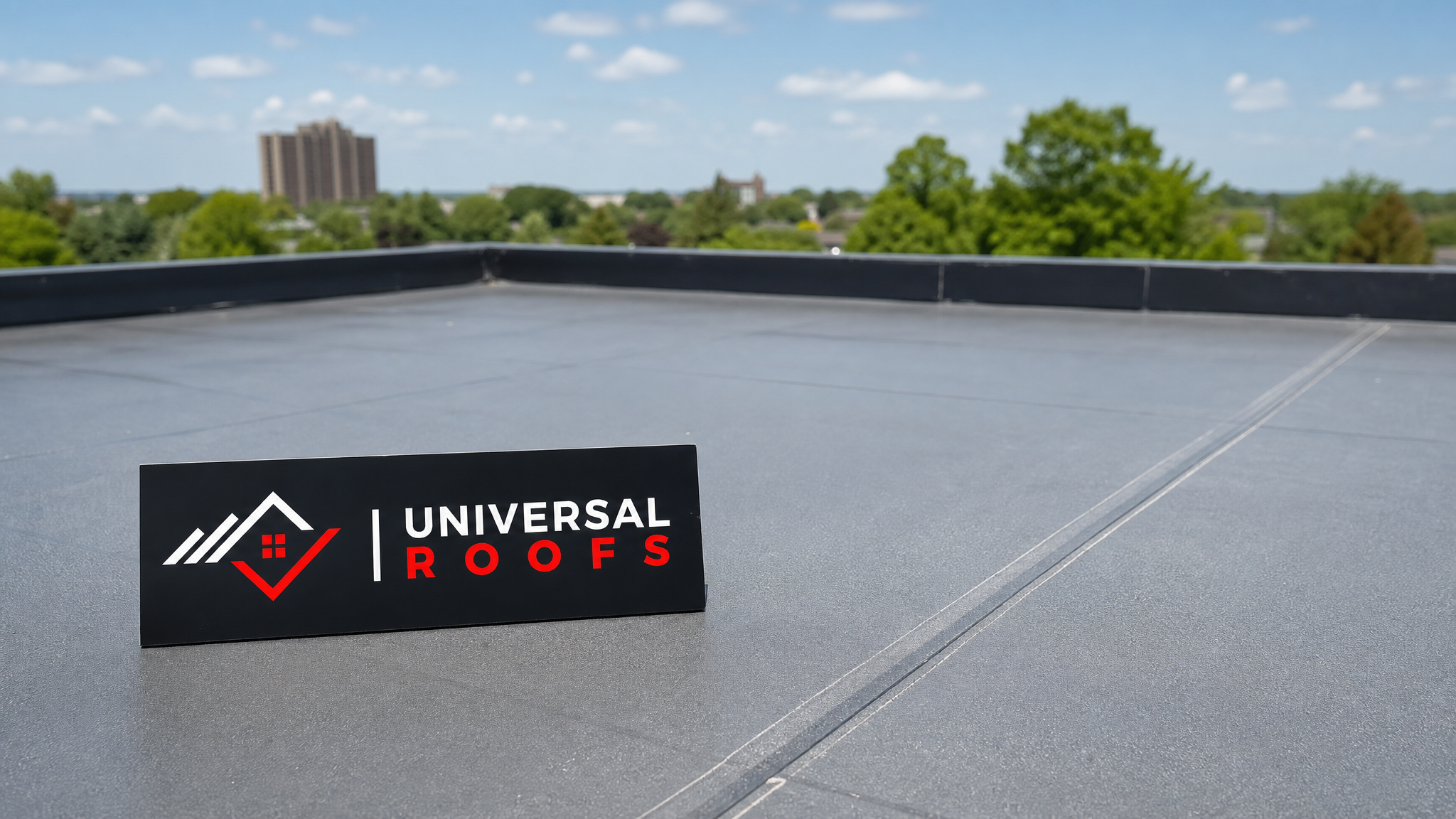
Commercial roofs are almost always flat or low-slope, which means there is no gravity assist pushing water toward the edges the way there is on a residential pitched roof. When a membrane seam opens up or a drain clogs, water pools instead of running off, and that ponding water finds the path of least resistance straight through the roof deck. On a warehouse or retail unit with a suspended ceiling, that water can travel laterally along ductwork and structural beams before it ever shows up as a stain, which means the leak you can see is rarely the leak you actually have.
Toronto’s climate makes this worse. Summer thunderstorms can drop 25-40 millimetres of rain in under an hour, overwhelming drains that were only marginally functioning before. In winter, freeze-thaw cycling opens up hairline cracks in membranes and flashing that widen every time meltwater refreezes. By the time July arrives, a roof that limped through spring on borrowed time is often one heavy storm away from a genuine emergency. This seasonality is exactly why urgent commercial roof repairs spike every summer across the GTA, and why property managers who wait for a “convenient” time to address a small leak often end up dealing with a much larger one.
Business interruption is the other factor that separates commercial emergencies from residential ones. A homeowner with a roof leak can usually place a bucket and wait for a scheduled repair. A grocery store, medical clinic, distribution warehouse, or multi-tenant office building cannot simply close for a week. That pressure is precisely why the three solutions below are ranked not just by durability, but by how fast each one gets a building watertight again.
Solution 1: Emergency Membrane Patching and Sealing
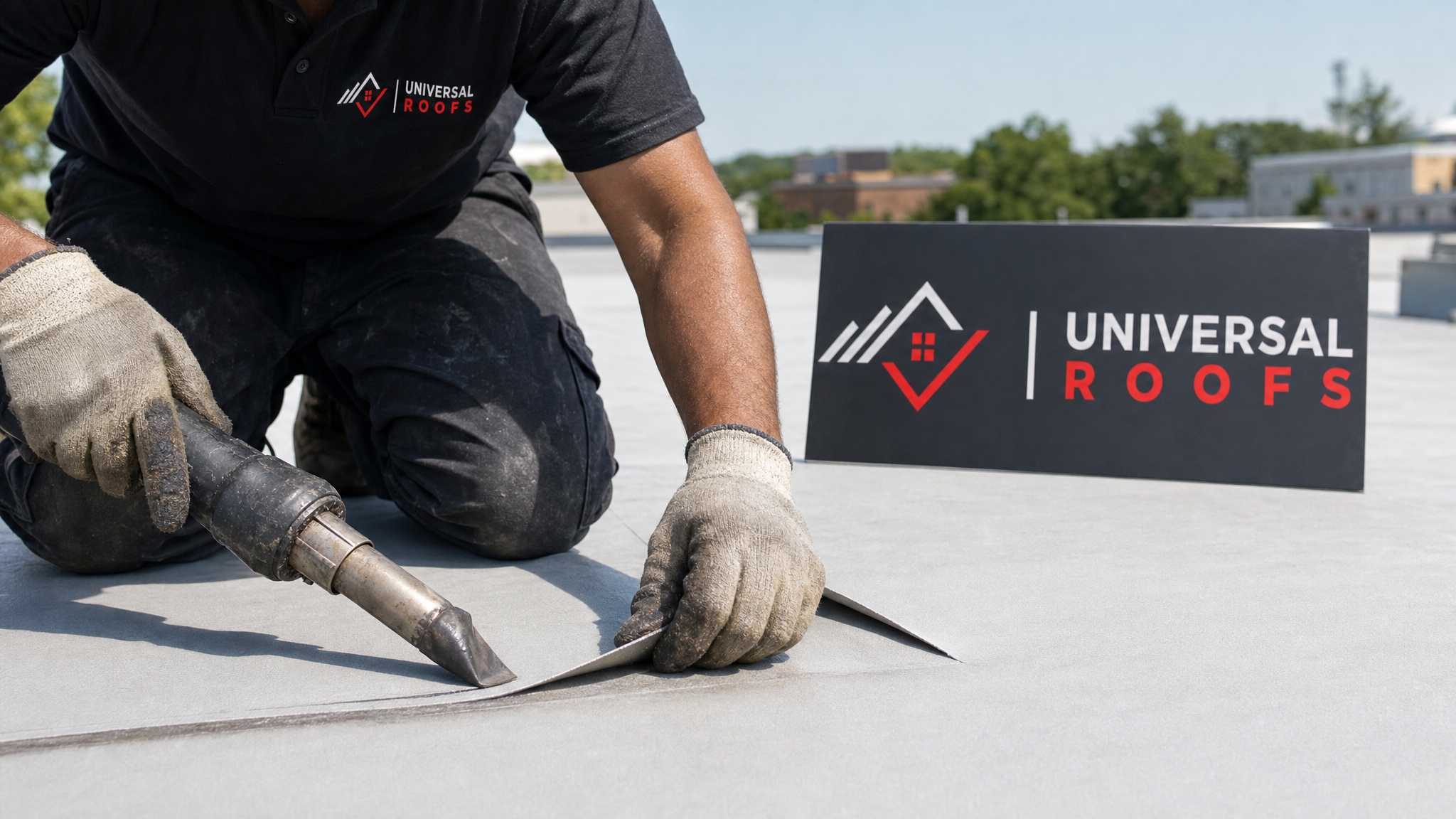
For the majority of urgent commercial roof repair calls, the fastest and most cost-effective solution is a targeted membrane patch. This applies to EPDM rubber, TPO, PVC, and modified bitumen roofing systems, which together make up the vast majority of commercial low-slope roofs in the GTA. A trained technician identifies the failure point, usually a split seam, a puncture from mechanical equipment, or a flashing detail that has pulled away from a wall or curb, and applies a compatible patch material with the correct primer and adhesive or heat-weld for that membrane type.
The key word here is “compatible.” One of the most common mistakes we see when we arrive at a building that has already had one emergency visit from another contractor is a mismatched patch: silicone caulk on a TPO membrane, or an EPDM patch heat-welded (which EPDM cannot be) instead of adhered. These mismatches fail again within weeks, sometimes days, because the patch material was never designed to bond with the base membrane. Getting this right the first time is the difference between a repair that lasts five years and one that leaks again during the next rainstorm.
Membrane patching is ideal when the damage is localized. If an inspection reveals the membrane has failed in one specific area but the rest of the roof is structurally sound and within a reasonable portion of its service life, a patch stops the immediate leak and can serve as a long-term fix, not just a stopgap, provided it is installed correctly. Our roof repair technicians carry patch kits for all major commercial membrane types specifically so this solution can be deployed on the first visit rather than requiring a return trip.
| Repair Solution | Best For | Typical Response Time | Expected Lifespan of Repair |
|---|---|---|---|
| Emergency membrane patching | Localized seam or puncture failures | Same day to 24 hours | 5-10+ years if compatible materials used |
| Temporary tarping and water diversion | Active leaks during storms, structural uncertainty | Within hours | Days to a few weeks (stopgap only) |
| Full section replacement | Widespread membrane failure or deck damage | 1-5 days scheduling, 1-3 days on-site | 15-25+ years depending on system |
| Drain and flashing repair | Ponding water and perimeter leaks | Same day to 48 hours | 10-15 years |
Solution 2: Temporary Tarping and Water Diversion
Sometimes the extent of the damage cannot be safely assessed or repaired the moment a leak is reported, especially during an active storm, at night, or when structural damage to the roof deck is suspected. In these cases, the correct urgent solution is not a permanent repair at all, it is a temporary tarping and water diversion setup that stops water intrusion immediately while a full inspection and repair plan is arranged for daylight or drier conditions.
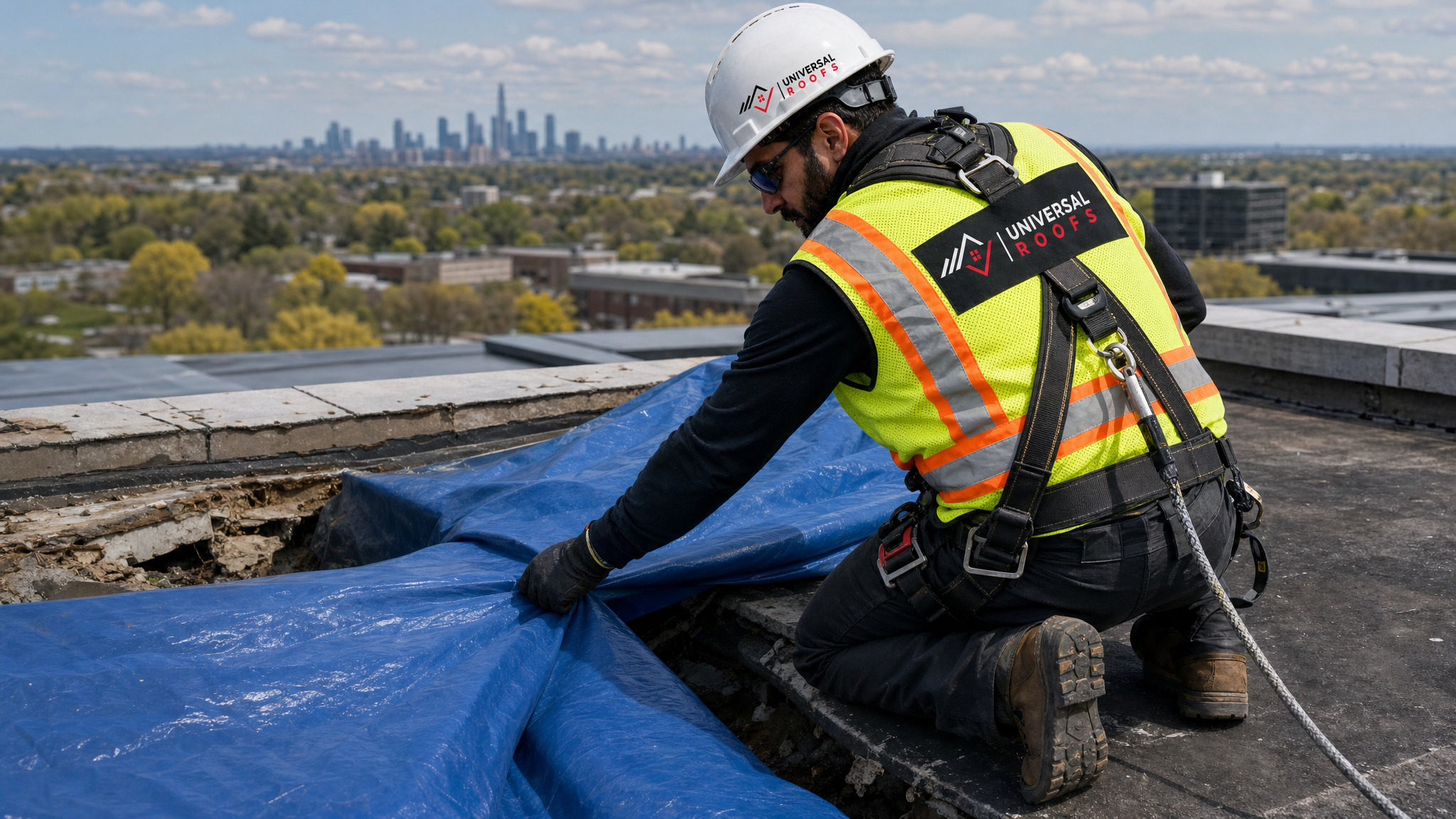
This typically involves securing heavy-duty reinforced tarps over the compromised section, sandbagging or mechanically fastening the edges so wind cannot lift them, and, where drainage is compromised, creating temporary channels or scuppers to direct water away from the damaged area and toward functioning drains. On buildings with rooftop mechanical units, ductwork, or electrical conduit near the failure point, technicians will also tent or divert water away from equipment that could be damaged or become a safety hazard if it gets wet.
Temporary tarping is explicitly not meant to be a long-term solution. It buys time, typically anywhere from a few days to a couple of weeks, so that a proper repair or replacement can be scoped, priced, and scheduled without the building owner absorbing ongoing interior damage in the meantime. Property managers sometimes ask why a contractor would not simply do the permanent fix immediately; the honest answer is that some failures, especially those involving saturated insulation or a compromised roof deck, cannot be properly repaired until the area has had a chance to dry out, and rushing a permanent patch onto wet substrate is one of the most common reasons repairs fail early.
Solution 3: Full Section Replacement for Compromised Areas
When an inspection reveals that the membrane failure is not an isolated incident but a symptom of widespread deterioration, patching becomes a losing game. This is common on commercial roofs that are 18-25+ years old, where the membrane has become brittle, seams throughout the field are failing at the same rate, or the insulation beneath the membrane has absorbed enough moisture over time that it no longer provides a stable, dry substrate anywhere nearby. In these situations, the only solution that actually resolves the urgent repair problem, rather than deferring it a few months, is a full section replacement.
A section replacement means removing the failed membrane and, if necessary, the saturated insulation beneath it, back to sound, dry substrate, then installing new insulation and membrane properly lapped and sealed into the surrounding existing roof. This is more involved than a patch, but it is still dramatically faster and less expensive than a full roof replacement across the entire building, because only the compromised zone is addressed. For a warehouse or retail plaza with one problem corner, this targeted approach can restore a fully watertight roof in that section within a few days rather than requiring the entire roof system to be torn off.
The decision between a patch and a section replacement usually comes down to moisture testing. Roofing contractors use infrared scanning or a moisture meter to map how far water has actually travelled beneath the membrane, since visible surface damage is often smaller than the wet insulation underneath it. If moisture has spread across a wide area, patching just the visible hole leaves saturated insulation trapped under a new patch, which will continue causing problems (mould, reduced R-value, deck rot) even after the surface leak has stopped. Our team always recommends a proper moisture survey before committing to any repair scope larger than a small localized patch, on both standard membrane roofs and specialty systems like flat roofing assemblies with built-up insulation layers.
How to Decide Which Solution Your Building Needs
Most property managers are not roofing experts, and they should not need to be in order to make a smart first call during an emergency. The decision tree is simpler than it looks:
If the leak is small, localized, and the roof is otherwise in good condition, a same-day membrane patch is almost always the right call and often becomes the permanent fix. If the leak is active, the storm has not passed, or nobody can safely get eyes on the roof deck yet, temporary tarping stops the bleeding until conditions allow a real assessment. And if an inspection turns up widespread membrane fatigue, saturated insulation, or a roof that is simply past its realistic service life, a full section replacement is the only solution that will not have you making the same emergency call again in six months.
Roof age is one of the most reliable predictors here. A membrane that is 5-10 years old with one localized failure is a strong patch candidate. A membrane approaching or past 20 years with a failure anywhere is a strong signal the rest of the roof is not far behind, and a section replacement (or a conversation about full replacement timing) is the more responsible recommendation, even if it costs more up front.
| Roof Age | Failure Pattern | Recommended Solution | Follow-Up Needed |
|---|---|---|---|
| 0-8 years | Single localized puncture or seam | Membrane patch | None, usually resolves permanently |
| 8-15 years | Isolated failure, rest of roof sound | Membrane patch plus moisture scan | Annual inspection recommended |
| 15-20 years | Multiple seam failures or ponding | Section replacement | Budget for full replacement within 3-5 years |
| 20+ years | Widespread membrane fatigue | Section replacement now, full replacement planning | Schedule full roof replacement assessment |
Drainage and Flashing: The Root Cause Behind Most Emergencies
It is worth calling out drainage and flashing failures specifically, because they are behind a disproportionate share of the “urgent” calls we receive, and they are almost entirely preventable with regular maintenance. Roof drains, scuppers, and internal gutters clog with leaves, gravel ballast, and debris far more often on commercial roofs than most building owners expect, simply because nobody is up there looking at them between scheduled inspections. Once a drain is blocked, ponding water has nowhere to go, and standing water dramatically accelerates membrane wear at exactly the low points where failures are hardest to access and most damaging when they occur.
Flashing, the metal or membrane detail where the roof meets a wall, curb, parapet, or rooftop unit, is the other recurring culprit. These transition points move differently than the flat field of the roof does during thermal expansion and contraction, which is exactly why flashing is sealed rather than fully rigid. When sealant dries out and cracks, usually starting around year 8-12 depending on exposure, water finds its way behind the flashing and can travel a surprising distance before it appears as a ceiling stain. Regular roof repair inspections that specifically check flashing and drainage twice a year (spring and fall) catch the vast majority of these issues before they become emergencies.
Skylights and rooftop penetrations deserve a specific mention here too. Any point where something passes through the roof membrane, a vent stack, an HVAC curb, or a skylight, is a higher-risk zone for leaks simply because the membrane has to be cut and resealed around it. On buildings where skylights are original to a much older roof, the surrounding flashing is often the actual point of failure rather than the skylight unit itself, and in some cases a skylight replacement that includes proper re-flashing resolves a recurring leak that patching alone never could.
What Urgent Commercial Roof Repairs Typically Cost in the GTA
Pricing for emergency commercial roof work depends heavily on membrane type, accessibility, and how much of the roof is affected, but property managers budgeting for a repair or trying to sanity-check a quote should expect the following general ranges across the Toronto area.
| Repair Type | Typical Cost Range (CAD) | Cost Drivers |
|---|---|---|
| Small membrane patch (under 1 sq. m) | $400 – $1,200 | Membrane type, roof access, after-hours call-out |
| Temporary tarp and diversion setup | $500 – $1,800 | Roof size, weather severity, equipment protection needs |
| Section replacement (50-200 sq. m) | $8,000 – $35,000 | Insulation replacement, membrane type, deck condition |
| Drain or scupper repair | $600 – $2,500 per drain | Clog severity, pipe access, structural repair needed |
| Flashing resealing per detail | $300 – $900 per penetration | Number of penetrations, height, material type |
These figures reflect typical Toronto-area commercial pricing as of 2026 and can vary based on building height, roof access (ladder versus crane or lift), and whether the work happens during regular hours or as an after-hours emergency call. A proper written estimate after an on-site inspection is always the most reliable number, and it is worth asking any contractor for a clear breakdown of materials versus labour so you can compare quotes on an apples-to-apples basis.
Preventing the Next Emergency: A Maintenance Checklist
The single best solution for an urgent commercial roof repair is never needing one in the first place. Buildings that schedule biannual roof inspections catch small problems while they are still cheap to fix. A basic maintenance routine that GTA property managers should have in place includes:
Clearing drains, scuppers, and gutters of debris every spring and fall, and immediately after any major storm. Inspecting all flashing details around parapets, walls, and rooftop units for cracked or dried-out sealant at least twice a year. Checking membrane condition for blistering, seam separation, or granule loss (on modified bitumen systems) annually. Documenting the age and material of the roofing system so replacement planning can begin well before an emergency forces the decision. Keeping the roof clear of stored materials, equipment, or debris that can puncture the membrane or block drainage paths. And finally, addressing every small leak immediately rather than waiting, since a $500 patch today is reliably cheaper than the same failure escalating into a $15,000 section replacement six months from now.
Buildings in Toronto, the Peel Region, York Region, Halton Region, and Durham Region all face similar freeze-thaw and summer-storm pressures, and a consistent inspection schedule is the most cost-effective insurance policy a property manager can put in place against future emergency calls.
What to Do in the First Hour of a Commercial Roof Emergency
If water is actively coming through a ceiling right now, a few steps in the first hour make a meaningful difference in how much interior damage accumulates. Move inventory, equipment, and furniture away from the affected area immediately. Place containers to catch dripping water and, if it is safe to do so, puncture a small hole in a sagging, water-filled ceiling tile to release pooled water in a controlled way rather than letting the tile collapse. Photograph the damage as it appears for insurance purposes before any cleanup begins. Shut off power to any electrical fixtures or outlets in the affected area if there is any risk of water contact. And call a licensed commercial roofing contractor immediately rather than waiting to see if the leak stops on its own, since the roof itself needs a professional assessment regardless of how the interior damage is handled.
Attic and roof-deck ventilation issues can also compound emergency situations, particularly on buildings with older insulation systems. If a leak has been allowed to sit for any length of time, trapped moisture in the attic or roof assembly can lead to secondary problems like mould growth and reduced insulation performance, which is another reason a fast, correct first response matters as much as the long-term repair solution chosen afterward.
Universal Roofs maintains emergency response capacity specifically for these first-hour calls, because we have seen firsthand how much a same-day response changes the total cost and disruption of a commercial roofing emergency. You can review examples of how we have handled emergency and planned roofing work for other GTA businesses on our reviews page, and our FAQ page answers many of the scheduling and warranty questions that come up most often during emergency calls.
Choosing the Right Commercial Roofing Contractor for Urgent Repairs
Not every roofing company is equipped to handle a true commercial emergency. Residential-focused contractors often lack experience with the specific membrane systems (TPO, EPDM, PVC, modified bitumen, built-up roofing) used on commercial buildings, and using the wrong repair materials or techniques on the wrong membrane type is one of the fastest ways to turn a fixable problem into a much larger one. When vetting a contractor for urgent commercial roof repairs, look for a company that can mobilize the same day or within 24 hours, carries compatible patch materials for multiple membrane systems rather than a one-size-fits-all approach, offers a written scope and price before work begins even under emergency conditions, and has verifiable experience and reviews specific to commercial, not just residential, roofing.
It is also worth asking whether the contractor is licenced, insured, and familiar with the specific commercial building codes that apply in your municipality, since requirements can differ between Toronto, Mississauga, Vaughan, and other GTA municipalities, particularly around fall protection, permitting for larger repairs, and rooftop equipment clearances. A contractor who cannot answer these questions confidently on the phone is not the one you want on your roof during an emergency. Learn more about our licencing, experience, and service history on our about page.
What are the best solutions for urgent commercial roof repairs?
How fast can an emergency commercial roof repair be completed?
How much does an urgent commercial roof repair cost in Toronto?
Is a temporary tarp a permanent solution for a commercial roof leak?
How do I know if my commercial roof needs a patch or a full section replacement?
What causes most urgent commercial roof repair calls in the GTA?
Need Help With 3 Best Solutions for?
A commercial roof emergency does not wait for a convenient time, and neither should your response. Whether you need a same-day membrane patch, emergency tarping during an active storm, or a full assessment of a section that has been failing for months, Universal Roofs has the commercial roofing experience to diagnose the problem correctly and deploy the right one of these three best solutions for urgent commercial roof repairs the first time.
Call us today at (416) 732-2421 or request a free inspection to get started.
Universal Roofs proudly serves Toronto, Mississauga, Brampton, Vaughan, Markham, Oakville and the GTA since 2005.