
A flat roof leak rarely announces itself politely. It shows up as a brown stain spreading across a ceiling tile, a soft spongy patch near a drain, or a slow drip during a July thunderstorm that has you scrambling for a bucket. If you own a commercial building, bungalow, or garage with a flat or low-slope roof anywhere in the Greater Toronto Area, knowing the essential tips for flat roof repair can be the difference between a $400 patch job and a $12,000 emergency replacement.
Flat roofs behave very differently from sloped shingle roofs. Water doesn’t run off quickly — it pools, it seeks out the smallest imperfection, and it exploits every seam, fastener, and flashing detail until it finds a way inside. Add in Toronto’s freeze-thaw winters, punishing UV exposure in summer, and sudden hailstorms, and a flat roof membrane takes a beating year-round. The good news is that most flat roof failures are preventable, and most early-stage repairs are straightforward once you know what you’re looking at.
This guide walks through nine essential tips for flat roof repair, covering how to identify problems early, what materials and methods actually work, when a patch is appropriate versus when you need a professional, and how to keep a flat roof performing for its full expected lifespan. Whether you manage a strip mall roof in Mississauga or a bungalow addition in Scarborough, these principles apply across the board.
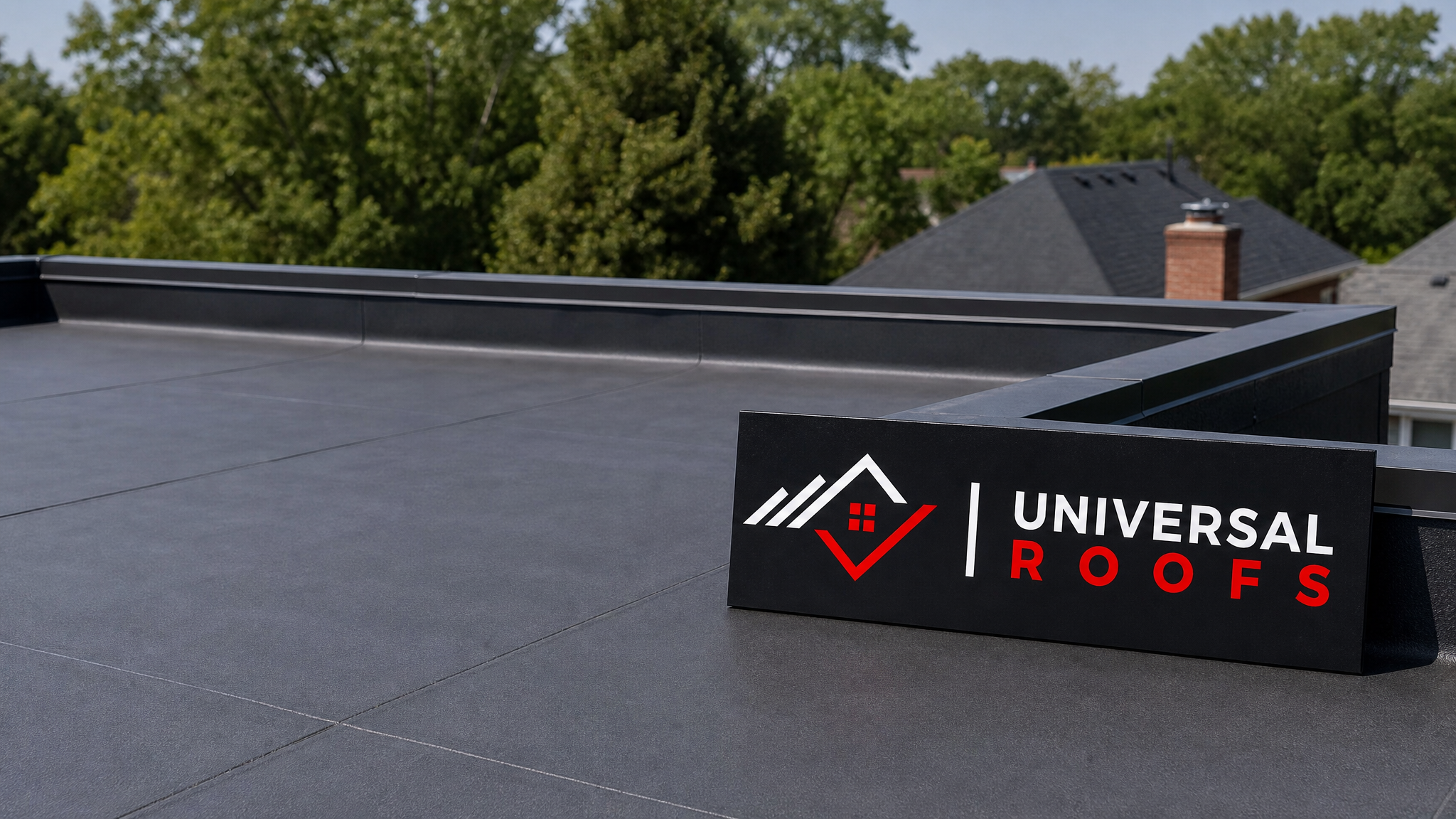
1. Identify the Real Source of the Leak Before You Touch Anything
The single biggest mistake homeowners and building managers make with flat roof repair is patching the spot where water appears inside the building, rather than where it actually enters the roof. Water travels. On a flat roof, it can enter at a flashing seam near a parapet wall, run along a rafter or truss for several metres, and drip through the ceiling on the opposite side of the room. If you seal the interior stain location without tracing the path back to the true entry point, the leak will simply return during the next rainfall.
Start your inspection at the highest point of the roof relative to the interior stain and work downward. Pay close attention to any roof penetrations — vents, HVAC curbs, satellite mounts, and skylights — since these account for a large share of flat roof leaks. If your building has a skylight or is due for a skylight replacement, check the flashing around the unit first, as failed skylight seals are one of the most common hidden leak sources on flat roofs.
Look for these telltale signs during your walkthrough: blistering or bubbling in the membrane, cracked or alligatored cap sheet, separated seams, pooled water that hasn’t drained within 48 hours of the last rain, and rusted or lifted flashing at walls and curbs. Each of these points to a different repair approach, which is why proper diagnosis always comes before any patching material touches the roof.
2. Know Your Membrane Type Before You Buy Repair Materials
Not all flat roofs are built the same way, and using the wrong repair product on the wrong membrane can actually accelerate failure rather than fix it. Toronto homes and commercial buildings commonly have one of four flat roofing systems, and each requires a different repair technique and compatible materials.
| Membrane Type | Common Age Range | Compatible Repair Materials | Typical Lifespan |
|---|---|---|---|
| Modified Bitumen (torch-down or peel-and-stick) | 10-25 years | Matching modified bitumen patches, torch or cold-applied adhesive | 20 years |
| EPDM (rubber membrane) | 10-30 years | EPDM-specific liquid adhesive and seam tape, never asphalt-based products | 25 years |
| TPO (thermoplastic single-ply) | 10-25 years | Heat-welded TPO patches or TPO-approved sealants only | 20 years |
| Built-Up Roofing (BUR, tar and gravel) | 15-30+ years | Hot or cold asphalt, fibreglass fabric reinforcement | 25 years |
If you’re not certain which membrane your roof uses, it’s worth pausing before applying any repair product. Mixing incompatible materials — for example, applying an asphalt-based sealant to an EPDM rubber roof — can cause the membrane to degrade faster and void any remaining manufacturer warranty. When in doubt, our team can identify the membrane type and recommend the right approach during a roof repair assessment.
3. Address Standing Water Before It Becomes a Structural Issue
Flat roofs are engineered with a slight slope, usually a minimum of 2% (about 1/4 inch per foot), to direct water toward drains or scuppers. Over time, however, structural settling, improperly installed insulation, or clogged drains can create low spots where water collects and simply sits — sometimes for days after a storm has passed.
Ponding water is more than a cosmetic nuisance. Standing water adds significant dead-load weight to the roof structure, accelerates UV-related membrane breakdown at the water line, and creates the perfect environment for algae and moss growth that can stain and weaken the surface. In freezing Toronto winters, that same ponded water expands as it turns to ice, stressing seams and flashing details even further.
Short-term fixes include clearing debris from drains and scuppers, installing tapered insulation crickets to redirect flow, or adding a supplementary drain in a chronic problem area. If ponding recurs in the same spot every season despite clearing debris, it usually indicates a structural or slope problem that a patch can’t solve — that’s a sign the roof deck itself needs professional evaluation, not just the membrane.
4. Master the Basics of Membrane Patching
For small punctures, splits, or blister repairs, a properly executed patch can add years of service life at a fraction of the cost of a full membrane replacement. The technique varies slightly by membrane type, but the core principles are consistent.
First, the area must be completely dry — never patch over damp or wet membrane, as trapped moisture will cause the patch to fail and can lead to mould growth beneath the surface. Clean the area thoroughly, removing loose granules, debris, and any old sealant residue. Cut away any damaged or blistered membrane back to solid material, then apply a compatible primer if the manufacturer specifies one.
The patch itself should extend at least 10 to 15 centimetres beyond the damaged area in every direction, with rounded corners to prevent the patch edges from lifting. Press firmly from the centre outward to eliminate air pockets, and seal all edges with a compatible liquid sealant or seam tape rated for exterior UV exposure. Allow the recommended cure time — often 24 to 48 hours — before the area is exposed to foot traffic or heavy rain.
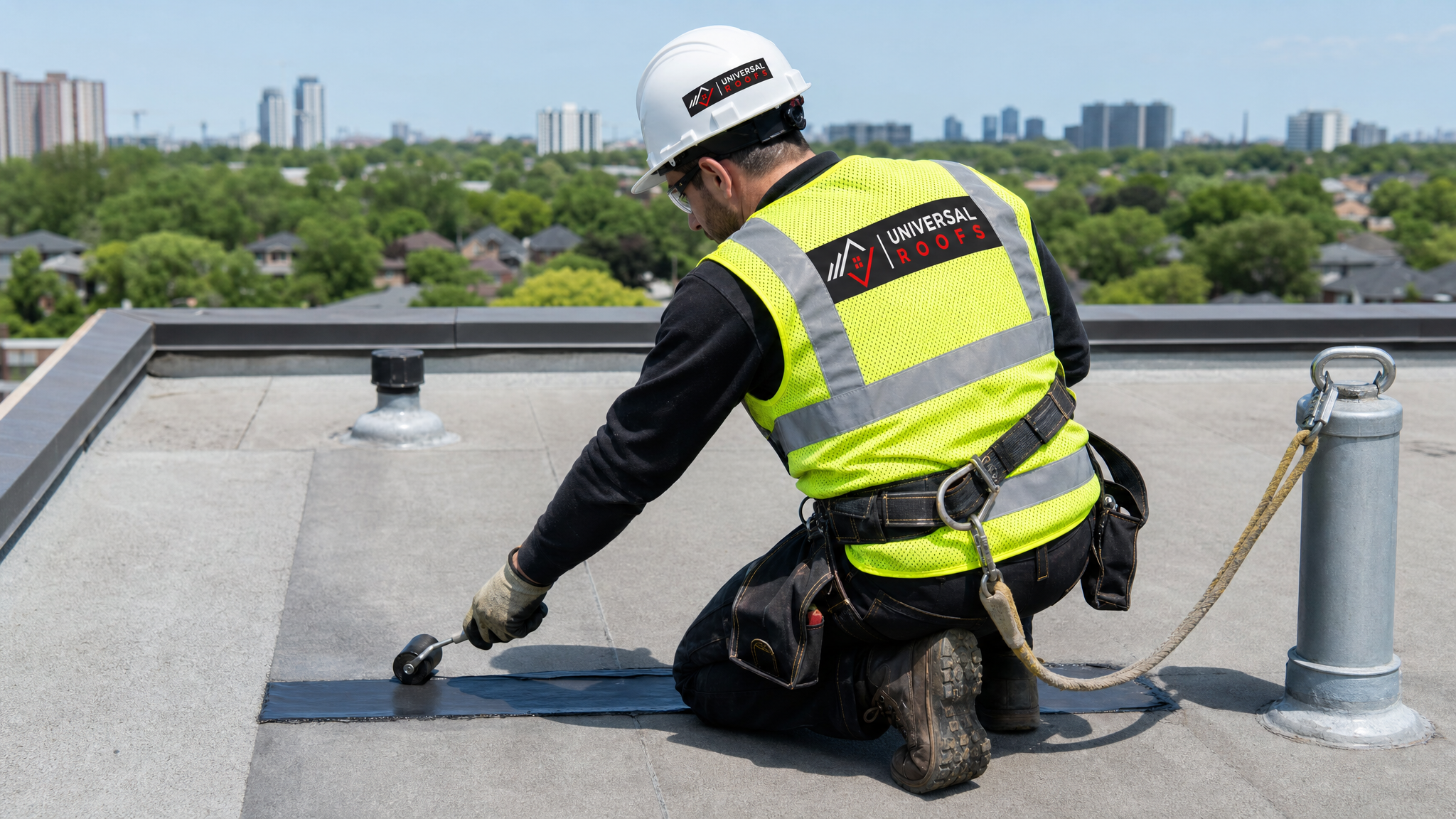
5. Pay Special Attention to Flashing and Penetrations
Statistically, the majority of flat roof leaks originate not from the flat field of the membrane itself, but from the details around it — flashing at parapet walls, pipe boots, HVAC curbs, and roof-to-wall transitions. These are the highest-stress points on any flat roof because they involve multiple materials meeting at an angle, and they’re the first place seals typically fail.
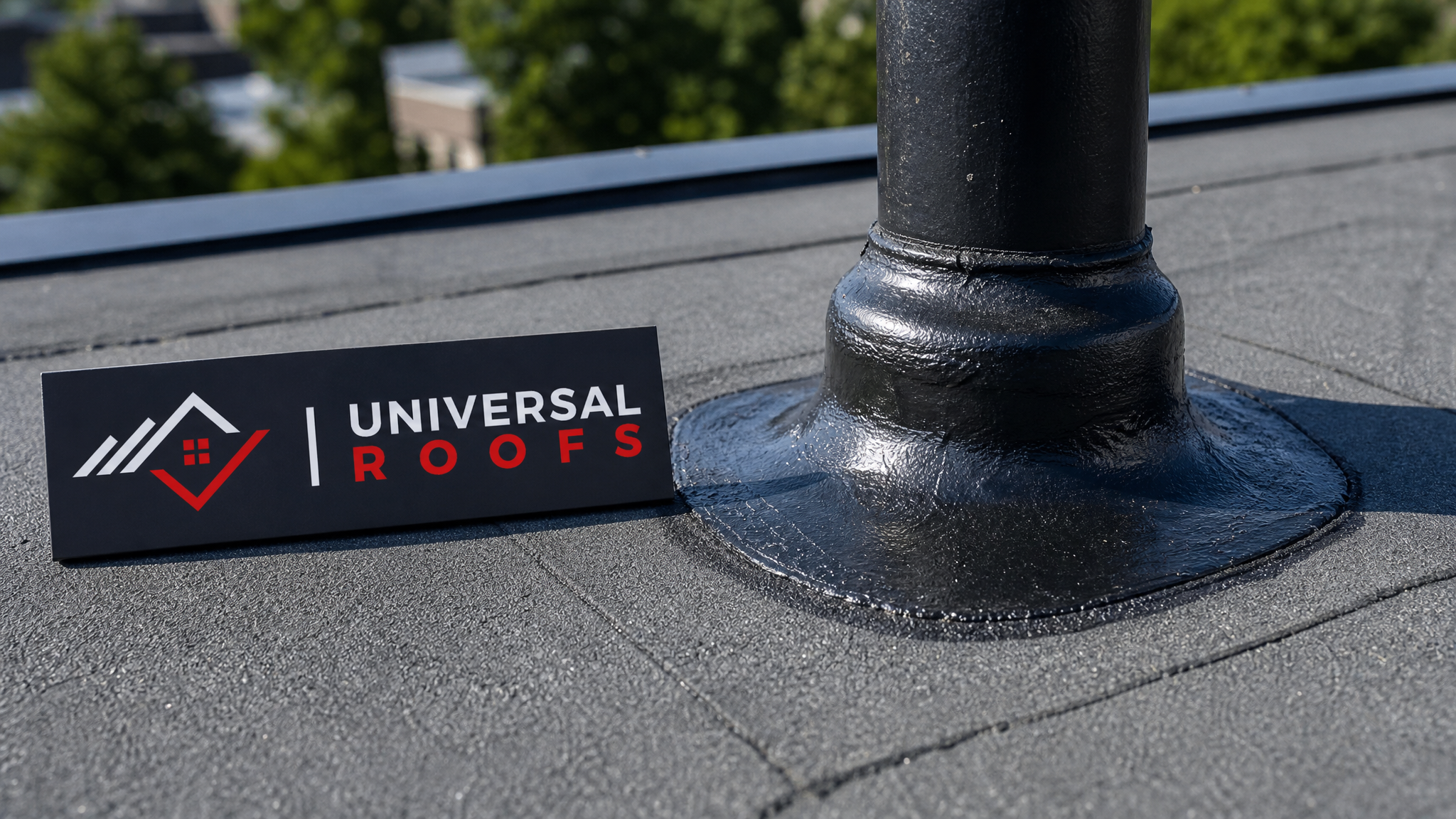
Inspect metal flashing for rust, separation from the wall or curb, and gaps where sealant has dried out and cracked. Rubber pipe boots around vents are especially prone to UV cracking after 8 to 10 years and should be replaced proactively rather than repaired repeatedly. Counter-flashing that has pulled away from a parapet wall allows wind-driven rain to enter behind the membrane entirely, bypassing the roof surface altogether — this is one of the trickiest leaks to diagnose because the water entry point can be metres away from where it eventually drips through the ceiling.
If your building has a low-slope roof section attached to a skylight, garage, or addition, our flat roofing team frequently finds that flashing failures around these transitions are the actual root cause of leaks that were previously (and incorrectly) attributed to the main membrane.
6. Understand When a Patch Is Enough vs. When You Need Full Replacement
One of the hardest calls for any property owner is deciding whether a repair is a sound investment or simply delaying an inevitable, more expensive replacement. As a general rule of thumb, if the damaged area affects less than roughly 25% of the total roof surface and the membrane is less than about 15 years old, a targeted repair is usually the more cost-effective choice. Beyond that threshold, the economics shift.
| Roof Condition | Recommended Action | Approximate Cost Range (CAD) | Expected Added Lifespan |
|---|---|---|---|
| Single puncture or small split, membrane under 10 years old | Localized patch | $300 – $800 | 5-10 years |
| Multiple leaks, membrane 10-15 years old | Section repair + flashing renewal | $1,200 – $3,500 | 3-7 years |
| Widespread blistering, membrane 15-20 years old | Full membrane replacement | $8,000 – $18,000 (residential) | 20-25 years |
| Structural sagging or wet insulation | Deck repair + full replacement | $15,000+ | 20-25 years |
Costs vary based on roof size, accessibility, and the specific membrane chosen, but this framework gives a realistic starting point. If your roof is approaching or past the higher end of its membrane’s expected lifespan and you’re facing repeat repairs, it’s often more economical in the long run to move to a roof replacement rather than continuing to invest in patches on a system that’s reaching end of life.
7. Don’t Ignore the Insulation and Deck Beneath the Membrane
A flat roof repair that only addresses the surface membrane can mask a much bigger problem developing underneath. Once water penetrates a membrane, it often saturates the insulation layer below before it ever becomes visible as an interior stain. Wet insulation loses most of its R-value, meaning your attic or roof insulation stops doing its job even if the leak is eventually sealed, driving up heating and cooling costs.
Saturated insulation also adds substantial weight, can promote wood rot in the roof deck, and creates conditions for mould growth that may not be visible from inside the building until it’s a significant health and structural concern. If a patch repair reveals soft, spongy, or waterlogged insulation when the membrane is peeled back, that section needs to be cut out, dried, and replaced with new insulation before the membrane patch goes down — patching over wet insulation is one of the most common reasons a “fixed” flat roof leaks again within a single season.
8. Time Your Repairs Around Toronto’s Climate
Weather windows matter enormously for flat roof repair quality. Most membrane adhesives, sealants, and torch-applied products require a minimum application temperature, typically above 5-10°C, and need a dry surface with no rain in the forecast for at least 24 hours after application to cure properly. This makes late spring through early autumn — including right now in the summer months — the ideal window for planned flat roof maintenance and repair work in the GTA.
That said, summer heat brings its own challenges. Intense UV exposure and high roof-surface temperatures (which can exceed 60°C on a dark membrane in direct July sun) accelerate the curing of some adhesives too quickly, so timing work for early morning or late afternoon often produces better results than midday application. Conversely, waiting until late autumn to address a known problem is risky: once overnight temperatures consistently drop below the minimum application threshold, many repair products can’t be properly applied until spring, leaving the roof vulnerable through an entire freeze-thaw winter.
If you’ve spotted an issue, addressing it during the current summer season rather than deferring it is almost always the more cost-effective choice, since winter emergency repairs on a frozen membrane are both more difficult and more expensive.
9. Schedule Regular Inspections, Not Just Reactive Repairs
The property owners who get the longest service life out of their flat roofs are the ones who inspect twice a year rather than waiting for a leak to force their hand. A spring inspection after winter’s freeze-thaw cycles and an autumn inspection before winter sets in will catch small issues — a lifted seam, a cracked pipe boot, debris blocking a drain — while they’re still inexpensive $200-$500 fixes rather than $3,000 emergencies.
| Inspection Item | Frequency | What to Look For | Who Should Check |
|---|---|---|---|
| Drains and scuppers | Every 3 months | Debris, leaves, granule buildup blocking flow | Owner or property manager |
| Membrane surface | Twice yearly (spring/fall) | Blisters, cracks, seam separation | Licensed roofing contractor |
| Flashing and penetrations | Twice yearly | Rust, gaps, pulled counter-flashing | Licensed roofing contractor |
| Interior ceilings below roof | Monthly | New staining, soft spots, musty odour | Owner or property manager |
| Full roof assessment | Every 3-5 years or after major storms | Overall membrane condition, remaining lifespan | Licensed roofing contractor |
A written inspection record also proves valuable when it comes time to sell a property or file an insurance claim after storm damage, since it demonstrates ongoing maintenance rather than neglect. Many of the reviews on our reviews page come from clients who caught small problems early through routine inspections and avoided far larger bills down the road.
Common Flat Roof Repair Mistakes to Avoid
Beyond the nine tips above, a handful of avoidable mistakes account for a disproportionate share of repeat flat roof failures across the GTA. Applying roof cement or asphalt-based sealant to an EPDM rubber membrane is one of the most frequent — the petroleum-based product actually breaks down the rubber over time rather than bonding to it. Similarly, walking on a flat roof in the wrong footwear, or allowing heavy foot traffic without protective walkway pads, can puncture or thin a membrane that would otherwise have lasted another decade.
Another common error is patching in wet or freezing conditions simply because the leak is urgent. A rushed repair applied to a damp surface or in temperatures below the product’s minimum threshold rarely bonds properly and often fails within weeks, requiring the work to be redone. It’s almost always better to apply a temporary tarp or emergency cover to stop active water intrusion, then schedule the permanent repair for the next suitable weather window, rather than compromising the quality of the fix.
Finally, DIY repairs on roofs with any significant slope, height, or structural uncertainty carry real safety risk. Falls from flat roofs are among the most common causes of serious injury in residential maintenance work, and a professional crew working with proper fall protection and harness systems can complete in an hour what might take an inexperienced homeowner an entire dangerous weekend.
How Local Conditions Across the GTA Affect Flat Roof Repair
Flat roof performance isn’t identical across the region. Properties in Toronto proper often deal with older building stock and a mix of built-up and modified bitumen roofs that are reaching the end of their natural lifespan, while newer developments across Peel Region and York Region more commonly feature TPO and EPDM systems installed within the last 15 years. Homes in Halton Region and Durham Region that sit closer to the lakeshore can also see accelerated wear from higher humidity and wind-driven precipitation.
Regardless of which part of the GTA a property is in, the fundamentals of flat roof repair remain the same: identify the true source of the leak, match repair materials to the membrane type, address standing water and failed flashing promptly, and don’t defer known problems into the winter season. Our FAQ page covers additional questions specific to flat roof maintenance, and our about page outlines our two decades of experience working on flat roofs throughout the region.
What are the most essential tips for flat roof repair on an older membrane?
Can I patch a flat roof myself, or should I hire a professional?
How long does a typical flat roof patch repair last?
Why does standing water matter so much for flat roof repair?
What is the best time of year in the GTA for flat roof repair?
How do I know if my flat roof needs a repair or a full replacement?
Need Help With 9 Essential Tips for?
Applying these tips correctly takes experience, the right materials for your specific membrane, and proper safety equipment for working at height — which is exactly what Universal Roofs brings to every flat roof repair project across the GTA.
Call us today at (416) 732-2421 or request a free inspection to get started.
Universal Roofs proudly serves Toronto, Mississauga, Brampton, Vaughan, Markham, Oakville and the GTA since 2005.