
A roof leak rarely announces itself politely. It shows up as a brown stain spreading across a bedroom ceiling, a drip behind a pot lid during a July thunderstorm, or a soft, spongy patch of drywall that gives way when you press a thumb into it. Once the shock wears off, most homeowners ask the same question in the same order: how bad is it, how much will it cost, and will my home insurance actually pay for it? That last question is the one that trips people up, because roof leak insurance coverage is full of exceptions, exclusions, and fine print that most policyholders never read until they need it.
This guide walks through insurance coverage for roof leak repair a how to approach, step by step, so you understand what your policy is likely to cover, what it almost certainly will not, and how to document a claim so it gets approved instead of denied. We wrote this from the perspective of a roofing contractor who has stood in hundreds of Toronto-area attics with insurance adjusters, filled out damage reports, and watched homeowners either win or lose claims based on decisions made in the first 48 hours after a leak appears.
We will also cover the practical side: what an adjuster looks for, how to get an estimate that satisfies your insurer, and when it makes more sense to simply pay out of pocket rather than file a claim at all. If you are dealing with active water intrusion right now, our roof repair team can stop the leak first — insurance paperwork can wait a day, but a spreading leak cannot.
How Home Insurance Actually Treats Roof Leaks
Most Canadian homeowner policies are “named perils” or “broad form” policies, and the wording matters enormously for a roof leak claim. A named perils policy only pays for damage caused by specific, listed events — wind, hail, fire, lightning, and a handful of others. A broad form or comprehensive policy covers everything except what is explicitly excluded. In both cases, the insurer is paying for sudden, accidental damage caused by a covered peril, not for a roof that failed because it was simply old or poorly maintained.
This distinction is the single biggest source of confusion for homeowners filing a roof leak claim. If a windstorm rips shingles off your roof and rain gets into the attic that same night, that is almost always covered — it is sudden, it is accidental, and wind is a named peril on nearly every policy. If your roof has been slowly deteriorating for eight years and finally starts leaking during a rainstorm with no wind event at all, the insurer’s adjuster is going to ask hard questions about maintenance, age, and gradual wear — and gradual wear is excluded on virtually every policy in Ontario.
Insurers essentially divide roof leak causes into two buckets: sudden and accidental events they will pay for, and gradual deterioration or lack of maintenance they will not. Your job, and your contractor’s job, is to establish clearly which bucket your leak falls into before the adjuster forms an opinion on their own.
What Is Typically Covered Versus Excluded
Every policy is different, and you should always read your specific declarations page and exclusions section, but the following pattern holds true across most major Canadian insurers writing policies in the Greater Toronto Area.
| Cause of Roof Leak | Typically Covered? | Why | What Improves Your Odds |
|---|---|---|---|
| Windstorm shingle loss | Yes | Named peril, sudden and accidental | Photos of storm date, wind speed records, missing shingle evidence |
| Hail impact damage | Yes | Named peril in most policies | Weather service hail reports, bruising visible on shingles |
| Falling tree limb or debris | Yes | Sudden physical damage from an external object | Photos of the limb/debris still in place, arborist or tree service note |
| Ice damming backup | Often, with conditions | Considered sudden water entry, but poor attic insulation can trigger denial | Attic insulation and ventilation report showing adequate levels |
| Gradual wear / worn-out shingles | No | Excluded as “wear and tear” or “lack of maintenance” | None — this is a maintenance issue, not an insurable event |
| Improper original installation | No | Considered a workmanship defect, not a peril | Possible recourse against original installer’s warranty instead |
| Flashing failure around skylight/chimney | Sometimes | Depends whether failure was sudden or a slow, known leak | Documentation showing first appearance date and no prior leak history |
Notice the pattern: insurers are looking for a trigger event. A specific date, a specific storm, a specific falling object. The moment your claim reads as “the roof has been getting worse for a while,” approval odds drop sharply. This is exactly why the first thing we tell homeowners after a leak is to pin down, as precisely as possible, the date and weather conditions when water first appeared indoors.
The Five Steps to Filing a Roof Leak Insurance Claim
Once you have water coming through a ceiling, the process from that moment to a paid-out claim follows a fairly consistent sequence. Skipping steps, or doing them out of order, is the most common reason claims get delayed or denied.
1. Stop Further Damage Immediately
Insurers expect you to mitigate damage — meaning you take reasonable steps to stop things from getting worse the moment you notice a problem. That means buckets under active drips, tarping an exposed section of roof if it is safe to do so, and moving furniture or belongings out of the affected area. Failing to mitigate can actually reduce a payout, since the insurer may argue that additional damage beyond the initial event was preventable.
2. Document Everything Before Any Repair Begins
Photograph the interior water stain, the ceiling, any pooling, and the exterior roof area you suspect is the source — all before a single shingle is touched. Note the date and, if possible, the weather conditions at the time you noticed the leak. If a storm caused it, screenshot the weather alert or news coverage from that day. This becomes your evidentiary trail.
3. Get a Professional Roof Inspection and Written Report
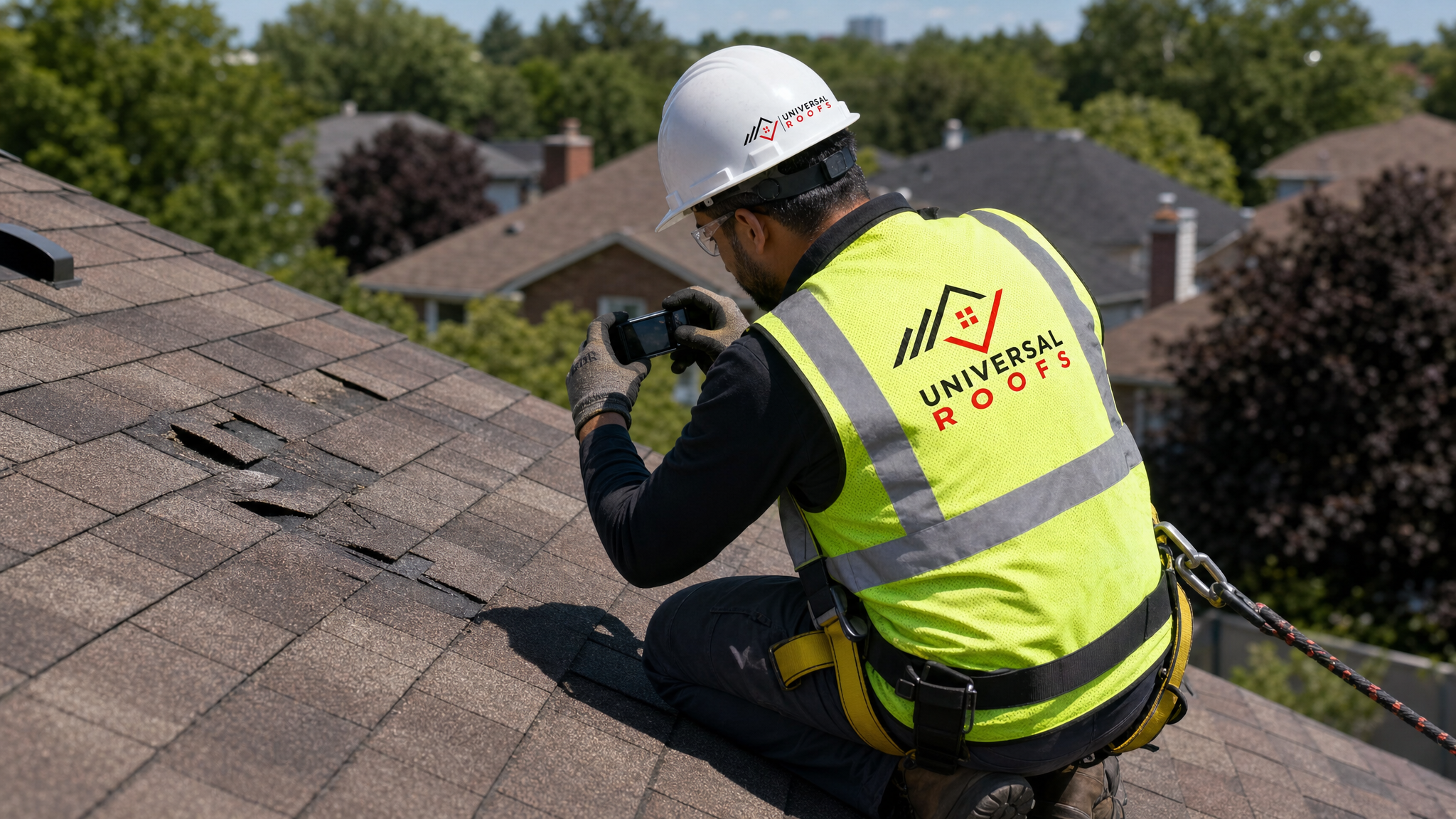
This is the step homeowners skip most often, and it is the one that matters most. An insurance adjuster is not a roofing expert — they are trained to evaluate claims against policy language, and they rely heavily on a contractor’s written assessment of cause and extent of damage. A vague verbal description will not do. You need a dated, written report that states the likely cause of the leak, whether it appears sudden or gradual, the extent of damage, and a repair scope. Our team provides this exact kind of documentation as part of every roof repair assessment, because we know it is what determines whether your claim gets paid.
4. File the Claim With Your Insurer
Call your insurance broker or the insurer’s claims line directly. Have your policy number ready, along with the date you discovered the leak and a summary of the suspected cause. Most insurers will assign a claims adjuster within a few business days, particularly during storm season when claim volumes are high across the GTA.
5. Meet the Adjuster On-Site (or Have Your Contractor Do It)
The adjuster will typically want to inspect the roof themselves or review photo and report documentation remotely. Having your roofing contractor present, or at minimum available by phone, during this inspection significantly improves outcomes. Contractors can point out storm damage indicators — bruised shingle mats, creased tabs, granule loss patterns consistent with hail — that an adjuster without roofing-specific training might otherwise attribute to age.
What a Strong Insurance-Ready Repair Estimate Includes
An estimate written for a homeowner paying out of pocket looks different from one written to support an insurance claim. Adjusters expect specific elements, and a report missing them often gets kicked back for revision, which delays the claim by weeks.
| Estimate Element | Why Adjusters Require It | Typical Detail Level |
|---|---|---|
| Cause of loss statement | Establishes whether damage matches a covered peril | One paragraph, specific and dated |
| Photo documentation with annotations | Visual proof tied to the written cause | 10-25 photos, arrows/labels on damage points |
| Itemized scope of repair | Prevents disputes over what work is “necessary” | Line items: tear-off, decking, underlayment, shingles, flashing |
| Material and labour cost breakdown | Adjusters compare against regional pricing databases | Separated line items, not a single lump sum |
| Code-upgrade notes, if applicable | Some policies cover code-required upgrades separately | Noted distinctly from like-for-like replacement costs |
If your estimate only covers the visible leak point and skips the underlying decking or underlayment, expect the claim to be reopened later when the “quick fix” fails. Adjusters increasingly ask contractors to inspect and quote the full affected roof plane, not just the leak’s immediate origin point, since water travels along the roof deck before it ever reaches the interior.
Deductibles, Depreciation, and What You Actually Receive
Even an approved claim rarely means the insurer writes a cheque for the full repair cost. Two factors reduce the payout: your deductible and, in many cases, depreciation.
Your deductible is the fixed amount you pay before insurance coverage kicks in, commonly $1,000 to $2,500 on residential policies in Ontario, though some older policies or higher-risk properties carry higher deductibles. If your approved repair cost is $6,500 and your deductible is $1,500, the insurer pays $5,000.
Depreciation is trickier. Many policies pay out on an Actual Cash Value (ACV) basis first, which factors in the age and expected lifespan of your roof, then release a second “recoverable depreciation” payment once the repair is actually completed and proof of payment is submitted. A roof that was 12 years into a 25-year expected lifespan might see 40-50% depreciated off the initial payout, refunded only after the work is done. Replacement Cost Value (RCV) policies skip this step and pay the full replacement cost upfront, which is why it is worth confirming which type of coverage you carry before you assume a quoted repair number is what you will actually receive.
| Payout Structure | How It Works | Homeowner Impact |
|---|---|---|
| Actual Cash Value (ACV) | Pays repair cost minus depreciation for roof age/condition | Lower initial cheque; older roofs depreciate more |
| Replacement Cost Value (RCV) | Pays full cost to repair/replace, no age deduction | Higher payout, but often higher premiums |
| RCV with holdback | Initial ACV payment, remainder released after repair proof submitted | Requires completing work and submitting receipts to get full amount |
| Deductible application | Fixed dollar amount subtracted from every approved claim | Applies regardless of payout structure chosen above |
When Filing a Claim Is Not Worth It
Not every roof leak should go through insurance, even if it technically qualifies. Filing a claim, especially a second one within a few years, can trigger a premium increase or non-renewal notice at your next policy term, particularly with Ontario insurers who have tightened underwriting after several high-loss storm seasons. As a rough guide, if your repair estimate is close to or below your deductible, filing accomplishes nothing except adding a claim to your record. We generally advise clients to request a written estimate first from a licensed contractor, compare it honestly against the deductible and expected depreciation, and only then decide whether the insurance route makes financial sense.
For minor, isolated leaks — a single lifted shingle after a windstorm, a small flashing gap around a vent stack — the repair cost often runs a few hundred dollars, well under most deductibles. In those cases, paying directly and keeping the claim history clean is usually the smarter move. For larger events involving structural decking replacement, insulation damage, or full slope re-roofing after storm damage, filing almost always makes financial sense.
Ice Damming, Attic Ventilation, and Denied Claims
Toronto’s freeze-thaw winters create a specific and frequent insurance dispute: ice damming. Warm air escaping into a poorly insulated or poorly ventilated attic melts snow on the upper roof, which refreezes at the cold eaves, building a dam that forces meltwater back up under the shingles. Homeowners experience this as a leak “out of nowhere” during a thaw, but insurers increasingly treat ice damming caused by inadequate attic insulation or ventilation as a maintenance issue rather than a sudden peril, since the underlying condition existed for months or years before the leak appeared.
This is where an attic inspection becomes relevant even for a roofing claim. If your attic has proper insulation depth and functioning soffit-to-ridge ventilation, that documentation supports your position that the ice dam was an unusual weather event rather than a foreseeable, maintainable condition. If ventilation is inadequate, an insurer has grounds to argue the homeowner should have addressed it, and claims are denied on this basis more often in the GTA than almost any other region in the province, given how many older homes have undersized attic ventilation relative to current building code expectations.
Skylights, Flat Roofs, and Claim Complications
Leaks around skylights and on flat or low-slope roof sections raise additional questions during a claim review, because these areas fail for different reasons than a standard sloped shingle roof. A skylight leak is frequently traced to a failed seal or aging flashing rather than storm damage, which insurers may classify as gradual deterioration. If you have an older skylight approaching or past its expected service life, our skylight replacement team can assess whether the unit itself, rather than a single storm event, is the real cause — information that matters both for your repair plan and for how you frame the claim.
Flat roofing systems, common on additions, garages, and some GTA bungalows, are held to different membrane standards and fail differently than shingles — ponding water, membrane seam separation, or blistering rather than wind-lifted tabs. If your leak originates from a flat roof section, request an inspection specifically from a contractor experienced with flat roofing systems, since a generalist assessment can misattribute the cause and weaken your claim’s credibility with the adjuster.
What Homeowners Get Wrong Most Often
After years of working alongside adjusters on GTA roof claims, a handful of mistakes come up again and again. Homeowners wait too long to report a leak, sometimes weeks, which lets the insurer argue secondary damage (mould, rot) resulted from delayed action rather than the original event. Homeowners also accept a verbal “it’s probably just wear and tear” opinion from whoever shows up first, without getting a second, written assessment — verbal opinions carry no weight in a claim file, but they can anchor an adjuster’s initial impression. And many homeowners submit a single lump-sum quote instead of an itemized scope, which reads as less credible to a claims department trained to expect line-item detail.
The pattern that gets claims approved is consistent: report quickly, document thoroughly, get a written and itemized professional assessment, and be honest about the roof’s age and history rather than letting an adjuster discover it themselves. Adjusters approve claims faster when the paperwork does the convincing for them.
If your roof is old enough that a leak claim keeps getting scrutinized for age-related wear, it may be more cost-effective in the long run to discuss a full roof replacement rather than repeated patch repairs and repeated claim disputes. We can walk you through that comparison honestly, including whether your existing roof still has enough serviceable life left to make repair the better financial choice.
Working With Your Insurer and Your Contractor Together
The claims process goes fastest when your roofing contractor and your insurance adjuster are working from the same information rather than in isolation. Ask your contractor to provide documentation written specifically for claims review, not just a standard repair quote. Ask your adjuster, early, what specific evidence they will need to approve the claim, since requirements vary slightly between insurers. And keep a simple written timeline yourself: the date you discovered the leak, the date you called your insurer, the date of inspection, and the date repairs were approved to begin. This timeline alone resolves a surprising number of disputes that would otherwise stall a claim for weeks.
If you are unsure whether your specific leak is likely to be covered, a free inspection is the fastest way to get a professional opinion before you even call your insurer. Our technicians serve homeowners across Toronto, Peel Region, York Region, Halton Region, and Durham Region, and we can tell you plainly whether your situation looks like a strong insurance case or one better handled as a direct repair. You can also read how other GTA homeowners describe our claims documentation process on our reviews page, and check our FAQ page for more on how our inspection reports are structured.
Does home insurance cover roof leak repair in Ontario?
What documentation do I need before filing a roof leak insurance claim?
Will filing a roof leak claim increase my insurance premium?
Is ice dam damage covered by home insurance?
What is the difference between actual cash value and replacement cost coverage?
How quickly should I report a roof leak to my insurer?
Need Help With Insurance Coverage for Roof?
Understanding insurance coverage for roof leak repair a how to process is only useful once you have a professional assessment backing it up, and that is exactly where Universal Roofs can help — with clear, adjuster-ready documentation from the very first inspection.
Call us today at (416) 732-2421 or request a free inspection to get started.
Universal Roofs proudly serves Toronto, Mississauga, Brampton, Vaughan, Markham, Oakville and the GTA since 2005.