
If you own a tile roof in the Greater Toronto Area, you already know it looks different from the sea of asphalt shingles around it — and the repair bills can look different too. Homeowners searching for the true cost of tile roof repairs are often shocked by the range of quotes they receive, from a modest $250 patch to a $6,000 partial re-tiling job. The reason for that spread is simple: tile roofing is a specialty trade, and the price depends heavily on tile type, the extent of damage, roof pitch, and whether matching tiles are still available.
This guide breaks down exactly what drives tile roof repair costs in Toronto and the surrounding GTA, what a fair estimate should include, and how to avoid overpaying for a job that should be straightforward. We will also cover the freeze-thaw realities of a Canadian climate, which quietly do more damage to clay and concrete tile roofs than most homeowners realize until a contractor points it out during an inspection.
Whether you are dealing with a handful of cracked tiles after a windstorm or planning ahead for a larger repair, understanding the cost drivers below will help you read quotes with confidence and ask the right questions before work begins.
What Determines the Cost of Tile Roof Repairs
Estimating the cost of tile roof repairs starts with understanding that tile is not a single product — it is a category that includes clay tile, concrete tile, and occasionally slate-look composite tile, each with its own price point, weight, and repair technique. A contractor pricing your job is really pricing several variables at once, and separating them out is the fastest way to understand why two quotes for what looks like the same repair can differ by hundreds of dollars.
The first variable is tile material. Clay tiles are fired at high temperatures and tend to be more brittle but also more colourfast over decades, while concrete tiles are more affordable to manufacture but can be heavier and slightly more porous, which affects how they handle freeze-thaw cycling. The second variable is accessibility — a steep, multi-storey roof with limited attic access costs more to work on than a simple single-storey bungalow roof, because more time goes into safety setup, staging, and careful foot placement to avoid cracking adjacent tiles.
The third variable, and often the most frustrating for homeowners, is tile availability. Older tile roofs, particularly those installed 20 to 40 years ago, may use profiles or colours that are no longer in production. When exact matches cannot be sourced, a contractor may need to source reclaimed tiles, blend in a close match from a less visible slope, or in rare cases replace a larger section than the damage alone would require. This single factor can swing an estimate more than any other variable on this list.
| Cost Factor | Low Impact | High Impact | Typical Cost Swing |
|---|---|---|---|
| Tile material | Standard concrete tile | Custom clay or historic profile | +15% to +40% |
| Roof pitch/access | Low-slope, single storey | Steep, multi-storey, no attic hatch | +20% to +50% |
| Tile availability | Common profile in stock | Discontinued or imported profile | +25% to +100% |
| Underlying damage | Cracked tiles only | Rotted decking or damaged underlayment | +30% to +75% |
| Number of repair zones | Single localized area | Multiple scattered areas | +10% to +35% |
Typical Price Ranges for Tile Roof Repairs in the GTA
While every quote should reflect your specific roof, homeowners in the Toronto area can generally expect the following ranges when budgeting for tile roof repairs. These figures assume the underlying roof deck and underlayment are in good condition — a broken tile sitting on healthy underlayment is a very different repair than one sitting on rotted plywood, and a thorough roof repair estimate should always specify which scenario applies to your home.
Minor repairs, such as replacing a small number of cracked or slipped tiles after a wind event, tend to fall at the lower end of the scale. Larger repairs involving valley flashing, ridge caps, or a cluster of tiles damaged by a fallen branch climb quickly once labour, staging, and material sourcing are factored in. It is worth noting that a full tile roof replacement is a separate conversation entirely from a repair — if more than roughly 25 to 30 percent of the roof surface needs attention, most contractors will recommend evaluating a broader roof replacement instead of continuing to patch an aging system piecemeal.
| Repair Type | Typical GTA Cost Range | Estimated Time on Site | Common Cause |
|---|---|---|---|
| Single or handful of cracked tiles | $250 – $650 | 1 – 3 hours | Wind, foot traffic, freeze-thaw |
| Ridge cap re-bedding/re-pointing | $600 – $1,800 | 4 – 8 hours | Mortar deterioration, age |
| Valley flashing replacement | $900 – $2,500 | 1 – 2 days | Corrosion, improper original install |
| Localized underlayment/decking repair | $1,500 – $4,000 | 2 – 3 days | Long-term leak, ice damming |
| Multi-area tile replacement (10-15% of roof) | $3,000 – $6,500 | 3 – 5 days | Storm damage, discontinued tile matching |
How Toronto’s Climate Affects Tile Roof Repair Costs
The GTA’s freeze-thaw climate is one of the more demanding environments for tile roofing in North America. Winter brings repeated cycles of water infiltrating hairline cracks, freezing, expanding, and gradually widening those cracks — a process that accelerates every spring thaw. This is why a tile roof that looked fine in October can develop a cluster of cracked or spalled tiles by April, and it is also why timing your repair matters.
Summer, including right now in July, is genuinely the best season to book tile roof repairs. Mortar and sealants cure properly in warm, dry conditions, tiles are less likely to crack further from a technician’s foot traffic than they would be in sub-zero weather, and contractors have full daylight hours to complete multi-day jobs without weather delays. Waiting until autumn often means competing for scheduling slots against homeowners rushing to winterize before the first frost, which can push both price and lead time upward.
Beyond seasonal timing, GTA homeowners should also factor in attic ventilation. Poor attic ventilation allows heat to build up under the tiles in summer and moisture to accumulate in winter, both of which shorten the lifespan of underlayment and accelerate the freeze-thaw cracking described above. An inspection that only looks at the tiles themselves, without checking attic airflow and insulation, is an incomplete estimate.
What a Trustworthy Written Estimate Should Include
A vague, one-line quote is one of the biggest red flags in tile roof repair pricing. Because so much of the final cost depends on what a contractor finds once they are actually on the roof, a trustworthy estimate should be detailed enough that you understand exactly what you are paying for and what could change that number.
At minimum, a proper written estimate should specify the number and location of tiles to be replaced, the source of replacement tiles (new, reclaimed, or matched from an inconspicuous slope), whether underlayment or decking will be inspected and what the contingency cost is if repairs are needed there, the type of fasteners and mortar or adhesive to be used, and a clear labour and material breakdown rather than a single lump sum. It should also state whether a workmanship warranty is included and for how long.
Homeowners should be cautious of quotes that arrive without an in-person inspection, since tile roofs are difficult to assess accurately from ground-level photos alone. A reputable contractor will walk the roof, check the attic side of the deck where accessible, and document existing damage with photos before finalizing a number.
DIY vs. Professional Tile Roof Repair: A Cost Comparison
It can be tempting to replace a single cracked tile yourself, especially if you can see the damage clearly from the ground or an attic hatch. In practice, tile roofs punish DIY mistakes more than asphalt shingle roofs do, because walking on tile incorrectly can crack additional tiles that looked fine before you climbed up. What starts as a one-tile repair can become a five-tile repair purely from foot traffic during the DIY attempt.
There is also a matching problem: hardware store tile is rarely the same profile, colour, or thickness as what is already on your roof, so a DIY patch is often visibly obvious from the street, which can matter for resale value and municipal heritage district rules in some older Toronto neighbourhoods. Professional crews carry tile lifters, walk boards that distribute weight safely, and often have relationships with tile suppliers and salvage yards that homeowners simply do not have access to.
| Factor | DIY Repair | Professional Repair |
|---|---|---|
| Upfront cost | $40 – $150 (materials only) | $250 – $6,500 (labour + materials) |
| Risk of additional tile breakage | High | Low |
| Colour/profile matching | Often poor | Sourced or blended professionally |
| Warranty on work | None | Typically 1-5 years workmanship |
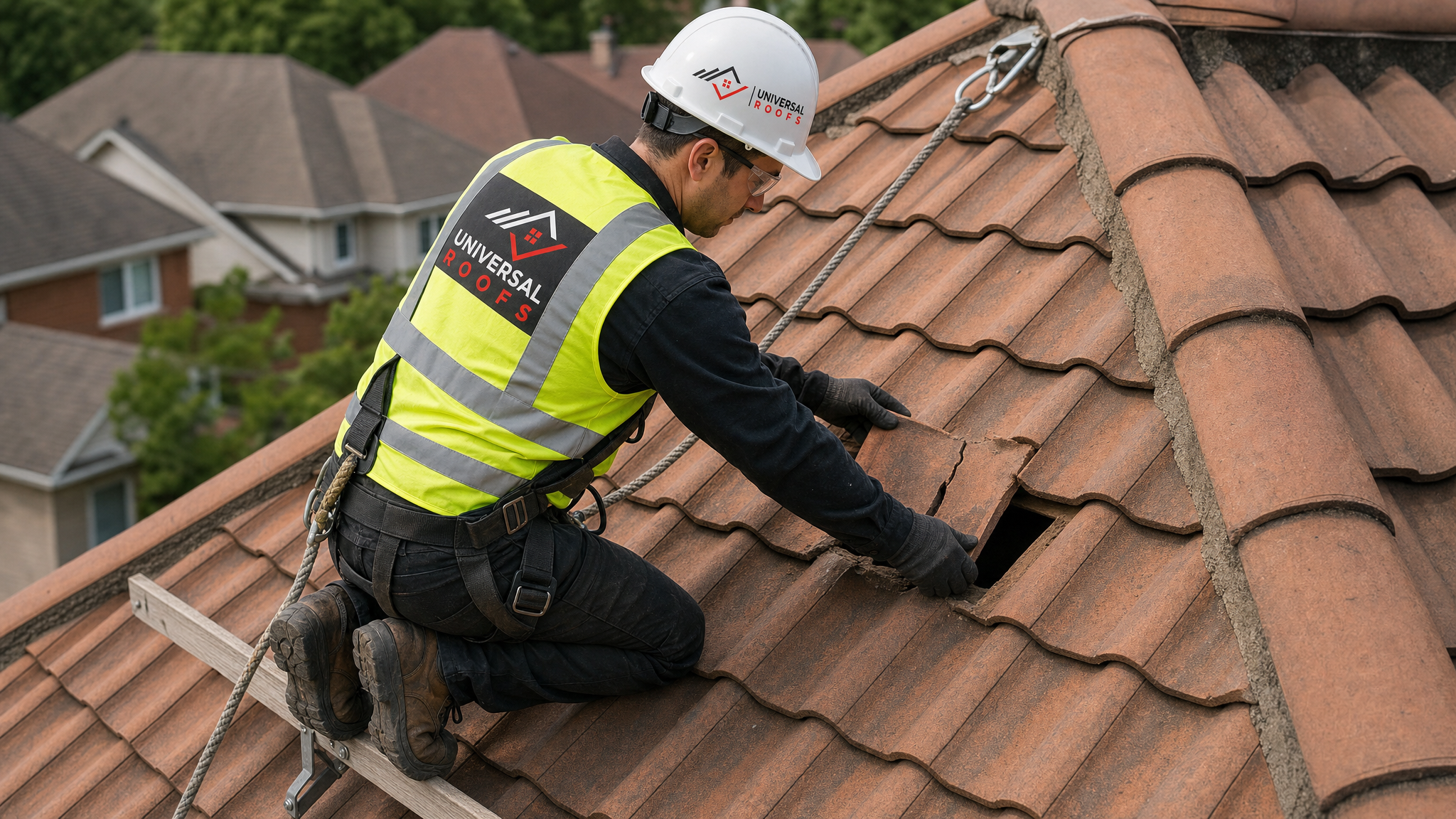
| Safety equipment used | Rarely proper fall protection | Harness, rope, walk boards standard |
Signs You Need a Tile Roof Repair Estimate Soon
Some warning signs are obvious from the ground: a tile that has visibly slipped out of alignment, a crack you can spot with binoculars, or debris in your gutters that looks like ceramic or concrete fragments after a storm. Others are subtler and show up first as a stain on a ceiling, a musty smell in an upstairs closet, or a slightly higher summer cooling bill caused by compromised attic insulation letting conditioned air escape.
Missing or displaced ridge caps are a particularly common issue in the GTA, since wind uplift along the ridge line is often the first place a tile roof shows stress. Homeowners who notice loose mortar crumbling near the ridge, or who can see daylight through gaps at the peak from inside the attic, should treat it as a priority rather than a cosmetic issue, since ridge failures let water travel much further into the roof structure than a single cracked field tile would.
If your home also has a skylight integrated into the tile roof, pay close attention to the flashing where the tile meets the skylight frame — this junction is one of the most common leak points on any tiled roof, tile or otherwise, and repairs here often get bundled with general tile work since both require careful flashing detail. In some cases, an aging skylight unit itself is the true source of a leak that looks like a tile problem; a skylight replacement assessment can rule this out before you pay for tile repairs that would not have solved the leak anyway.
How Roof Design and Region Affect Repair Estimates Across the GTA
Tile roofing is more common in certain pockets of the Greater Toronto Area than others, often tied to home age, architectural style, and municipality. Estimating the cost of tile roof repairs in Toronto itself often means dealing with older, established neighbourhoods where tile profiles from decades past are harder to match, while newer subdivisions in Peel Region and York Region are more likely to have concrete tile in still-available profiles.
Homes in Halton Region and Durham Region often feature larger roof footprints and steeper architectural rooflines on custom-built homes, which affects staging and access costs even when the tile material itself is common. Regardless of region, the same core principle holds: an estimate is only as accurate as the inspection behind it, and remote or drive-by quotes tend to under- or over-shoot the real number once a crew is actually on the roof.
How to Get the Most Accurate Estimate for Your Tile Roof
The single best way to protect yourself from cost surprises is to insist on a physical roof inspection, not just a phone consultation, before agreeing to a price. Ask the contractor to photograph the specific tiles or areas of concern and to explain, in writing, what would change the price if hidden damage is found once they start work — this keeps a “final” quote from ballooning after the job has already begun.
It is also worth asking directly whether replacement tiles are readily available in your roof’s exact colour and profile, since this is the variable most likely to move your number significantly. A contractor who has done tile work across the GTA for years, rather than one who occasionally takes on a tile job between asphalt shingle projects, is more likely to have existing supplier relationships that keep sourcing costs down.
Finally, compare more than the bottom-line number. Ask what warranty is offered, whether the crew carries proper fall-protection equipment for tile work specifically (tile roofs require different footing techniques than asphalt shingles), and whether the estimate separates labour from materials so you can see where your money is actually going.
Questions to Ask Before Approving a Tile Roof Repair Quote
Before signing off on any estimate, homeowners should ask enough questions to understand exactly what they are paying for. This is especially important with tile roofing, where the gap between a mediocre repair and an excellent one is often invisible until a few winters have passed and the mediocre repair starts leaking again.
Reasonable questions include: How many tiles, specifically, will be replaced, and where are they sourced from? Will the underlayment be inspected, and is that inspection included in this price or billed separately if access is needed? What is the workmanship warranty, and does it cover leaks specifically or just tile breakage? Is the quote a fixed price or an estimate subject to change once work begins? A contractor who answers these clearly and in writing is generally more trustworthy than one who resists specifics.
It’s also reasonable to check a company’s track record. Reading through reviews from other GTA homeowners, or reviewing a company’s FAQ page and about page for how long they have serviced the region, gives useful context before you commit to a repair that may run into the thousands of dollars.
Common Estimate Mistakes That Cost Homeowners Money
Several recurring mistakes inflate the final bill on tile roof repairs beyond what was necessary. The first is delaying repair after noticing a cracked tile, which allows water infiltration to spread to underlayment and decking — turning a $400 tile swap into a $2,500 structural repair. The second is accepting a quote based only on street-level or drone photos without an on-roof inspection, which frequently misses hairline cracks, deteriorated mortar, or displaced tiles that are only visible up close.
The third mistake is choosing the lowest bid without checking whether it includes proper tile sourcing and matching. A rock-bottom quote that uses mismatched tiles from a different manufacturer may save money upfront but can reduce curb appeal and resale value, and mismatched tiles sometimes perform differently in freeze-thaw cycles, leading to repeat repairs sooner than expected. Finally, some homeowners skip asking about warranty coverage entirely, only to discover that a “repair” without a workmanship guarantee leaves them fully exposed if the same leak returns within a year.
| Mistake | Short-Term Saving | Long-Term Cost |
|---|---|---|
| Delaying repair after first crack noticed | $0 | +$1,500 to +$3,000 in decking damage |
| Skipping on-roof inspection | Faster quote | Underestimated scope, change orders mid-job |
| Choosing lowest bid without tile matching check | 10-20% lower quote | Reduced curb appeal, possible repeat repair |
| No warranty on workmanship | Marginal savings | Full cost of repeat repair if leak returns |
What is the average cost of estimating the cost of tile roof repairs in Toronto?
Why do estimates for tile roof repairs vary so much between contractors?
Can I get an accurate tile roof repair estimate without an in-person inspection?
Does the season affect the cost of tile roof repairs?
Is it cheaper to repair a tile roof myself instead of hiring a professional?
What should a written tile roof repair estimate include?
Need Help With Estimating the Cost of?
Getting a clear, accurate estimate starts with a proper on-roof inspection from a team that has worked on tile roofs across the region for years. Universal Roofs has been assessing and repairing tile, shingle, and flat roofs throughout the GTA since 2005, and we know exactly what drives cost on a tile repair before we ever hand you a number.
Call us today at (416) 732-2421 or request a free inspection to get started.
Universal Roofs proudly serves Toronto, Mississauga, Brampton, Vaughan, Markham, Oakville and the GTA since 2005.