
Every winter, GTA homeowners reach for whatever will melt the ice fastest — usually a bag of rock salt or calcium chloride pellets scattered across the roof edge, gutters, and walkways. It works, but it comes with a cost that is easy to overlook in February and obvious by May: corroded flashing, dead perennials along the foundation, salt-stained concrete, and runoff that eventually reaches storm drains, creeks, and Lake Ontario. Finding genuinely environmentally friendly snow removal solutions for your roof means rethinking both the tools and the chemistry, not just swapping one de-icer for a “greener” version of the same idea.
This guide covers the full range of low-impact and non-toxic approaches to clearing snow and ice from a residential roof — from mechanical tools that need no chemicals at all, to biodegradable melt products, to structural and behavioural changes that reduce how often removal is needed in the first place. We will also flag which methods homeowners can safely do themselves and which belong with a trained crew.
It is July as you read this, which is exactly the right time to plan. Salt damage, plant loss, and gutter corrosion from last winter are already visible now, and any structural fixes — insulation upgrades, snow guards, drainage corrections — are far easier to schedule and install in warm weather than in the middle of a storm. If your roof needed an eco-conscious approach last winter and did not get one, this is the season to change that before the snow returns.
Why Conventional Snow Removal Methods Harm More Than Just Your Lawn
Rock salt (sodium chloride) is cheap and effective, which is exactly why it is overused. Once it dissolves, it does not disappear — it runs off the roof and eavestroughs, seeps into soil around the foundation, and eventually reaches municipal storm sewers untreated. Environment and Climate Change Canada has flagged road salt as a substance of concern for freshwater ecosystems for years, and the same chloride ions that damage rivers and wetlands damage your property on a smaller scale: metal flashing corrodes faster, aluminum eavestroughs pit and discolour, and any evergreen shrubs or perennials near the drip line absorb enough salt spray to brown out by spring.
On the roof itself, the damage is often structural rather than cosmetic. Chloride-based de-icers accelerate corrosion on galvanized fasteners, drip edge, and any exposed metal flashing around chimneys, vents, and skylights. Over several winters, that corrosion can compromise the very flashing that is supposed to keep water out — turning a snow-removal shortcut into a future roof repair bill. Choosing environmentally friendly snow removal solutions for your roof is not just an ethical preference; it protects the building materials as much as it protects the soil.
Mechanical Removal: The Most Environmentally Friendly Option by Default
The single most eco-friendly snow removal method is the one that uses no chemicals whatsoever — physically moving the snow before it has a chance to compact into ice. Mechanical methods have zero runoff impact and, done correctly, cause no damage to roofing materials either.
- Roof rakes — long-handled aluminum or plastic tools that pull snow off the lower metre or two of a sloped roof from ground level. This is the safest and most sustainable tool a homeowner can own, and it needs nothing but physical effort.
- Soft-bristle roof brooms — useful for light, dry snow on metal or steep-slope roofs where a rake’s edge risks catching a seam.
- Plastic or rubber-edged shovels — the standard for flat and low-slope roof sections, since metal blades gouge membranes and speed up wear.
- Snow rope and cable systems — two operators on ladders draw a rope back and forth across the roof to shear through packed snow in sections, a technique that clears long roof runs quickly without a single chemical involved.
The tradeoff is timing and labour. Mechanical removal has to happen before snow compacts into ice, which usually means within a day or two of a heavy snowfall. Once an ice dam has already formed along the eaves, mechanical tools alone are rarely enough, and this is where the choice of de-icing product becomes the real environmental decision.
Biodegradable and Low-Toxicity Ice Melt Products
When mechanical removal is not enough on its own — typically once an ice dam has started to form — the product used to melt it matters. Not all ice melts are equal, and “eco-friendly” labelling on bagged de-icers is not regulated, so it pays to know what is actually in the bag.
| De-Icing Product | Environmental Impact | Effective Temperature | Roof Safety |
|---|---|---|---|
| Rock salt (sodium chloride) | High — corrosive runoff, plant and soil damage | Down to -9°C | Corrodes flashing and fasteners; avoid on roofs |
| Calcium chloride | Moderate — still chloride-based, but effective in smaller quantities | Down to -25°C | Safer than rock salt; still a chloride, use sparingly |
| Calcium magnesium acetate (CMA) | Low — biodegradable, minimal aquatic toxicity | Down to -7°C | Gentle on metal flashing and shingles |
| Potassium acetate / urea-based blends | Low to moderate — biodegrades, some nitrogen loading in runoff | Down to -15°C | Non-corrosive; commonly used at airports for this reason |
| Sand or non-clumping cat litter | Very low — no chemical runoff, provides traction only | No melting effect | Safe for any roof surface; use for traction on walkways only |
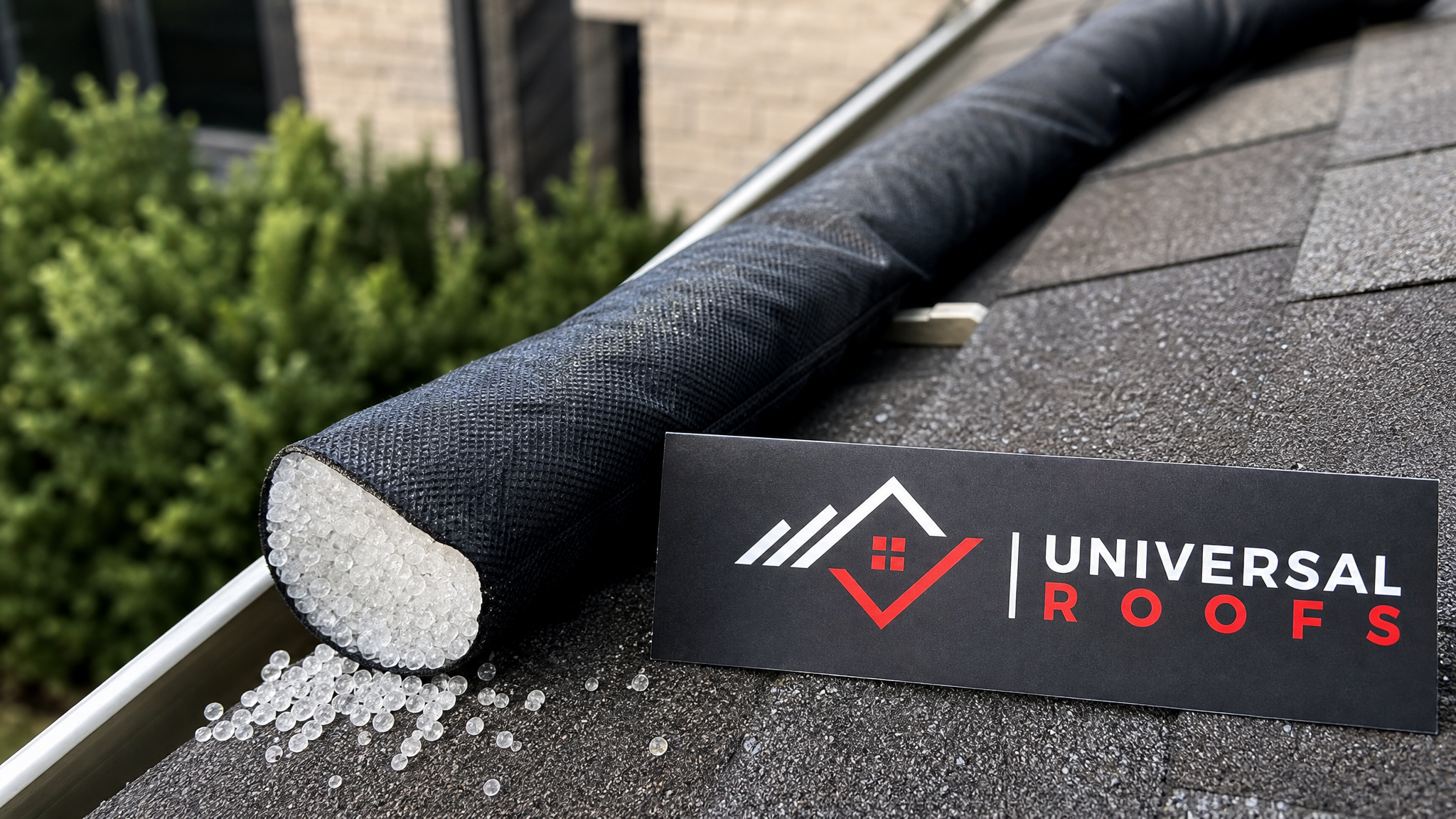
For actual roof use, calcium magnesium acetate (CMA) and potassium-acetate-based products are the two categories worth stocking. Both are sold as ice-melt socks or granular products specifically marketed as roof-safe, biodegradable de-icers. They cost more per bag than rock salt, but because a roof only needs to clear a channel through an ice dam — not de-ice an entire driveway — the quantity needed is small enough that the price difference rarely matters.
Steam and Hot Water: Zero-Chemical Ice Dam Removal
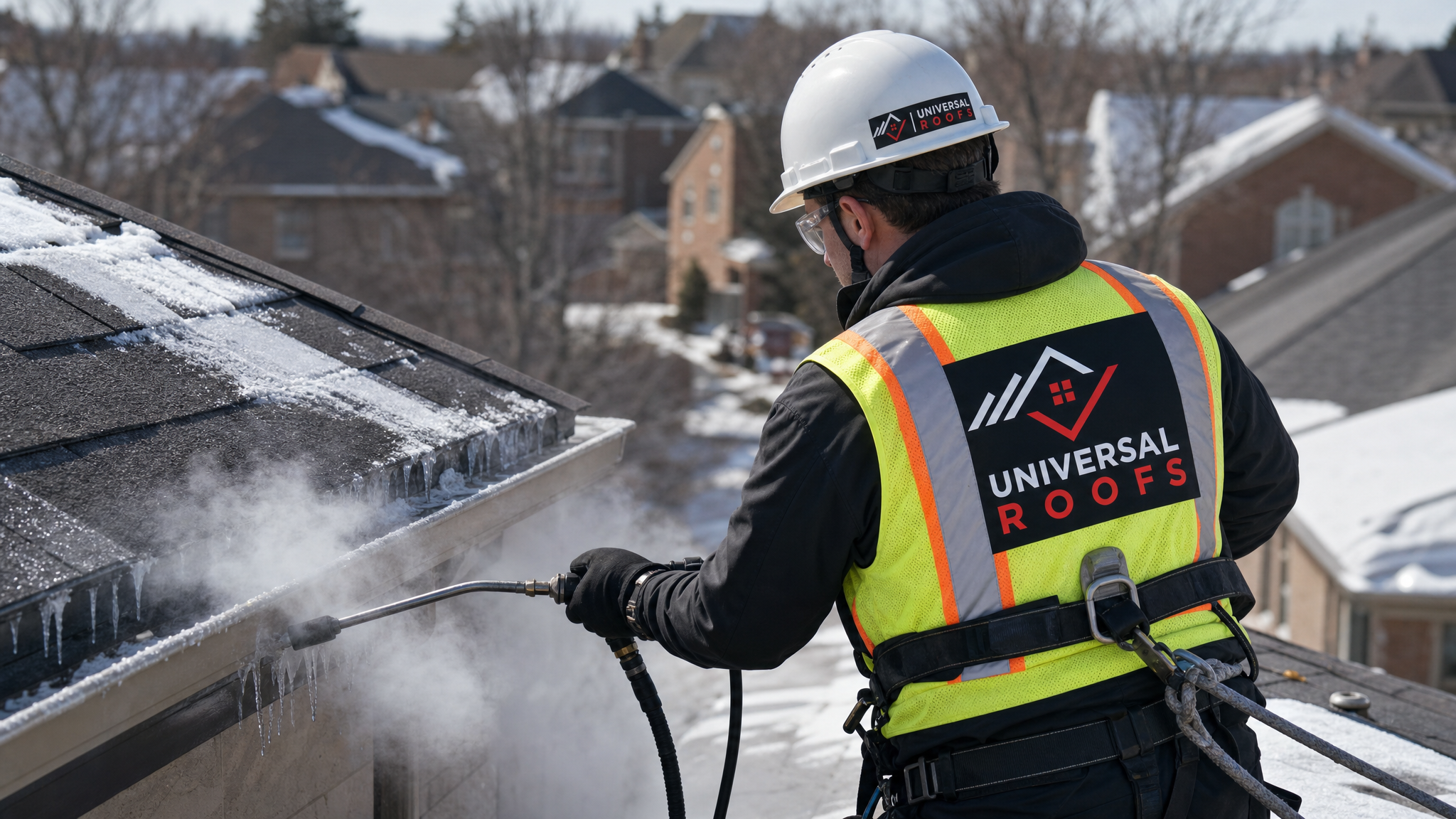
The most environmentally sound way to remove an established ice dam is to skip chemicals entirely and use heat. Low-pressure steam or hot water systems melt through packed ice from the outside in, creating drainage channels without introducing any de-icing compound to the roof, gutters, or soil below.
This is specialized professional equipment — the machines regulate water temperature and pressure carefully enough to melt ice without softening asphalt shingle granules or scalding a membrane roof. It is also, by a wide margin, the safest method for the roofing material itself, since there is no chipping, no chemical exposure, and no residue left behind once the ice is gone. Homeowners should not attempt this with a household pressure washer or a garden hose and hot tap water; the equipment used by trained crews is purpose-built to avoid uneven heating that can crack shingles or warp flashing.
Preventing Ice Dams Reduces the Need for Any Removal Method
The greenest snow removal solution is the one you never have to perform, because the underlying cause of most ice damming — heat escaping through a poorly insulated or poorly ventilated attic — is preventable. When warm air leaks into the attic space, it melts the underside of the snowpack even in freezing outdoor temperatures. That meltwater runs down to the cold eaves, refreezes, and forms the dam that eventually forces water back under the shingles.
Addressing this at the source means less roof-top intervention every winter, which in turn means less salt, less steam equipment, and less wear on the roofing material overall:
- Air-seal and insulate the attic floor so conditioned air from living spaces stops migrating upward. This is usually the single highest-impact fix.
- Ensure balanced soffit-to-ridge ventilation so any residual heat that does reach the attic is vented outside rather than warming the roof deck from below.
- Seal bypasses around pot lights, bathroom fans, and attic hatches, which are common, overlooked sources of warm air leakage.
- Inspect and upgrade flashing around skylights and vents, since gaps here both leak heat and are common points where meltwater finds its way inside.
A poorly ventilated attic will keep generating ice-dam conditions no matter how diligently you clear snow off the roof surface, so this step is not optional if the goal is to genuinely reduce environmental impact and repair costs together. Homeowners weighing options between patch fixes and a full roof replacement often find that addressing attic insulation and ventilation during a replacement project solves the ice-dam problem permanently, rather than requiring a new de-icing routine every year.
Snow Guards: A One-Time, Chemical-Free Investment
Snow guards are small mechanical devices installed across a metal or steep-slope roof to break large sheets of snow into smaller sections that melt and shed gradually, rather than releasing all at once in a dangerous avalanche off the eave. They involve no chemicals, no annual product purchases, and no ongoing environmental footprint beyond the one-time manufacturing and installation.
For homeowners specifically prioritizing sustainability, snow guards are one of the best returns on investment on this list: a single installation, done once, reduces both the frequency of active snow removal and the risk of sudden snow-slide damage to eavestroughs, decks, or anyone standing below. They are most effective on metal roofing, where snow tends to release in large sheets rather than melting gradually the way it does on asphalt shingles.
Eco-Conscious De-Icing Cables: Using Less Energy, Not More
Electric heat cables installed along the eaves and inside gutters get a mixed environmental reputation, and fairly so — they draw continuous electricity through the coldest months. But for a roof with a chronic, structural ice-dam problem that insulation upgrades alone have not solved, modern thermostatically controlled cables use meaningfully less energy than older always-on models, cycling only when temperature and moisture sensors detect actual freeze-thaw conditions rather than running the entire winter.
From a strictly environmental standpoint, heat cables should be a secondary measure behind attic air-sealing and insulation, not a first response. But paired with proper ventilation, a smart-controlled cable system uses a fraction of the electricity of an older model and avoids chemical de-icers entirely, which for many homeowners is the more sustainable tradeoff.
| Method | Chemical Use | Best Applied | Typical Cost Range (CAD) |
|---|---|---|---|
| Roof rake / broom | None | Fresh snow before it compacts | $40–$100 (tool purchase) |
| Snow rope/cable clearing | None | Long sloped roof runs | $200–$500 per visit |
| Steam/hot water de-icing | None | Established ice dams | $400–$900 per visit |
| CMA or potassium acetate melt | Biodegradable, low toxicity | Small, localized ice dams | $25–$70 (materials) |
| Snow guards | None | Metal/steep roofs, prevent slides | $500–$2,000 (one-time) |
| Thermostatic heat cables | None (electricity only) | Chronic ice-dam roofs | $600–$1,800 (one-time) |
| Attic insulation/ventilation upgrade | None | Root-cause prevention, any roof | $1,200–$4,000 (one-time) |
What to Avoid: Common Snow Removal Habits That Aren’t Actually Green
A few widely repeated pieces of winter advice do more environmental and structural harm than good, and are worth ruling out explicitly:
- Rock salt on the roof or gutters. It is the most corrosive and least biodegradable common option, and the runoff travels directly into soil and storm drains from the roofline.
- Chipping or hacking at ice with an axe, hammer, or ice pick. This causes cracked shingles and torn underlayment, turning a maintenance task into a repair project, with no environmental upside to offset the damage.
- Pouring hot tap water on an ice dam. Without proper heat regulation, this can refreeze instantly in colder sections, making the dam worse, and offers none of the controlled melting that professional steam equipment provides.
- Over-application of “ice melt” pellets “just in case.” Even biodegradable products have a real environmental cost at scale; the goal is the minimum effective amount applied precisely to the problem area, not a blanket application across the whole roof.
- Skipping attic ventilation upgrades because removal “works fine.” Treating the symptom every winter while ignoring the cause guarantees the environmental and financial cost repeats indefinitely.
Flat Roofs and Skylights Need Their Own Eco-Friendly Approach
Flat and low-slope roofs do not shed snow naturally, which means environmentally friendly removal on these surfaces depends almost entirely on mechanical clearing with plastic tools plus functioning drains — chemical de-icers are rarely appropriate on membrane roofing because pooling meltwater carries the product directly toward drains and scuppers rather than diluting into surrounding soil. Keeping drains and scuppers clear before winter, so meltwater has somewhere to go, does more for the environmental footprint of a flat roofing system than any product choice made mid-storm.
Skylights carry a similar consideration. Snow and ice that build up against the upslope edge of a skylight curb should never be treated with de-icing pellets, since runoff and any residue sit directly against the glazing seal and flashing. Mechanical clearing by a trained technician, or a steam-based approach for established ice, is the only environmentally sound option this close to a skylight unit. If snow and ice repeatedly cause staining or drips around an older skylight, it may be a sign the unit’s seals have degraded enough that a skylight replacement is a better long-term answer than a fresh de-icing routine every winter.
Building a Full-Season Environmentally Friendly Snow Removal Plan
The homeowners who see the least roof and landscaping damage over time are the ones who treat environmentally friendly snow removal as a season-long plan rather than a single product choice made during a storm. That plan typically layers several of the methods above:
| Season Stage | Action | Environmental Benefit | Priority |
|---|---|---|---|
| Summer/fall (now) | Attic insulation and ventilation assessment, snow guard installation, drain clearing | Reduces total ice-dam frequency for years, not just one winter | High |
| Early winter (Nov–Dec) | Mechanical clearing with roof rake or broom after each snowfall | Zero chemical use, prevents compaction into ice | Medium |
| Mid-winter (Jan) | Targeted CMA or potassium acetate melt on any forming ice dam | Minimal, biodegradable chemical footprint vs. rock salt | Medium–High |
| Deep winter (Feb) | Professional steam de-icing for established dams | Zero chemical use for the most stubborn ice | High |
| Spring thaw (Mar) | Drain and gutter inspection, soil and plant check for salt damage | Confirms whether runoff caused damage, guides next season’s plan | Medium |
Homes across Toronto, the Peel Region, York Region, Halton Region, and Durham Region all face the same freeze-thaw cycle that drives ice damming, though snowfall totals shift somewhat depending on proximity to Lake Ontario and local microclimates. The environmentally friendly methods above apply regardless of which part of the GTA a home sits in — only the number of times per winter they are needed tends to change.
Questions to Ask a Roofing Contractor About Eco-Friendly Snow Removal
Not every company that offers winter roof services asks about environmental impact, and it is a fair question to raise directly. Before hiring anyone for snow or ice removal, it is reasonable to ask:
- Do you use rock salt, or exclusively biodegradable, roof-safe de-icing products?
- Can you perform steam or hot-water de-icing as a chemical-free alternative for established ice dams?
- Will your crew use plastic or rubber-edged tools rather than metal shovels or ice picks?
- Do you offer an attic insulation and ventilation assessment as part of a long-term ice-dam prevention plan?
- Can you recommend snow guards or heat cables suited to my specific roof type, rather than a one-size-fits-all product?
A contractor who has a clear, specific answer to each of these is one worth trusting with both your roof and your landscaping. Checking recent reviews from homeowners in your area, and reviewing a company’s FAQ page for how they handle winter service calls, are both quick ways to confirm a track record before a storm forces a rushed decision. You can also learn more about our team and how long we have been serving the GTA before booking an assessment.
What are the most environmentally friendly snow removal solutions for your roof?
Is rock salt bad for my roof and gutters?
Can I remove roof snow without using any chemicals at all?
What is the best biodegradable ice melt for a roof?
Does preventing ice dams reduce the environmental impact of snow removal?
Are snow guards a sustainable alternative to chemical snow removal?
Need Help With Environmentally Friendly Snow Removal?
Whether you want to move away from rock salt for good, are dealing with an ice dam that formed last winter, or are planning attic insulation upgrades before the next snowfall season, the team at Universal Roofs has helped GTA homeowners manage snow and ice sustainably since 2005.
Call us today at (416) 732-2421 or request a free inspection to get started.
Universal Roofs proudly serves Toronto, Mississauga, Brampton, Vaughan, Markham, Oakville and the GTA since 2005.