
Most homeowners assume a shingle roof fails because the shingles themselves were low quality or simply reached old age. In reality, one of the biggest factors in premature asphalt shingle failure has nothing to do with the shingles at all — it is what is happening underneath them, in the attic. How roof ventilation affects shingle longevity is one of the most misunderstood relationships in residential roofing, and it is especially important in Toronto and the surrounding GTA, where hot, humid summers and brutal freeze-thaw winters put roofing systems through extreme stress every single year.
An attic that cannot properly exhaust heat and moisture turns your shingles into a slow-cooking oven in July and a condensation trap in January. Both conditions accelerate the breakdown of the asphalt, granules, and underlying decking, shaving years off a roof that should have lasted two or three decades. Manufacturers know this so well that most shingle warranties are explicitly conditional on proper attic ventilation being installed and maintained.
In this guide, we will break down exactly how roof ventilation affects shingle longevity, what proper intake and exhaust balance looks like, how to recognize the warning signs of a poorly ventilated attic, and what it costs to fix. Whether you are troubleshooting a roof that is aging faster than it should or planning a new roof replacement, understanding ventilation is essential to protecting your investment.
Why Attic Ventilation Matters More Than Most Homeowners Realize
Asphalt shingles are engineered to handle direct sun, rain, wind, and snow load from above. What they are not designed to handle well is sustained, trapped heat radiating up from below. When an attic lacks adequate airflow, hot air has nowhere to go. On a 30-degree Celsius July afternoon in Toronto, an unventilated attic can easily reach 60 to 70 degrees Celsius. That heat soaks upward directly into the underside of the shingles and the roof deck, cooking the asphalt from beneath at the same time the sun is baking it from above.
This double exposure accelerates a process called thermal degradation. Asphalt shingles contain oils that keep the material flexible and bonded to its mineral granules. Excess heat causes these oils to evaporate faster than they should, leaving the shingle brittle, prone to cracking, and more likely to shed its protective granules. Once granule loss begins, UV rays attack the asphalt mat directly, and the shingle’s remaining lifespan drops sharply.
Ventilation problems don’t just shorten lifespan in the summer. In winter, an under-ventilated attic traps warm, moist air from the living space below. That warm air rises into a cold attic, condenses on the underside of the roof deck, and can lead to wood rot, mould growth, and — critically for Toronto homeowners — ice damming along the eaves. Ice dams force water backward under the shingles, which can cause leaks, staining, and structural damage that has nothing to do with the age or quality of the shingles themselves.
The Two Halves of a Healthy Ventilation System
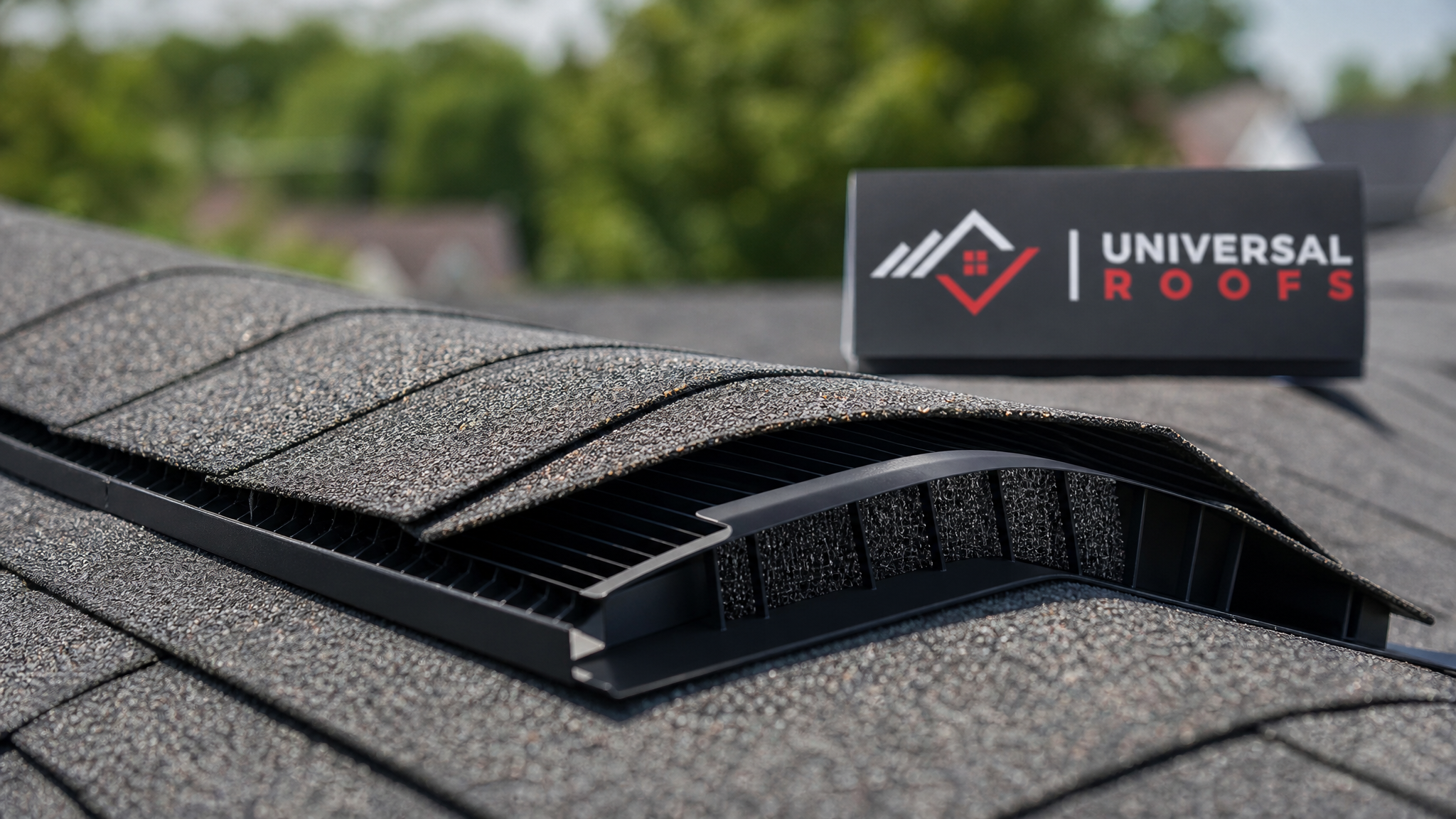
Proper attic ventilation depends on a balanced system of intake and exhaust. Intake vents, typically installed in the soffits under the eaves, draw cooler outside air into the lowest part of the attic. Exhaust vents, usually along the ridge or in the upper gable areas, allow that warmed air to escape. This creates continuous, passive airflow that pulls fresh air in low and pushes hot, moist air out high — no fans or electricity required in most residential setups.
The Canadian Roofing Contractors Association and shingle manufacturers alike recommend a general rule of 1 square foot of net free ventilation area for every 300 square feet of attic floor space, split roughly 50/50 between intake and exhaust. Getting this ratio wrong — even with a large amount of total venting — can actually make things worse. Too much exhaust relative to intake, for example, can pull conditioned air from the living space through ceiling penetrations, wasting energy and pulling in humid indoor air that then condenses in the attic.
| Ventilation Component | Location | Function | Typical Issue Found |
|---|---|---|---|
| Soffit vents | Underside of roof eaves | Intake — draws in cool outside air | Blocked by insulation or paint |
| Ridge vent | Peak of the roof | Exhaust — continuous passive airflow out | Missing baffle or crushed under shingles |
| Gable vents | Triangular wall sections at roof ends | Exhaust (or intake, depending on design) | Fighting against ridge vent, short-circuiting airflow |
| Box/turtle vents | Scattered across roof slope | Exhaust — localized venting | Too few units for attic size |
| Power/attic fans | Mounted on roof or gable | Active exhaust, mechanically driven | Pulling conditioned air instead of attic air |
How Excess Heat Directly Shortens Shingle Life
Shingle manufacturers test and rate their products assuming a reasonably ventilated attic space beneath them. When that assumption fails, the real-world performance of the shingle falls well short of its rated lifespan. A 30-year shingle installed over a poorly vented attic in the GTA can realistically start showing granule loss, curling, and blistering within 12 to 15 years — sometimes sooner on south and west-facing slopes that already receive the most direct summer sun.
Heat damage tends to show up in a few recognizable patterns. Blistering occurs when trapped moisture or gas within the shingle expands under heat and pushes bubbles up through the surface, which then pop and expose bare asphalt. Curling happens when the shingle’s edges dry out and shrink faster than the centre, lifting the corners and making them vulnerable to wind uplift. Accelerated granule loss leaves bald patches that show up as dark, shiny streaks on the roof surface and in the gutters as ground-up grit. All three are hallmark signs that heat, not just age, is driving the deterioration.
How Trapped Moisture Compounds the Damage
While heat degrades shingles from prolonged sun exposure, moisture attacks from the structural side. Every household generates water vapour — from showers, cooking, laundry, and even breathing — and a portion of it always finds its way into the attic through recessed lighting, bathroom fans vented into the attic instead of outside, and small gaps around plumbing stacks. In a properly ventilated attic, that moisture is carried outside before it can condense. In a poorly ventilated one, it settles on the cold underside of the roof deck.
Over a Toronto winter, this condensation cycle repeats night after night. The moisture soaks into the plywood or OSB roof sheathing, causing it to swell, delaminate, and eventually rot. Once the deck beneath a shingle is no longer flat and rigid, the shingle above it loses proper support and adhesion, making it far more likely to crack, lift, or blow off in high winds. This is one of the most common reasons a roof that “should” have another decade of life suddenly needs full replacement — the shingles were fine, but the deck underneath failed first.
Ice Dams: A Uniquely GTA Ventilation Problem
Ice damming deserves special attention for anyone in the Greater Toronto Area, because our winters are almost perfectly designed to create them. An ice dam forms when heat escaping from a poorly insulated or poorly ventilated attic warms the roof deck enough to melt the snow sitting directly above it. That meltwater runs down the roof slope until it reaches the unheated overhang past the exterior wall, where it refreezes into a ridge of ice. Successive melt-refreeze cycles build the dam higher, eventually backing up water under the shingles.
Ice dams are frequently misdiagnosed as a shingle problem when the shingles are simply the final victim of a ventilation and insulation issue. Water forced backward under shingles bypasses the shingle’s designed water-shedding overlap entirely, soaking into the underlayment and deck, staining ceilings, and causing insulation to compress and lose R-value once wet. Balanced soffit-to-ridge airflow, combined with adequate attic insulation, keeps the roof deck at a consistent cold temperature that matches the outside air, preventing the uneven melting that starts the whole cycle.
Signs Your Attic Ventilation Is Hurting Your Shingles
Because ventilation problems build slowly, many homeowners do not notice anything is wrong until the shingles are already visibly failing. Watch for these warning signs, ideally checked twice a year:
- Attic feels noticeably hotter than outdoor temperature on a summer afternoon
- Frost or condensation visible on the underside of the roof deck or nails in winter
- Musty odour or visible mould/mildew on rafters, sheathing, or insulation
- Granules collecting in gutters and at downspout outlets faster than expected
- Shingles curling at the edges or showing shiny, bald patches
- Icicles and ice ridges forming consistently along the same section of eave every winter
- Uneven snow melt pattern on the roof — patchy melting instead of a uniform blanket
If you notice any combination of these, it is worth having a professional inspect both the shingles and the attic ventilation system together, since treating one without the other rarely solves the underlying problem. Our roof repair team frequently finds that a “shingle problem” homeowners called in about is actually a ventilation imbalance that has been quietly damaging the roof for years.
How Much Ventilation Issues Cost to Fix
The good news is that correcting ventilation problems is almost always far less expensive than the premature roof replacement it prevents. Costs vary depending on attic size, roof complexity, and how much soffit or decking repair is needed, but the table below gives realistic GTA pricing ranges as of 2026.
| Ventilation Fix | Typical GTA Cost Range | Time to Complete | Notes |
|---|---|---|---|
| Clearing blocked soffit vents | $150 – $400 | Half day | Often solves airflow issues alone |
| Adding ridge vent (retrofitted) | $500 – $1,200 | 1 day | Requires cutting deck slot along ridge |
| Installing additional box/turtle vents | $300 – $700 per vent | Half day | Used when ridge venting isn’t feasible |
| Attic baffle installation | $400 – $900 | 1 day | Keeps insulation from blocking soffit intake |
| Rotted deck section replacement | $800 – $2,500+ | 1–2 days | Needed if moisture damage has already occurred |
| Full ventilation system redesign | $1,500 – $4,000 | 1–3 days | Recommended after multiple failed spot fixes |
Ventilation and Your Shingle Warranty
One detail that catches many homeowners off guard is that most major shingle manufacturers include ventilation clauses in their warranty terms. Warranties are typically written and tested under the assumption that the attic beneath the shingles meets minimum ventilation standards. If a manufacturer’s inspector determines that inadequate or absent ventilation contributed to premature blistering, curling, or granule loss, a claim can be reduced or denied entirely — even on shingles that are otherwise well within their rated lifespan.
This is one of the most overlooked reasons to have ventilation assessed at the same time as any new roof installation, rather than treating it as an optional add-on. When we complete a roof replacement, calculating and balancing intake and exhaust ventilation for the specific attic is a standard part of the process, not an upsell — because it directly protects both the shingle warranty and the underlying roof deck.
Special Considerations for Complex or Low-Slope Roofs
Standard soffit-to-ridge ventilation works well on straightforward gable and hip roofs, but many GTA homes have additions, dormers, cathedral ceilings, or sections of flat roofing that complicate the airflow path. Cathedral ceilings with no true attic space require continuous air channels built into the rafter bays themselves, since there is no open attic volume to circulate air through. Low-slope and flat roof sections need a different ventilation strategy altogether, often relying on strategically placed vents rather than a continuous ridge-to-soffit path.
Homes with skylights add another layer of complexity, since poorly flashed or poorly insulated skylight shafts can create localized condensation and heat pockets that mimic ventilation problems even when the rest of the attic is fine. If your home has skylights installed, it is worth having the surrounding insulation and any light shaft venting checked as part of a broader ventilation assessment, and older units may benefit from a skylight replacement with better-sealed, better-insulated framing.
Balancing Ventilation With Attic Insulation
Ventilation and insulation work as a team, not as substitutes for each other. Insulation’s job is to keep conditioned indoor heat from escaping into the attic in the first place, while ventilation’s job is to remove whatever heat and moisture does make it up there. A well-insulated attic with poor ventilation will still overheat in summer sun and can still trap moisture from minor air leaks. A well-ventilated attic with poor insulation wastes energy and still allows enough heat transfer to contribute to ice damming at the eaves.
Getting both right typically means confirming insulation meets current recommended R-values for the GTA climate zone, ensuring insulation is not stuffed into the soffit area in a way that blocks intake airflow (a very common issue we find during attic inspections), and confirming baffles are installed to maintain a clear air channel from soffit to ridge even where insulation is thick.
| Symptom Observed | Likely Cause | Recommended Fix | Urgency |
|---|---|---|---|
| Shingles curling only on south/west slopes | Localized heat buildup, insufficient exhaust | Add ridge or box vents on affected slope | Moderate — address before next summer |
| Frost on nail tips visible in attic | Warm moist air reaching cold deck | Improve air sealing + confirm exhaust venting | High — active moisture damage risk |
| Consistent ice dam at one section of eave | Heat loss or blocked soffit in that bay | Clear soffit, check insulation depth locally | High — recurring water intrusion risk |
| Granules filling gutters within 5–8 years | Sustained attic overheating | Full ventilation balance assessment | High — shingle lifespan actively shortening |
| Musty smell only in summer | Trapped humidity with poor air exchange | Add continuous ridge or gable exhaust | Moderate — monitor and address seasonally |
What a Proper Ventilation Assessment Involves
A thorough assessment starts inside the attic, not on the roof. A technician measures the attic floor area to calculate the required net free ventilation area, then physically inspects existing soffit, ridge, gable, and box vents to confirm they are clear, correctly sized, and not fighting against each other. Insulation is checked to ensure it has not migrated into or been installed over soffit intake points, which is one of the single most common ventilation failures found in GTA attics, especially in homes that have had insulation top-ups added over the years without anyone checking the soffit baffles first.
From the exterior, the roof slope, ridge line, and existing vent hardware are inspected for damage, blockage, or incorrect installation — a surprisingly common issue with ridge vents that were partially covered by shingles during a rushed installation. Combined, the interior and exterior findings determine whether the fix is as simple as clearing existing vents or requires adding new exhaust or intake capacity.
Protecting a New Roof From Day One
If you are planning a re-roof, the best time to correct ventilation issues is during that project, not years afterward. Removing the old shingles gives full access to the deck and any existing vent penetrations, making it far cheaper to add or correct ridge and soffit venting than retrofitting later through a finished roof. It also ensures the new shingles are protected by proper airflow from their very first day in service, rather than starting their service life fighting the same heat and moisture problems that shortened the previous roof’s lifespan.
Homeowners across Toronto, the Peel Region, York Region, Halton Region, and Durham Region all deal with the same freeze-thaw winters and humid summers, so this is not a niche concern limited to one type of house — it applies to nearly every asphalt shingle roof in the GTA, regardless of age or slope.
How does roof ventilation affect shingle longevity in a typical Toronto home?
Can poor attic ventilation void my shingle warranty?
What is the correct ratio of intake to exhaust ventilation?
How do I know if my attic ventilation is causing ice dams?
Does adding more roof vents always improve shingle longevity?
Is it worth fixing ventilation on an older roof instead of waiting for replacement?
Need Help With How Roof Ventilation Affects?
If your shingles are ageing faster than expected, ventilation is one of the first things worth ruling out before assuming the worst. Universal Roofs has been assessing and correcting attic ventilation issues across the GTA since 2005, helping homeowners protect their roofs and their warranties.
Call us today at (416) 732-2421 or request a free inspection to get started.
Universal Roofs proudly serves Toronto, Mississauga, Brampton, Vaughan, Markham, Oakville and the GTA since 2005.