
Every winter, Toronto and the surrounding GTA cycle through freeze-thaw swings that turn a beautiful metal roof into a battleground of ice, meltwater, and trapped moisture. Metal roofing is prized for its longevity and its ability to shed snow, but that same slick surface can create dangerous ice dams when heat loss, poor ventilation, and freezing temperatures collide at the eaves. The result is water backing up under panels, staining ceilings, and soffits dripping icicles the size of baseball bats.
Preventing and repairing metal roof ice dams is one of the most common concerns homeowners bring to us each season, and it is also one of the most misunderstood. Many people assume a metal roof is immune to ice dams because snow slides off so easily. In practice, metal roofs form dams differently than asphalt shingle roofs, and the fixes require a slightly different playbook. This guide walks through why metal roof ice dams form, how to stop them before they start, what to do when one has already caused damage, and when it makes sense to call in a professional roofing team.
We have inspected and repaired hundreds of ice-damaged roofs across Toronto, Mississauga, Brampton, Vaughan, Markham, Oakville, and the wider GTA, and the patterns repeat themselves year after year. With the right combination of insulation, ventilation, and eave protection, most metal roof ice dam problems are entirely preventable.
What Causes Ice Dams on a Metal Roof
An ice dam forms when heat escaping from the attic warms the underside of the roof deck enough to melt the snow sitting on top of it. That meltwater runs down the slope until it reaches the cold overhang past the exterior wall, where there is no heat loss from below. There, it refreezes into a ridge of ice. Snow and water continue to pool behind that ridge, and eventually the trapped water finds a way in, under panels, through fastener holes, or along seams that were never designed to hold standing water.
On a metal roof, this cycle is often driven less by the roofing material itself and more by what is happening in the attic below it. Poor insulation, gaps around bathroom fans and pot lights, inadequate soffit and ridge ventilation, and warm air leaking from living spaces are the real culprits. Metal is an excellent conductor, so uneven attic heat translates quickly to an uneven roof surface temperature, which is exactly the condition that produces ice dams. A well-detailed metal roof with proper insulation and airflow will stay close to outdoor air temperature across its entire surface, which is the single best defence against dam formation.
Toronto’s freeze-thaw pattern makes this worse than in climates with steadier winter temperatures. A week of daytime melting followed by overnight refreeze can build several centimetres of ice at the eave in a matter of days, and each cycle adds another layer.
Why Metal Roofs Behave Differently Than Shingles
Homeowners often ask whether a metal roof is more or less prone to ice dams than an asphalt shingle roof. The honest answer is that metal roofs tend to shed loose snow faster, which reduces the total volume of snow available to melt and refreeze. That is a genuine advantage. However, metal panels are smooth and have far less surface friction than shingles, so when an ice dam does form, meltwater travels faster and can find its way past seams, end laps, and fastener penetrations more easily than it would seep under overlapping shingles.
Standing-seam panels, in particular, rely on tight, weathertight seams rather than gravity and overlap alone. If a dam builds up enough standing water at the eave, hydrostatic pressure can push moisture backward, uphill, against the direction the panels were designed to shed water. This is why eave detailing, underlayment choice, and snow retention design matter even more on a metal roof than they do on a shingled one. If you are weighing roof repair against a full system upgrade, this is often the deciding factor.
| Factor | Asphalt Shingle Roof | Metal Roof |
|---|---|---|
| Snow retention on the surface | High friction, snow lingers longer | Low friction, snow sheds quickly |
| Typical ice dam location | Spread along the eave and valleys | Concentrated at the drip edge and seam ends |
| Water intrusion path | Under shingle tabs and nail holes | Through seams, end laps, and fastener penetrations |
| Sensitivity to attic heat loss | Moderate | High, due to fast heat transfer through metal |
| Best primary defence | Attic insulation plus ice-and-water shield | Attic insulation plus heat cable and sealed seams |
Warning Signs You Already Have an Ice Dam Problem
Some ice dam damage is obvious. A thick ridge of ice hanging off the eave, icicles forming in unusual clusters, or visible water stains on interior ceilings near exterior walls are all clear signals. Other signs are subtler and easy to miss during a quick glance from the driveway.
Look for peeling paint or bubbling on interior wall surfaces just below the roofline, a musty smell in upstairs closets, soffit panels that look swollen or discoloured, and dark streaking on siding below the eave. On a metal roof specifically, watch for panels that seem to be lifting slightly at the seam near the eave, or fasteners that show rust streaks running down the panel face, both of which suggest water has been sitting where it should not.
If you notice any of these signs, it is worth scheduling a full roof and attic inspection rather than waiting for the next storm. Left unaddressed, repeated ice damming can rot roof decking, damage insulation, and create the kind of hidden moisture problems that lead to mould. Our attic inspection service is designed specifically to catch these issues at the source, in the insulation and ventilation layer, before they show up as visible roof damage.
Prevention: Insulation and Ventilation Fixes That Actually Work
The single most effective way to prevent metal roof ice dams is to stop warm air from reaching the underside of the roof deck in the first place. This is fundamentally an attic problem, not a roofing problem, even though the damage shows up on the roof.
Start with air sealing. Gaps around bathroom exhaust fans, recessed pot lights, plumbing stacks, and the attic hatch let warm, moist household air rise directly into the attic space. Sealing these penetrations with fire-rated caulk or foam is inexpensive and often solves fifty percent of the problem on its own.
Next, verify insulation levels. Current Ontario building guidance recommends an attic insulation value in the range of R-60, yet many older GTA homes still have R-20 to R-30 of aging insulation with gaps and compressed spots around the perimeter. Topping up with blown-in cellulose or fibreglass, and making sure insulation does not block soffit vents, restores an even thermal barrier across the whole attic floor.
Finally, confirm balanced ventilation. A healthy attic needs continuous intake at the soffit and continuous exhaust at the ridge, working together to keep the underside of the roof deck at close to outdoor temperature all winter. Baffles at the soffit keep insulation from blocking airflow, and a properly sized ridge vent lets warm air escape before it can warm the metal panels above it.
| Prevention Measure | Typical Cost Range (CAD) | Effectiveness | Best Timing |
|---|---|---|---|
| Air sealing attic penetrations | $300 – $700 | Very high, addresses root cause | Anytime, ideally before fall |
| Topping up attic insulation to R-60 | $1,200 – $3,000 | Very high | Spring through fall |
| Adding or clearing soffit and ridge ventilation | $800 – $2,500 | High | Spring through fall |
| Installing eave heat cable | $600 – $1,800 | Moderate, treats symptom not cause | Before first freeze |
| Upgrading eave flashing and ice-and-water shield | $1,500 – $4,000 | High, especially combined with insulation work | Spring through fall, during re-roofing |
Eave Protection and Snow Retention Systems
Even a well-insulated attic benefits from good eave detailing, because some heat loss and some meltwater are unavoidable in a Canadian winter. A properly installed ice-and-water shield membrane under the metal panels at the eave, extending at least 900 millimetres past the interior wall line, gives water a sealed surface to sit on if a dam does form, rather than a path straight into the roof deck.
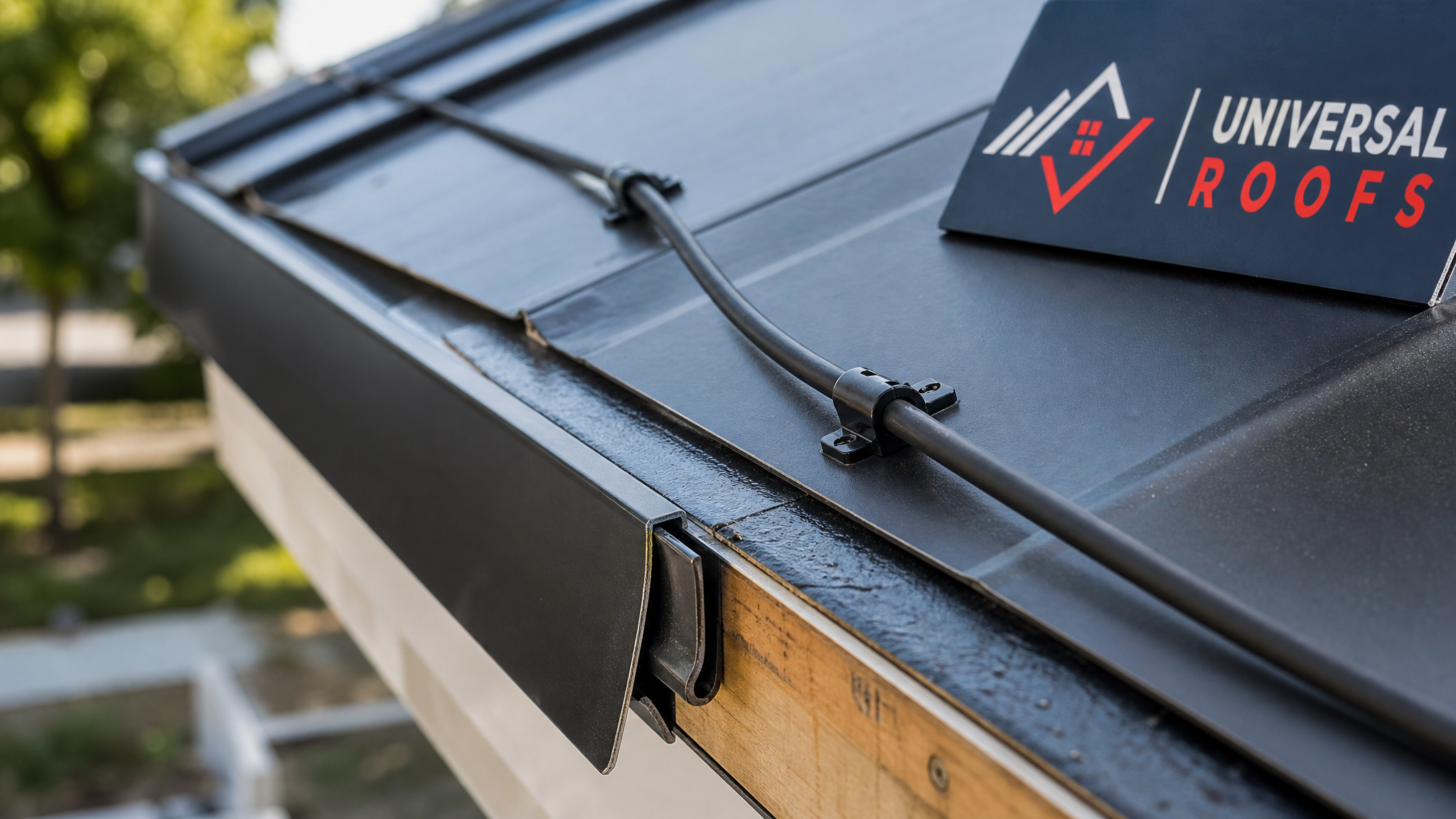
Metal drip edge flashing, correctly lapped over the underlayment and hemmed to direct water away from the fascia, closes off one of the most common entry points we see during repairs. On roofs with a history of ice damming, self-regulating heat cable installed in a zig-zag pattern along the eave and inside gutters or downspouts melts a channel through the ice, giving water somewhere to drain instead of backing up under panels.
Snow guards deserve a mention too, though for a different reason. Their job is safety, not ice dam prevention, holding sheets of snow and ice on the roof so they release gradually instead of sliding off in a single dangerous slab onto a walkway or parked car below. Many GTA municipalities effectively require them on metal roofs over entrances and driveways for exactly this reason.
Repairing an Existing Ice Dam Safely
If an ice dam has already formed, the priority is relieving the trapped water without damaging the roof or risking a fall. Never use a hammer, axe, or ice pick directly on a metal roof; you will dent panels, crack seams, or puncture the finish, and create new leak points that outlast the ice dam itself.
The safest do-it-yourself approach is a roof rake with a long telescoping handle, used from the ground to pull loose snow off the lower few feet of roof before it has a chance to melt and add to the dam. This will not remove existing ice, but it slows the problem from getting worse. Calcium chloride ice melt placed in old stockings or mesh bags and laid perpendicular across the dam can create channels for water to escape, though this only manages symptoms rather than fixing anything.
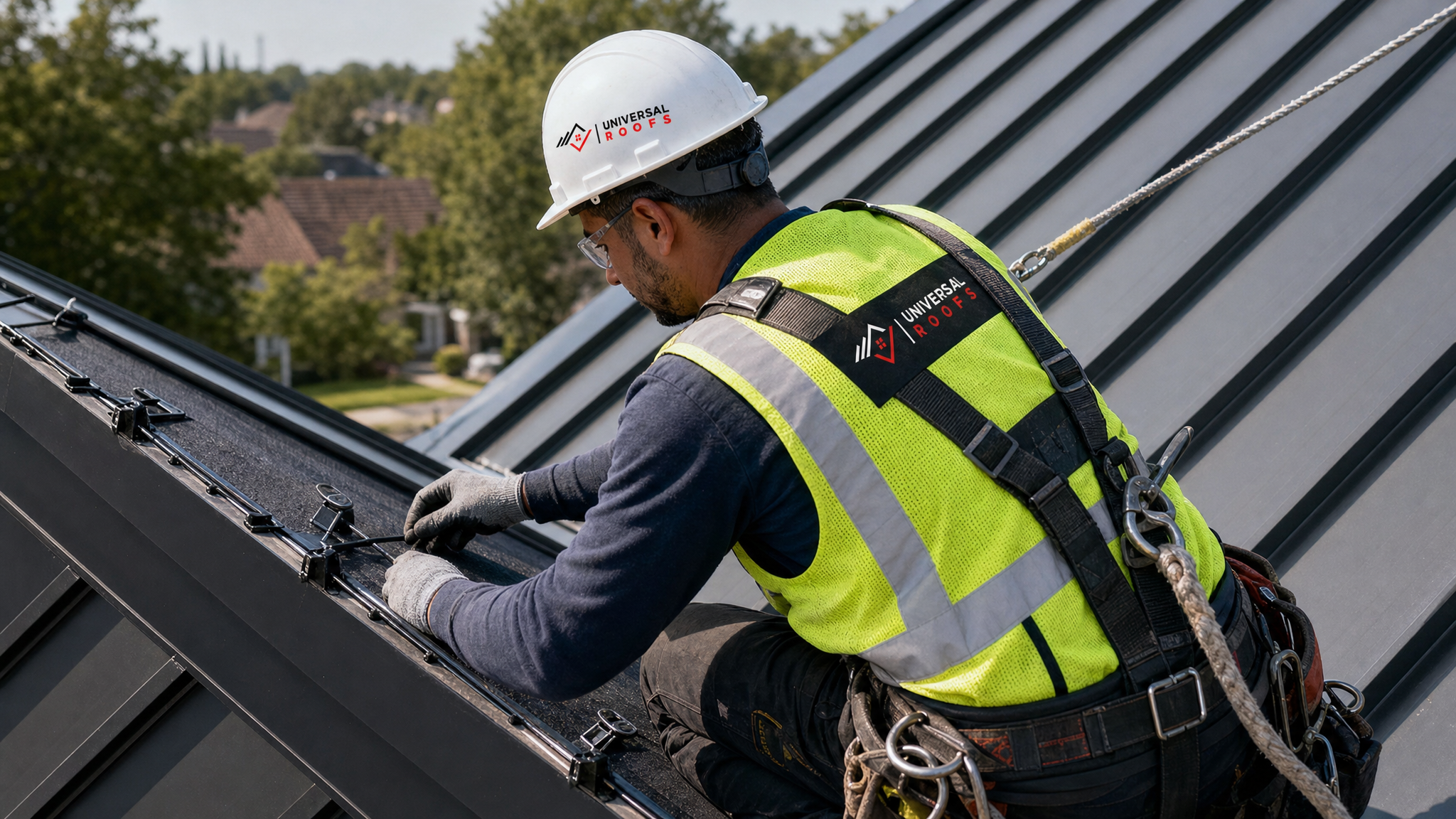
For an ice dam that is already causing active leaking, or one that has built up more than a few centimetres of solid ice, this becomes a job for a professional with the right equipment: low-pressure steam removal that will not gouge the metal finish, a harness and rope system for safe access on a slick roof, and the experience to spot underlying damage while they work. Our teams use steam-based removal specifically because it melts ice without the mechanical impact that chips paint or dents standing-seam panels.
| Situation | Recommended Action | DIY Appropriate? |
|---|---|---|
| Light snow accumulation, no ice yet | Roof rake from the ground, clear lower 1.2 to 1.8 metres | Yes |
| Small ice ridge, no interior leaking | Calcium chloride channels, monitor daily | Yes, with caution |
| Thick ice dam, active dripping indoors | Professional steam removal and eave inspection | No, call a roofer |
| Visible panel lifting or seam separation | Full roof assessment and possible panel repair | No, call a roofer |
| Recurring dams every winter for multiple years | Attic insulation and ventilation upgrade plus eave retrofit | No, needs a combined assessment |
When to Repair Versus When to Replace
Not every ice dam problem ends in a full roof replacement, but repeated dams over several winters are a strong signal that something systemic needs attention rather than a one-time patch. If your metal roof is relatively new and the ice damming stems purely from an attic ventilation gap, the fix may be entirely in the attic, with no roofing work required at all.
If the roof itself is older, has multiple areas of seam separation, corroded fasteners, or sections where the ice-and-water shield was never properly installed at the eaves to begin with, patch repairs may only buy a season or two before the same damage reappears. In these cases, a broader roof replacement that corrects the underlayment, flashing details, and ventilation at the same time is usually more cost-effective than repeated emergency callouts.
We also frequently find that ice dam damage near skylights is its own category of problem. Skylight curbs interrupt the smooth flow of the roof deck, creating a natural spot for meltwater to pool and refreeze. If you are dealing with leaks concentrated around a skylight during winter thaws, it is worth having the flashing evaluated separately, and in some cases a skylight replacement with modern, better-integrated flashing resolves a leak that no amount of eave work ever could.
Planning Your Ice Dam Prevention Project This Summer
Summer is, somewhat counterintuitively, the ideal time to fix a winter ice dam problem. Attic insulation and ventilation work is far more pleasant to perform in July than in January, and any roof-level repairs, from re-sealing seams to adding heat cable clips or upgrading eave flashing, go faster and cost less without snow and ice complicating the job site. Scheduling this work now, well ahead of the first frost, also means you are not competing with every other homeowner in the GTA who waits until the first snowfall to call a roofer.
A thorough assessment starts with the attic: checking insulation depth and evenness, confirming soffit and ridge ventilation are actually functioning and not blocked, and looking for any air leaks from the living space below. From there, we walk the roof itself, inspecting seams, fasteners, flashing, and the condition of any existing ice-and-water shield at the eaves. For homes with flat roof sections feeding into a sloped metal roof, drainage and ice damming interact in ways that need their own look; our flat roofing team handles that transition zone specifically.
If you are unsure whether your home’s attic or roof is the bigger contributor to past ice dam damage, an inspection is the fastest way to get a clear answer rather than guessing and spending money in the wrong place.
Ice Dam Prevention Across the GTA’s Microclimates
Ice damming risk is not identical across the region. Homes closer to Lake Ontario in Toronto often see more freeze-thaw cycling because lake effect keeps daytime temperatures hovering near freezing rather than staying solidly below it, which is exactly the condition that produces repeated melt-and-refreeze at the eaves. Further inland and north, in parts of York Region and Durham Region, winters tend to stay colder for longer stretches, which means less daily cycling but heavier, longer-lasting ice buildup once a dam does form.
Homes in Peel Region and Halton Region see a mix of both patterns depending on proximity to the escarpment and local wind exposure. None of this changes the fundamentals of prevention, insulation, ventilation, and proper eave detailing still matter everywhere, but it does affect how aggressively we recommend heat cable and snow retention hardware on a given property.
Maintaining Your Metal Roof Between Winters
Ice dam prevention is not a one-time project; it benefits from a light annual check-up. Each fall, clear leaves and debris from gutters and downspouts so meltwater has somewhere to go instead of backing up at the eave. Confirm that soffit vents are not obstructed by insulation, bird nests, or renovation debris. If you have added attic storage, insulation, or new light fixtures over the summer, double check that none of those changes introduced a new air leak into the attic space.
It is also worth a quick visual scan of the roof surface itself for any seam that looks like it has shifted, any fastener showing rust bleed, or any section of ice-and-water shield visible at a panel edge that looks disturbed. Catching a small issue in October is dramatically cheaper and easier than dealing with a full ice dam and interior water damage in February. Homeowners who want an outside opinion on their maintenance routine can browse feedback from other GTA clients on our reviews page, and more general roofing questions are answered on our FAQ page.
What is the fastest way to know if I have a metal roof ice dam problem?
Can preventing and repairing metal roof ice dams be done without replacing the roof?
Is it safe to remove ice dams myself on a metal roof?
Why does my metal roof get ice dams if snow slides off it easily?
What attic insulation level helps prevent metal roof ice dams in Toronto?
When is the best time to schedule ice dam prevention work?
Need Help With Preventing and Repairing Metal Roof Ice Dams?
If your home has struggled with ice dams in past winters, or you simply want peace of mind before the next cold season arrives, Universal Roofs can assess both your attic and your roof to find the real cause and fix it properly, not just patch the symptoms.
Call us today at (416) 732-2421 or request a free inspection to get started.
Universal Roofs proudly serves Toronto, Mississauga, Brampton, Vaughan, Markham, Oakville and the GTA since 2005.