
A dirty roof is more than a cosmetic problem. Across Toronto and the GTA, algae streaking, moss colonies, and years of accumulated grime trap moisture against your shingles, accelerate granule loss, and quietly shorten the life of a roofing system that should last two decades or more. Homeowners often wait until the black streaks are visible from the street before doing anything about it, but by then the underlying shingles have usually been degrading for a season or two already.
The good news is that cleaning a roof safely and effectively is a well-understood process, and the differences between the methods available are significant enough that choosing the wrong one can cause more harm than leaving the roof alone. This guide walks through the five best roof cleaning methods and techniques used by professionals today, explains when each one is appropriate, and covers the safety, cost, and maintenance considerations every GTA homeowner should know before booking a cleaning or climbing a ladder themselves.
At Universal Roofs, we have been maintaining, repairing, and cleaning roofs across the Toronto area since 2005, and roof cleaning questions are among the most common calls we get every summer. This article distills what we tell clients on-site into a single reference you can use before your next cleaning.
Why Roof Cleaning Matters More in the GTA Than You Might Think
Southern Ontario’s climate is uniquely hard on roofing surfaces. Humid summers followed by freeze-thaw winters create the perfect environment for gloeocapsa magna, the blue-green algae responsible for the dark streaks you see on north-facing roof slopes. That algae feeds on the limestone filler in asphalt shingles, and as colonies grow they retain moisture that seeps into the shingle mat itself. Left untreated for several seasons, algae and moss buildup can shave years off a roof’s expected lifespan and contribute to problems that eventually require a full roof repair instead of a routine cleaning.
Moss is the more serious offender of the two. Because moss holds water like a sponge, it keeps shingles damp for days after a rainfall, which promotes rot in the underlying decking and accelerates granule loss. On steep GTA roofs with north or east exposure — areas that get less direct sun and dry out more slowly — moss can establish itself within two or three years of a new roof install if the microclimate favours it.
Beyond structural concerns, a stained or moss-covered roof measurably reduces curb appeal and resale value. Real estate agents in Toronto and the surrounding regions regularly note that buyers associate roof staining with “deferred maintenance,” even when the roof itself has years of usable life left. A clean roof signals that a home has been cared for, and it is one of the least expensive ways to improve a property’s exterior presentation before a sale or refinance appraisal.
| Roof Growth Type | Appearance | Primary Risk | Best Cleaning Method |
|---|---|---|---|
| Gloeocapsa magna (algae) | Black or dark green streaks, usually north-facing | Granule degradation, heat absorption | Soft washing with algaecide |
| Moss | Raised green cushions, often at shingle edges | Moisture retention, decking rot | Manual removal + soft wash |
| Lichen | Crusty grey-green patches, tightly adhered | Granule loss where rooted | Chemical treatment, slow removal |
| General grime/dust | Dull grey film, uniform coverage | Cosmetic mainly, minor heat absorption | Low-pressure rinse |
| Leaf and debris buildup | Organic matter in valleys and gutters | Water damming, rot at contact points | Manual clearing + blower |
Method 1: Soft Washing — The Industry Standard for Asphalt Shingles
Soft washing is the method professional roof cleaning companies use most often, and it is the one we recommend for the vast majority of GTA homes with asphalt shingle roofs. The technique uses a low-pressure pump — typically under 100 psi, far gentler than a pressure washer — combined with a cleaning solution formulated to kill algae, moss spores, and lichen at the root.
The solution itself is usually a blend of sodium hypochlorite (a controlled-strength bleach) and a surfactant that helps the mixture cling to sloped surfaces long enough to work. Some formulations substitute sodium percarbonate for properties that require a bleach-free approach, such as roofs near sensitive landscaping or koi ponds. The solution is applied, left to dwell for ten to twenty minutes depending on the severity of growth, and then rinsed with clean, low-pressure water.
The main advantage of soft washing is that it cleans without disturbing the shingle granules themselves. Because the technique relies on chemistry rather than mechanical force, it is safe for asphalt, wood shake, and even some clay tile applications when the correct dilution is used. Soft washing also has a longer-lasting effect than a simple rinse because the algaecide continues killing spores for weeks after application, which slows the rate at which streaking returns.
The tradeoff is that soft washing requires careful handling of the cleaning chemicals. Runoff needs to be diverted away from gardens, lawns, and storm drains, and the applicator needs experience judging dwell time so the solution does its job without sitting so long it damages surrounding materials. This is one of the main reasons most homeowners hire a professional rather than attempting a DIY soft wash with retail-grade chemicals and a garden sprayer.
Method 2: Low-Pressure Rinsing for Light Surface Grime
Not every roof needs a full chemical treatment. When a roof shows general dust, pollen film, or light dirt without established algae or moss colonies, a simple low-pressure rinse with plain water can restore its appearance without introducing any cleaning agents at all. This is most common on newer roofs, roofs that were soft washed within the past year, or roofs in more exposed, sun-drenched locations where organic growth struggles to establish.
A proper low-pressure rinse uses a fan-tip nozzle at well under 500 psi, always working from the ridge downward in the same direction the shingles overlap, never against the grain. Water forced upward under a shingle tab can work its way past the underlayment and cause interior leaks, so technique matters even at low pressure. This is a task some confident, careful homeowners can do themselves with a garden hose attachment, provided they have safe roof access and stable footing — though we still recommend a professional assessment first if you have never inspected your own roof up close, since surface rinsing won’t reveal early signs of shingle wear the way a trained eye will.
Because a rinse alone does nothing to kill algae spores or moss roots, it is a poor choice for a roof that already shows staining. Rinsing a lightly algae-affected roof will remove loose surface debris but the black streaking will typically return within weeks because the biological growth itself was never treated.
Method 3: Manual Moss and Debris Removal
Moss requires a different approach than algae because it grows in raised clumps that a chemical rinse alone cannot fully dislodge. Professional crews remove established moss by hand, typically using a stiff-bristle brush or a specialized moss-removal tool that lifts the growth away from the shingle surface without gouging the granules underneath. This manual step is almost always paired with a soft wash application afterward to kill any remaining spores and prevent the moss from regrowing within the same season.
Debris removal — clearing leaves, pine needles, and branches from valleys, behind chimneys, and around vent stacks — is a related but distinct task. Debris left in these low points holds moisture against the roof deck and is one of the more common causes of hidden rot that isn’t visible until a roof repair technician pulls back the shingles. On roofs with mature trees overhead, this kind of clearing may be needed once or twice a year regardless of whether algae or moss is present.
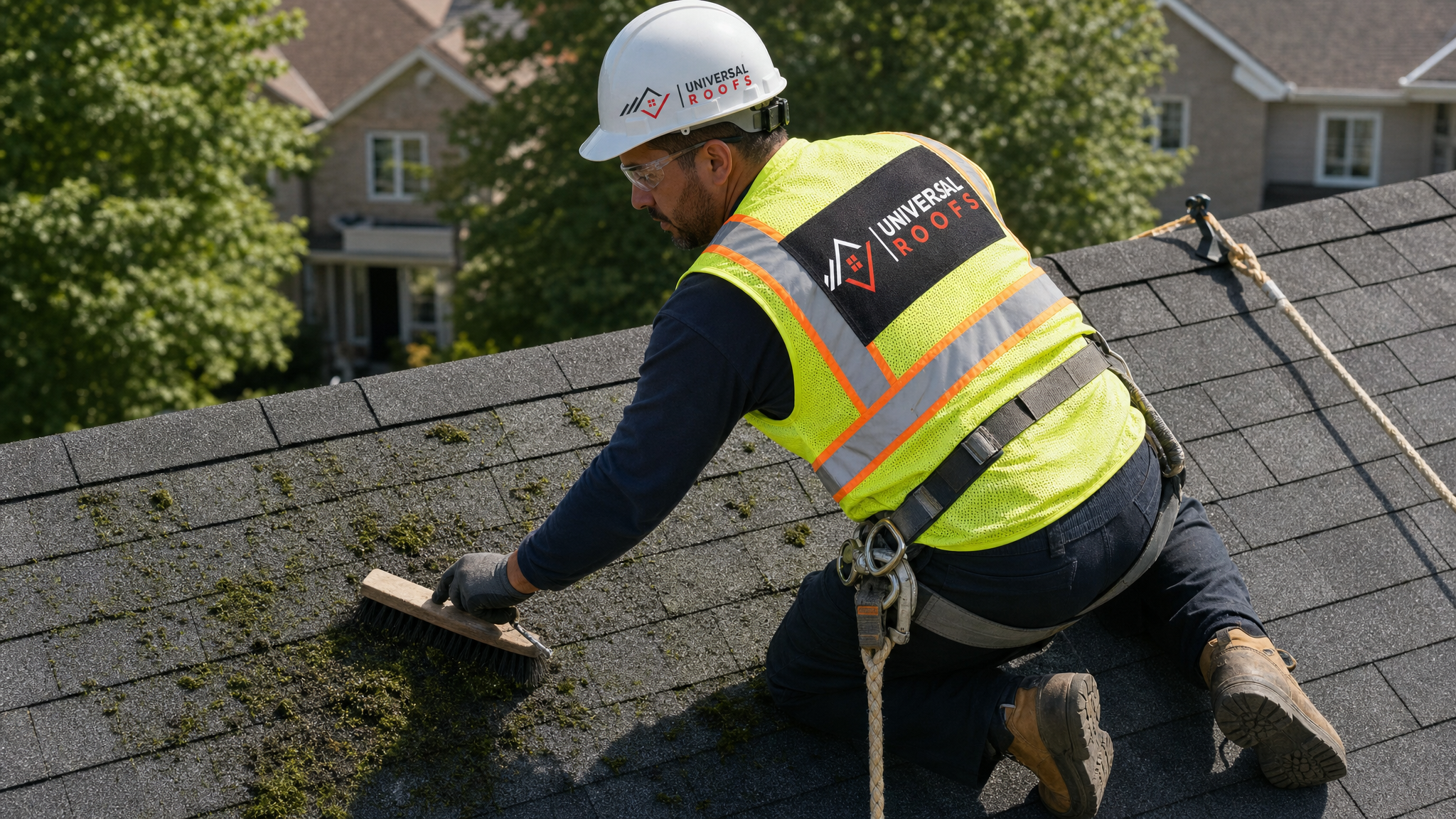
Manual removal is labour-intensive and requires a crew comfortable working at height on a wet, uneven surface, which is exactly why most homeowners leave this method to professionals. Attempting to scrape moss off a steep roof without proper harness equipment is one of the more common causes of fall injuries we hear about from homeowners who tried to handle it themselves.
Method 4: Zinc and Copper Strip Prevention Treatment
The first three methods address existing growth. Zinc and copper strips are a preventative technique installed near the ridge line that stop new algae and moss colonies from forming in the first place. When it rains, trace amounts of the metal ions wash down the roof slope with the water, creating an inhospitable surface for algae spores and moss to take root.
This method works best as a complement to an initial soft wash rather than a standalone fix. Once a roof has been cleaned, installing zinc strips at the ridge can meaningfully extend the interval before algae streaking reappears — often stretching a cleaning cycle that would otherwise be needed every two to three years out to five years or longer. The strips themselves are unobtrusive, typically a few centimetres wide, and can be colour-matched or tucked under the ridge cap so they are barely visible from the ground.
Zinc strips are a smaller, less aggressive version of the treatment, suitable for lighter algae exposure. Copper strips are more effective against heavier moss pressure but cost more and can, in rare cases, cause slight discolouration on lighter-coloured shingles directly beneath the strip over many years. For most GTA homes, our crews recommend zinc as the default, upgrading to copper only on roofs with a documented history of aggressive moss regrowth.
| Method | Typical Cost (GTA) | Time to Complete | Effect Longevity |
|---|---|---|---|
| Low-pressure rinse | $150–$300 | 1–2 hours | 2–4 months |
| Soft washing (chemical) | $350–$650 | 2–4 hours | 2–3 years |
| Manual moss removal + soft wash | $500–$900 | 4–6 hours | 2–3 years |
| Zinc/copper strip installation | $200–$450 (add-on) | 1–2 hours | 5+ years |
| Full professional maintenance plan | $400–$700/year | Ongoing | Continuous |
Method 5: Professional Maintenance Plans and Scheduled Inspections
The fifth method is less a single cleaning technique and more a strategy: pairing periodic cleaning with a scheduled inspection so that small issues are caught before they require a bigger intervention. A maintenance plan typically bundles an annual or biannual soft wash with a visual inspection of flashing, vent boots, valleys, and the general condition of the shingle mat.
This approach matters because roof cleaning and roof health are closely linked. A technician cleaning a roof is also in a position to notice curling shingles, cracked pipe boots, or granule loss in the gutters that might otherwise go unnoticed for another year. Catching these issues early is almost always cheaper than waiting for a leak to appear, and it extends the interval before a homeowner needs a full roof replacement.
Maintenance plans are especially valuable for flat roofing systems and homes with skylights, where ponding water, membrane wear, and seal degradation around penetrations need a trained eye rather than a simple rinse. If your property includes a flat roof section, ask any cleaning contractor whether their process differs for flat roofing membranes versus sloped shingle areas — the cleaning chemistry and pressure tolerances are not the same, and using a shingle-rated process on a modified bitumen or EPDM membrane can cause premature wear.
Pressure Washing: Why We Do Not Recommend It for Shingle Roofs
It is worth addressing directly why pressure washing, despite being widely available and inexpensive, is not one of the five methods recommended above. High-pressure washing — anything above roughly 1,000 to 1,500 psi applied directly to asphalt shingles — strips away the protective granules that shield the asphalt layer from UV degradation. Once granules are gone, they do not grow back, and the exposed asphalt beneath ages far faster under direct sun.
We have inspected many roofs across Toronto, Mississauga, and Vaughan where a well-intentioned homeowner or a general power-washing company (rather than a roofing specialist) used a standard consumer pressure washer to clean algae stains, only to find bald patches and accelerated shingle wear within a single season. In several cases, what should have been a routine cleaning turned into an insurance claim because the roof’s remaining service life had been meaningfully shortened.
Pressure washing does have a legitimate place on some non-shingle surfaces, such as concrete walkways, certain metal roofing profiles rated for it, or flat roof membranes designed to tolerate higher pressure — but it should never be the default choice for a residential asphalt shingle roof. If a contractor offers pressure washing as their standard roof cleaning service without asking about your roofing material first, that is a signal to get a second opinion.
How Often Should a GTA Roof Be Cleaned?
Cleaning frequency depends on tree cover, roof pitch, orientation, and the shingle brand’s algae resistance rating, but most homes in the Toronto area fall into a fairly predictable pattern. A roof with heavy tree cover and a shaded north face may need attention every eighteen to twenty-four months, while an open, sun-exposed roof with algae-resistant shingles might go five years or more between cleanings, particularly if zinc strips were installed after the last treatment.
Summer is generally the best season to schedule a cleaning in this region. Warmer, drier conditions allow the cleaning solution to dwell and work effectively, and technicians can move safely across a dry roof surface without the slip risk that spring rains or early autumn frost can introduce. Scheduling cleaning in July or August, as many homeowners do, also means the roof enters the fall and winter freeze-thaw cycle as clean and dry as possible, which reduces the odds of ice-related damage at existing algae or moss sites.
| Roof Condition | Recommended Interval | Best Season to Clean | Notes |
|---|---|---|---|
| Heavy tree cover, shaded slopes | 18–24 months | Early-to-mid summer | Pair with debris clearing each fall |
| Moderate exposure, mixed sun/shade | 2–3 years | Summer | Add zinc strips to extend interval |
| Full sun exposure, algae-resistant shingles | 4–5+ years | Summer | Inspect annually even without visible staining |
| Flat roof / low-slope membrane | Annually | Late spring or summer | Requires membrane-specific process |
| New roof, first 2 years | Inspection only, clean as needed | Any season | Preventative zinc strips often installed at install |
DIY vs. Professional Roof Cleaning: What Homeowners Should Weigh
Some elements of roof maintenance are reasonable for a capable homeowner to handle — clearing visible debris from gutters at ground level, for instance, or a light rinse on a single-storey garage roof with safe ladder access. But full roof cleaning, particularly anything involving chemical application or work at height on a sloped surface, carries real risk that professional crews are equipped to manage and homeowners typically are not.
The biggest risk is not chemical exposure, though that matters too — it is falls. Wet, sloped shingle surfaces are slippery even without added cleaning solution, and most residential roof fall injuries happen on jobs that seemed simple at the outset. Professional crews use harnesses, anchor points, and rope systems specifically because experience has shown that even a short, “easy” cleaning job on a steep roof carries meaningful fall risk without them.
There is also a knowledge gap that matters more than most homeowners expect. Diagnosing whether staining is algae, moss, or lichen — and choosing the correct chemical concentration and dwell time for each — takes experience that is hard to replicate from a how-to article alone. Getting the concentration wrong can either fail to kill the growth or damage the shingles and surrounding landscaping. If you are ever unsure whether your roof’s condition calls for a simple rinse or a full soft wash, it is worth having a professional take a look before choosing a method yourself.
Signs Your Roof Needs Cleaning Now
Beyond the obvious black streaking, there are a few less-obvious signs that indicate a roof cleaning is overdue. Granules collecting in gutters and downspouts in noticeably larger amounts than usual often point to accelerated wear at a growth site. A persistently damp patch on a roof slope that takes far longer to dry than the surrounding area after rain is frequently a sign of moss holding moisture against the shingle. And a spike in attic humidity or a musty smell in upper-floor rooms can, in some cases, trace back to trapped moisture entering through a compromised area beneath algae or moss growth — something worth having checked alongside your attic ventilation if it comes up.
If your roof includes skylights, it is also worth having the surrounding flashing checked during a cleaning visit, since debris and organic growth around a skylight curb can mask early signs of a seal failure. Our skylights and skylight replacement teams frequently get called in after a routine cleaning reveals a flashing issue that had gone unnoticed for a season or two.
What to Expect From a Professional Cleaning Visit
A typical professional visit starts with a ground-level and, where safe, a roof-level inspection to identify the type and severity of growth present. From there, the crew selects the appropriate method — usually soft washing for algae, with manual removal added for any established moss — and protects surrounding landscaping, gutters, and downspouts before applying any solution. After the appropriate dwell time, the roof is rinsed at low pressure, working with the shingle overlap rather than against it, and the crew does a final walk of the roof to confirm all growth has been addressed.
Most single-family homes in the Toronto area can be fully cleaned in an afternoon, though homes with steep pitches, multiple roof planes, or heavy moss coverage can take longer. A reputable contractor will also flag anything unrelated to cleaning that they notice during the visit, whether that is a lifted shingle tab, a gap in flashing, or a vent boot that has started to crack — the kind of small issue that is far cheaper to address immediately than after another winter.
Homeowners across our service areas in Toronto, Peel Region, York Region, Halton Region, and Durham Region deal with slightly different microclimates — homes backing onto ravines or mature tree cover in York Region, for example, tend to see moss faster than more open subdivisions further east — so a locally experienced crew that understands these patterns will typically recommend a more tailored cleaning interval than a generic national franchise would.
What are the best roof cleaning methods and techniques for asphalt shingles?
Is soft washing better than pressure washing for roof cleaning?
How much does professional roof cleaning cost in the Toronto area?
How often should I clean my roof in Toronto’s climate?
Can I clean my own roof safely without a professional?
Will black streaks on my roof come back after cleaning?
Need Help With 5 Best Roof Cleaning?
Whether your roof needs a routine soft wash, manual moss removal, or a full inspection to check for hidden wear beneath years of buildup, the team at Universal Roofs can assess your roof and recommend the right method for your specific shingles, pitch, and exposure.
Call us today at (416) 732-2421 or request a free inspection to get started.
Universal Roofs proudly serves Toronto, Mississauga, Brampton, Vaughan, Markham, Oakville and the GTA since 2005.