
A sagging roofline is one of the most alarming things a homeowner can spot from the driveway. It is also one of the most misunderstood when it comes to who pays for the fix. Many Toronto homeowners assume that because a roof problem is “structural,” their home insurance policy will automatically cover it. In reality, insurance companies draw a hard line between sudden, accidental damage and gradual deterioration, and a sagging roof can fall on either side of that line depending on what caused it.
At Universal Roofs, we have inspected hundreds of sagging rooflines across the Greater Toronto Area since 2005, and we have sat across the table from just as many insurance adjusters. This guide explains exactly how roof sagging is diagnosed, what actually gets covered under a typical Ontario homeowner policy, what does not, and the steps you need to take, in the right order, to give yourself the best possible chance at a successful claim.
We will walk through the common causes of a sagging roof, how a claims adjuster evaluates the damage, the documentation that makes or breaks a claim, realistic repair costs with and without coverage, and the practical steps for fixing the sag once the insurance question is settled. Whether you noticed a dip near the ridge after last winter’s snow load or a sag that has been slowly worsening for years, this article will help you understand your options before you pick up the phone.
What Causes a Roof to Sag in the First Place
Before any insurance conversation can happen, you need to understand why the roof is sagging. Adjusters will ask this question first, because the cause determines whether the damage is an insurable peril or an excluded maintenance issue. In our experience across the GTA, sagging traces back to one of five root causes.
Undersized or deteriorated rafters and trusses. Homes built before the 1980s in older Toronto neighbourhoods were sometimes framed with rafters that were adequate by the building codes of the day but are undersized by today’s snow load standards. Decades of freeze-thaw cycling can also slowly weaken lumber, especially where past roof leaks went unnoticed.
Water damage and rot. A slow leak around a chimney, vent stack, or valley can saturate the sheathing and rafters for years without ever showing an obvious stain indoors. By the time a homeowner notices a dip in the roofline, the wood underneath may already be significantly compromised.
Excessive snow load. Toronto winters can dump heavy, wet snow that sits on a roof for weeks. When several storms stack up without a thaw in between, the cumulative weight can exceed what the framing was designed to carry, particularly on flat or low-slope sections.
Improper past renovations. Removed load-bearing walls, notched rafters for HVAC ducting, or an added layer of shingles without reinforcing the deck are common culprits we find during inspections. These changes often happened years before the current owner purchased the home.
Age and gradual wear. Every roof structure has a service life. As fasteners loosen, connections weaken, and wood naturally settles over 40 or 50 years, a very gradual sag can develop even without a single dramatic event.
Only some of these causes are treated as sudden and accidental by insurers. Understanding which bucket your situation falls into is the single biggest factor in whether your claim will be approved.
How Home Insurance Actually Treats Roof Sagging
Standard Ontario homeowner policies are all-risk contracts that cover sudden and accidental loss, think wind, hail, fire, or a falling tree branch. They are not maintenance contracts, and insurers explicitly exclude damage that results from wear and tear, lack of maintenance, or gradual deterioration. This distinction is the single most important thing to understand before filing a claim for a sagging roof.
If your roof sagged because an unusually heavy, well-documented snowstorm overloaded the structure in a single event, most all-risk policies will treat that as an insured peril, similar to wind or hail damage. If, on the other hand, the sag developed slowly over several seasons because of a long-ignored leak or aging rafters, the insurer will almost always classify it as a maintenance issue and deny the claim.
There is a middle category that trips up a lot of homeowners: sudden collapse caused by an underlying, unnoticed weakness. Many policies include a specific collapse endorsement that covers sudden collapse of a building or part of a building, even if weight of snow, ice, or water on the roof was a contributing cause, as long as decay or insect damage was not the sole cause and was not known to the homeowner before the loss. This clause is genuinely useful for Toronto homeowners, since our region routinely sees heavy late-winter snow accumulation.
| Cause of Sagging | Typically Covered? | Why | What Adjusters Look For |
|---|---|---|---|
| Sudden collapse from one heavy snow event | Often yes, with collapse endorsement | Treated as a sudden, accidental peril | Weather records, timeline matching the event |
| Long-term leak and rot | Usually no | Classified as gradual deterioration or lack of maintenance | Water staining, moisture readings, wood condition |
| Wind or falling tree impact | Yes, in most all-risk policies | Sudden external peril | Broken framing consistent with impact |
| Undersized framing (original construction defect) | Rarely | Considered a pre-existing structural or design issue | Rafter spacing and span vs. code requirements |
| Previous unpermitted renovation | Rarely | Excluded as faulty workmanship | Cut or notched members, missing permits |
| Gradual age-related wear | No | Explicitly excluded as normal wear and tear | Overall roof age, uniform deterioration pattern |
Every policy is worded differently, and endorsements vary by insurer, so the table above is a general guide, not a substitute for reading your specific policy wording. If you are unsure how your policy treats collapse or gradual damage, call your broker before you call a contractor, since the order matters and we will explain why in the next section.
The Correct Order of Operations After You Notice a Sag
We get calls every summer from homeowners who already had a full roof replacement done before they ever spoke to their insurer, only to learn afterward that a portion of the cost might have been reimbursable had they filed first. Following the right sequence protects both your safety and your claim.
- Stop using the affected space if the sag is severe. If you can see daylight through the roof deck, hear cracking, or notice the dip has worsened in days rather than months, treat it as an emergency and stay out of the room below until a professional assesses structural safety.
- Photograph everything immediately. Take wide shots of the roofline from the street, close-ups of the dip from the attic if it is safe to access, and photos of any obvious cause such as ice damming, a broken branch, or water staining.
- Call a licensed roofing contractor for an inspection, not a repair. You want a written assessment of the cause and extent of the sag before any work begins, so you have independent documentation that does not come from the insurer’s own adjuster.
- Contact your insurance broker or insurer to report the potential claim. Ask directly whether your policy includes a collapse endorsement and how it applies to your situation.
- Schedule the adjuster’s site visit and have your contractor’s written report and photos ready to share.
- Get a detailed repair quote that separates structural reinforcement, roofing materials, and any interior repairs, since the adjuster may approve some scope items and deny others.
- Only proceed with permanent repairs after the coverage decision, unless there is an active safety risk that requires emergency stabilization.
Skipping the inspection-before-repair step is the most common mistake we see. Once a contractor removes the old roofing and framing to make repairs, the physical evidence the adjuster needs to evaluate the cause is gone, and claims that could have been approved get denied for lack of documentation.
What a Professional Structural Inspection Actually Involves
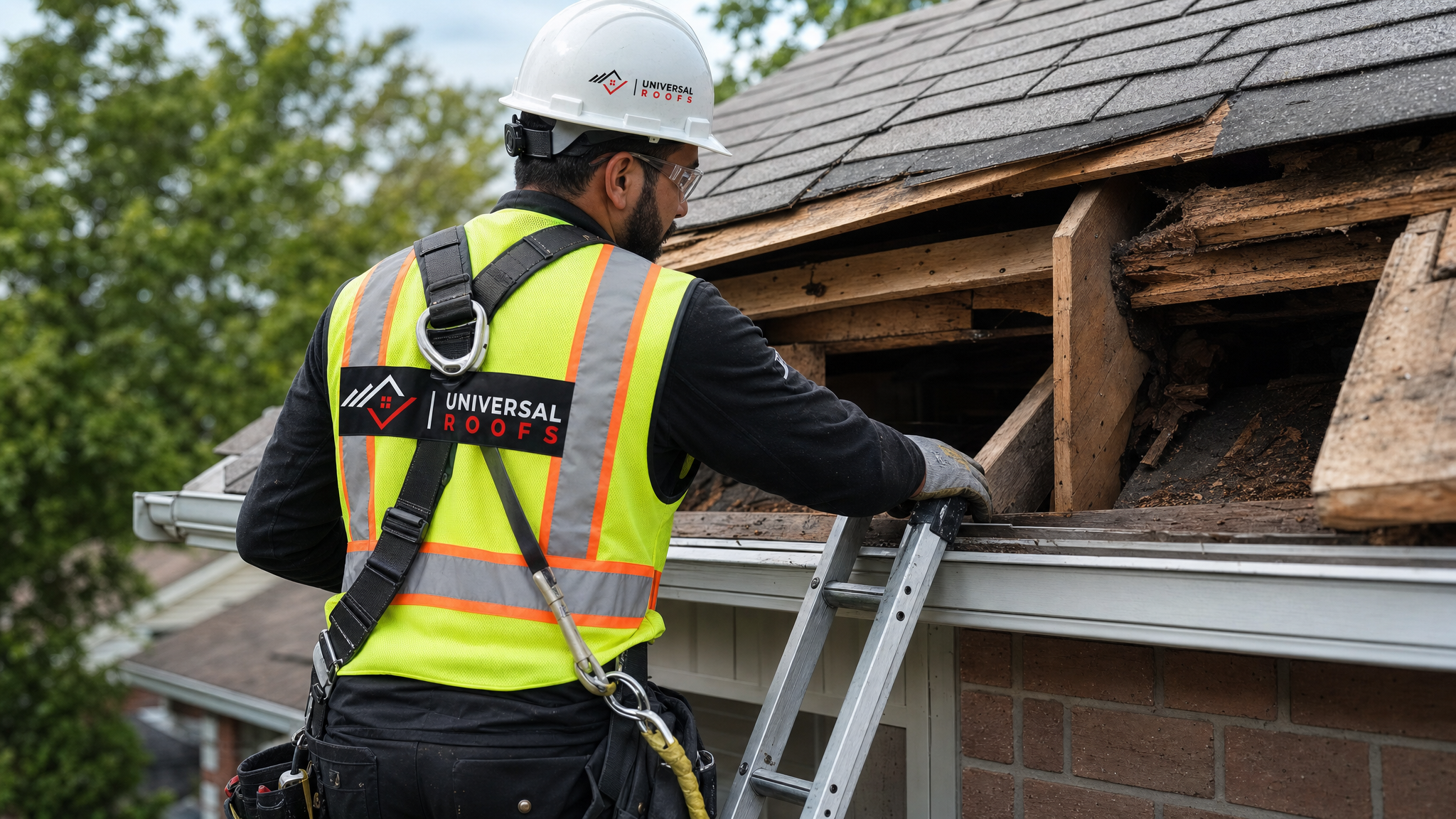
A proper sagging-roof inspection goes well beyond a visual look from the ground. Our crews approach it in stages, and we recommend homeowners insist on this level of detail from any contractor providing documentation for an insurance claim.
First, we measure the deflection. Using a string line or laser level along the ridge and eaves, we quantify exactly how many millimetres the roofline has dropped and where the low point sits relative to the span. A sag of a few millimetres over several metres may be within normal tolerance for an older home, while a pronounced dip localized over one section usually points to a specific failed member.
Second, we access the attic or roof cavity to examine the rafters, collar ties, ridge board, and any purlins or struts directly. This is where we look for cracked or split lumber, rot, insect damage, undersized spans, and any past cuts or notches from electrical or HVAC work.
Third, we check for water intrusion using a moisture meter on the sheathing and framing near the sag, since elevated moisture readings are strong evidence of an ongoing or recent leak versus purely mechanical overload.
Finally, we document the exterior roofing surface, shingles, flashing, and the attic ventilation system, since poor attic ventilation is a frequent contributing factor to both ice damming and premature deck deterioration in our climate.
| Inspection Step | Tools Used | What It Reveals | Typical Duration |
|---|---|---|---|
| Deflection measurement | Laser level, string line, tape measure | Severity and exact location of the sag | 20-30 minutes |
| Attic and rafter examination | Flashlight, moisture meter, awl | Cracked, rotted, or undersized framing members | 30-45 minutes |
| Moisture testing | Pin-type or pinless moisture meter | Active vs. historical water intrusion | 15-20 minutes |
| Exterior roof surface review | Ladder, roof walk, camera | Flashing failures, shingle wear, ice dam evidence | 30-45 minutes |
| Written report and photo log | Inspection software, photo documentation | Formal record for insurer and permit purposes | Delivered within 2-3 business days |
Repair Methods for a Sagging Roof
Once the cause is confirmed and the coverage question is settled, the actual repair depends entirely on what is failing. There is no single fix for roof sagging; the correct method matches the specific structural issue found during inspection.
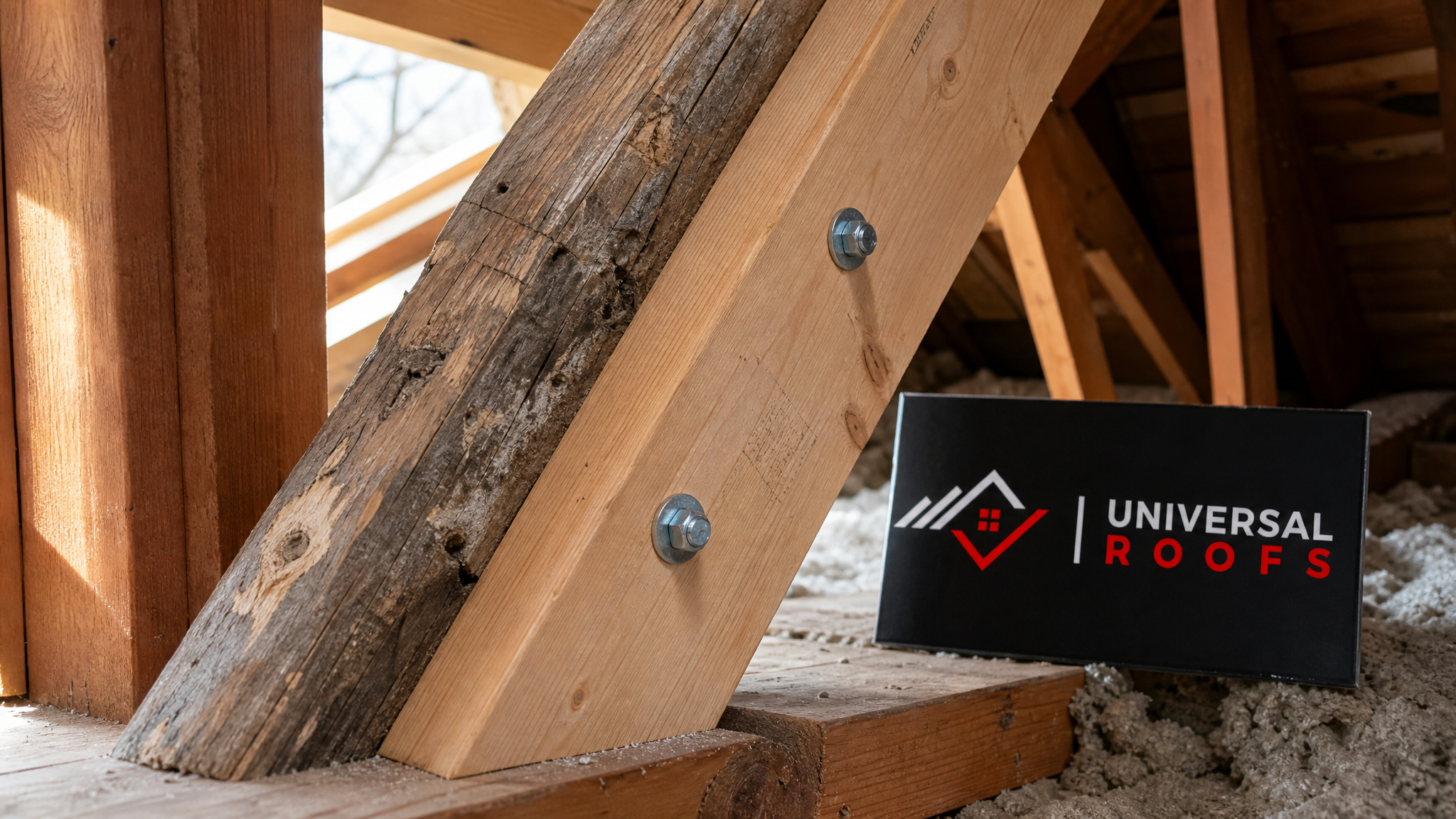
Sistering rafters. When individual rafters are cracked, undersized, or mildly rotted but the majority of the framing is sound, we bolt or screw a new rafter alongside the existing one along its full length. This sistering approach restores load capacity without a full teardown and is often the most cost-effective structural fix.
Installing additional support posts or beams. In attics and cathedral ceilings where the ridge itself has dropped, adding a properly sized ridge beam with vertical support posts down to a load-bearing wall or new footing can permanently correct the sag. This is more invasive and often requires an engineer’s sign-off and a building permit through the City of Toronto or the relevant regional municipality.
Jacking and straightening. For moderate sags, we sometimes use hydraulic jacks to very gradually lift the ridge back toward level over several weeks, allowing the wood to relax without cracking, before permanently bracing the new position. Aggressive one-time jacking is a common mistake that can snap already-weakened members.
Full deck and structural replacement. Where rot has spread extensively, or where a previous renovation compromised multiple structural members, a full tear-off with new rafters, sheathing, and roofing is the only durable option. This is also the point where a complete roof replacement often makes more financial sense than a patchwork of repairs.
Addressing the root cause. Whatever structural fix is chosen, we always pair it with a correction of the underlying problem, whether that is improving attic ventilation and insulation to stop ice damming, repairing flashing around a leaking chimney, or reinforcing a valley that channels excessive water and snow.
| Repair Method | Best For | Typical Cost Range (CAD) | Permit Usually Required? |
|---|---|---|---|
| Sistering rafters | Isolated cracked or undersized rafters | $1,500 – $4,500 | Sometimes |
| Ridge beam and support posts | Dropped ridge line, cathedral ceilings | $4,000 – $12,000 | Yes |
| Gradual jacking and bracing | Moderate, uniform sag without rot | $2,000 – $6,000 | Sometimes |
| Full structural and deck replacement | Extensive rot or multiple failed members | $12,000 – $30,000+ | Yes |
| Ventilation and flashing correction (add-on) | Preventing recurrence | $800 – $3,000 | Rarely |
These figures are general GTA market ranges based on projects we have quoted and completed. Your actual cost will depend on roof size, accessibility, and the extent of hidden damage found once the framing is opened up. A written, itemized quote is always the right starting point, both for budgeting and for your insurance file.
Working With Your Adjuster: Documentation That Wins Claims
Insurance adjusters are trained to look for evidence that separates a sudden, accidental event from ongoing neglect. The strength of your documentation package often matters as much as the actual cause of the damage. Based on the claims we have supported over the years, the following materials consistently make the biggest difference.
A dated, written inspection report from a licensed contractor that states plainly when the damage was first observed and what likely caused it. Vague verbal assessments carry little weight; a signed report on company letterhead carries much more.
Weather data corroborating a specific event. Environment Canada’s historical weather records for the Toronto area can confirm a heavy snowfall or windstorm on a specific date, which helps establish that the damage was sudden rather than gradual.
A clear photo timeline. If you have any prior photos of the roofline, from a real estate listing, a previous inspection, or even a casual photo of the house, that show the roof was straight before a specific date, this is powerful evidence of a sudden change.
An itemized, scope-separated repair quote that distinguishes structural work from cosmetic or unrelated upgrades, since adjusters will often approve the structural portion while pushing back on unrelated improvements bundled into the same invoice.
Proof of prior maintenance. Records of past roof inspections, gutter cleaning, or previous repairs help counter any suggestion that the damage resulted from neglect on your part.
If your initial claim is denied, you are entitled to ask for the specific policy language the denial is based on, and you can request a second inspection or appeal through your insurer’s internal review process. An independent adjuster or public adjuster can also be hired at your own cost to advocate on your behalf, which is sometimes worthwhile on larger structural claims.
Preventing Roof Sagging Before It Starts
The best insurance claim is the one you never have to file. A handful of preventive habits dramatically reduce the odds of ever facing a sagging roofline, and they are especially relevant here in the GTA given our freeze-thaw winters and heavy snow loads.
Schedule a professional roof inspection every two to three years, and always after a major storm. Catching a small leak or a cracked rafter early keeps a repair in the hundreds of dollars rather than the thousands.
Keep gutters and downspouts clear so water is directed away from the roof edge instead of backing up under shingles and saturating the deck, which is one of the most common hidden causes of long-term rafter rot.
Improve attic insulation and ventilation. A well-ventilated, properly insulated attic keeps the underside of the roof deck cold in winter, which reduces ice damming, a major contributor to water intrusion along eaves and valleys across Toronto and the wider GTA.
Have any new HVAC, electrical, or renovation work reviewed by a structural professional before cutting into rafters or trusses, and confirm the appropriate permits were pulled. Unpermitted structural modifications are one of the most common reasons insurance claims get denied outright.
Remove excessive snow load after major storms, particularly from flat or low-slope sections and areas prone to drifting, rather than waiting for a natural thaw. This is a simple habit that meaningfully reduces the odds of a sudden collapse event.
Address minor sagging signs immediately rather than monitoring them. A slight dip that is caught and sistered early is a straightforward repair; the same issue left for several more winters can progress into a full structural replacement.
Sagging Roof vs. Other Roofing Emergencies: How Insurers Compare Them
It helps to see how sagging compares with other common roofing damage claims, since the same all-risk policy structure applies across the board but the approval odds differ significantly by cause.
| Type of Damage | Typical Insurance Approval Rate | Key Evidence Needed | Common Denial Reason |
|---|---|---|---|
| Wind-lifted shingles | High | Wind speed records, visible lifted or missing shingles | Pre-existing wear at edges |
| Sudden collapse from snow load | Moderate to high with collapse endorsement | Snowfall records, sudden timeline | Evidence of pre-existing decay |
| Roof sagging from long-term leak | Low | Not applicable, usually excluded | Classified as gradual deterioration |
| Fallen tree impact | High | Photos of tree, impact damage pattern | Rare, usually approved quickly |
| Ice dam water damage | Moderate | Proof of storm event vs. chronic ventilation issue | Attributed to inadequate insulation or maintenance |
Notice that sagging caused by chronic issues sits at the lower end of approval likelihood industry-wide, which is exactly why establishing a sudden triggering event, where one genuinely exists, is so central to the claims process.
When Repair Makes More Sense Than a Full Replacement
Not every sagging roof needs a full teardown, and not every insurance denial means you are stuck with the whole bill. If the structural inspection shows the sag is isolated to one or two rafters, a targeted roof repair using sistering and localized flashing correction is often sufficient and considerably more affordable than replacement.
Conversely, if the roof covering is also near the end of its service life, or if the sag has caused shingle cracking and granule loss across a wider area, combining the structural fix with a full roof replacement avoids paying for scaffolding and tear-off labour twice within a few years. This is a judgment call best made jointly with your contractor after the inspection findings are in hand, weighing the extent of damage against the remaining life of the existing shingles.
Flat-roofed additions and garages present their own version of this problem. On flat roofing systems, sagging is almost always tied to ponding water and long-term membrane failure rather than a single event, which typically pushes these claims into the excluded, gradual-deterioration category. If you have a flat-roof section showing a dip, prioritize the inspection even more urgently, since standing water accelerates deck deterioration quickly.
If a skylight sits anywhere near the sagging section, have it checked at the same time. Skylight curbs are cut directly into the rafters, and a poorly reinforced opening is a surprisingly common contributor to localized sagging nearby. Our skylight and skylight replacement teams routinely find this during joint inspections.
Serving Homeowners Across the GTA
We handle sagging roof inspections, insurance documentation support, and structural repairs across the entire Greater Toronto Area, including Toronto, Peel Region, York Region, Halton Region, and Durham Region. Local knowledge matters here since building code requirements, typical framing practices, and snow load expectations vary somewhat by municipality, and our crews are familiar with the permitting process in each.
You can read what past clients have said about our inspection and repair work on our reviews page, and check our FAQ page for answers to other common roofing questions. You can also learn more about our history and licensing on our about page.
Does home insurance cover fixing roof sagging?
What is the difference between a covered collapse and an excluded gradual sag?
What documentation do I need when fixing roof sagging insurance coverage explained by my adjuster requires?
How much does it cost to fix a sagging roof without insurance coverage?
Can I get my roof repaired before the insurance adjuster inspects it?
What should I do if my roof sagging insurance claim is denied?
Need Help With Fixing Roof Sagging Insurance?
A sagging roofline is not something to monitor and hope improves on its own. Whether your situation qualifies for insurance coverage or not, Universal Roofs can provide the professional inspection, documentation, and structural repair you need to resolve it safely and permanently.
Call us today at (416) 732-2421 or request a free inspection to get started.
Universal Roofs proudly serves Toronto, Mississauga, Brampton, Vaughan, Markham, Oakville and the GTA since 2005.