
If you have ever stood in your driveway on a January morning and noticed a thick ridge of ice gripping the edge of your roofline, you have seen an ice dam forming. Most homeowners assume the fix is as simple as clearing snow or adding a few extra inches of insulation. In reality, the structural framework holding your roof together, the trusses, often plays a much bigger role than most people realize. That is why roof truss repairs essential for ice damming prevention has become such a common search among GTA homeowners trying to understand why their ice dam problem keeps coming back year after year.
A sagging, twisted, or improperly braced truss system changes the shape of your roof deck in ways that are invisible from the street but very visible in your attic and on your energy bill. Uneven roof planes create low spots where snow melt refreezes, gaps around damaged truss members let warm air escape into the attic, and compromised structural members can no longer support the additional weight ice dams place on the eaves. Left unaddressed, these small structural issues compound every winter until they become expensive repairs or, in worst cases, safety hazards.
At Universal Roofs, we have spent nearly two decades inspecting attics across Toronto, Mississauga, Brampton, Vaughan, Markham, Oakville, and the wider GTA, and we consistently find that homes with recurring ice dam problems have some form of truss deflection, damage, or design flaw at the root of the issue. This guide walks through exactly how truss health connects to ice damming, how to recognize the warning signs, and what a proper repair and prevention plan looks like heading into the next freeze-thaw season.
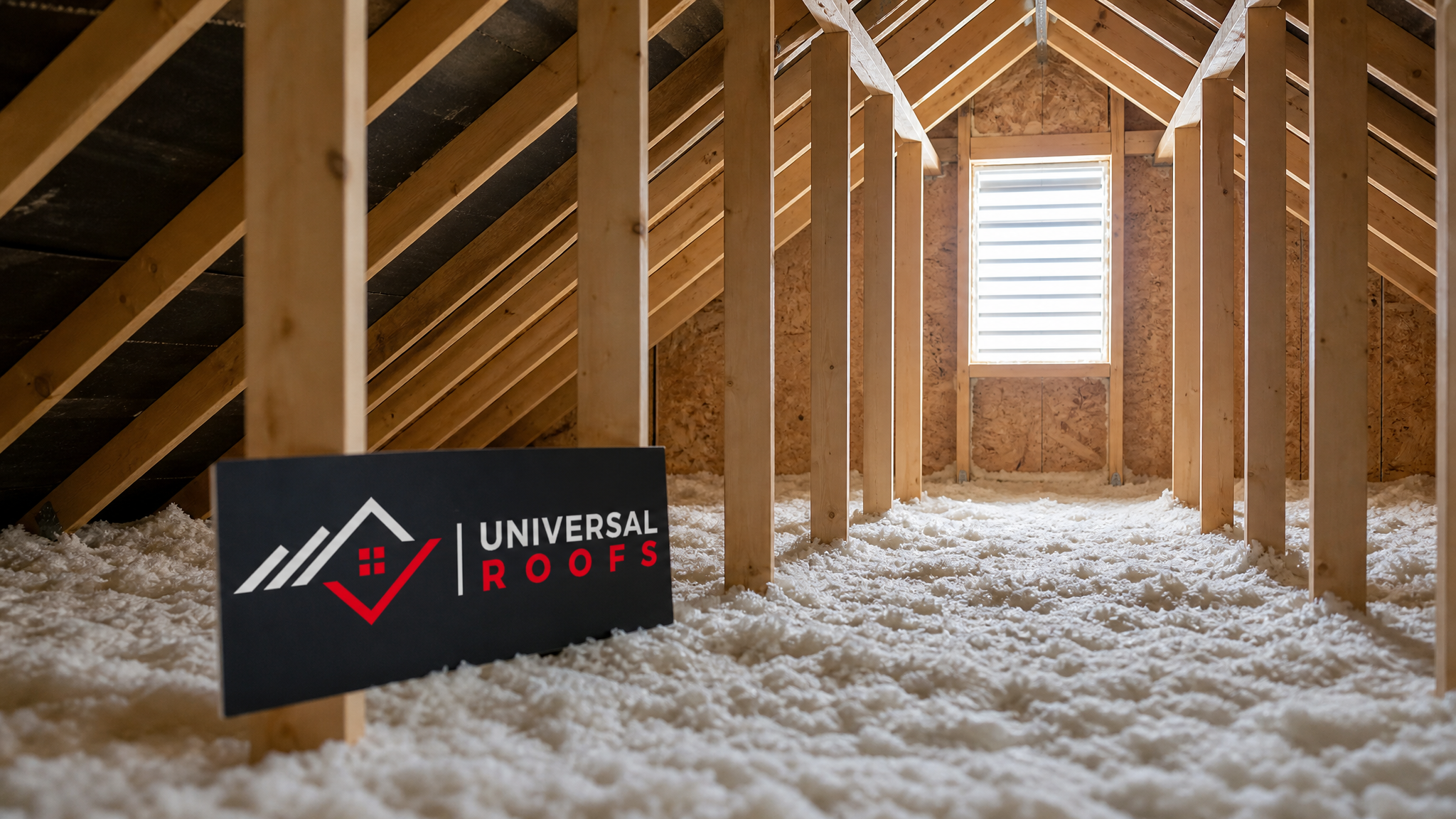
How Roof Trusses Influence Ice Dam Formation
Ice dams form through a simple but destructive cycle: heat escapes from the living space into the attic, warms the underside of the roof deck, melts the snow sitting on top, and that meltwater runs down the slope until it reaches the colder eaves overhang, where it refreezes into a ridge of ice. Once that ridge forms, subsequent meltwater backs up behind it, works its way under shingles, and finds its way into the attic insulation, ceiling drywall, and exterior walls.
Roof trusses are the engineered skeleton that determines the shape, slope, and evenness of that roof deck. When trusses are properly installed, braced, and maintained, the roof plane stays flat and consistent, snow melts and drains evenly, and there are no unusual cold spots or hot spots for ice to concentrate around. When trusses sag, split, or shift out of alignment, the roof deck develops subtle valleys and high points that most homeowners cannot see from ground level but that dramatically change how snow, heat, and water behave overhead.
A sagging truss chord lowers a section of roof deck by even a centimetre or two, and that is enough to create a natural collection point for meltwater. Combine that with a gap in insulation or a broken truss connection that lets warm attic air leak directly against the roof sheathing, and you have created a reliable ice dam factory that will produce the same problem every winter until the underlying structural issue is corrected.
Common Truss Problems That Make Ice Damming Worse
Not every truss issue is dramatic. Many of the problems we find during attic inspections are subtle enough that homeowners have lived with them for years without realizing they were contributing to recurring leaks. Below are the truss conditions we see most often in older GTA homes, particularly those built before modern engineered truss standards were widely adopted.
Sagging bottom chords are the most common culprit. Over decades, the combined weight of insulation, ductwork, and stored items in the attic can cause the horizontal bottom chord of a truss to bow downward. This changes the pitch of the roof deck directly above and creates low pockets where snow melt pools and refreezes.
Cracked or split webbing is another frequent finding, especially in homes that have had plumbing, electrical, or HVAC work done in the attic without proper truss engineering sign-off. Trades sometimes cut or notch web members to run pipes or ducts, weakening the truss triangle and allowing localized deflection.
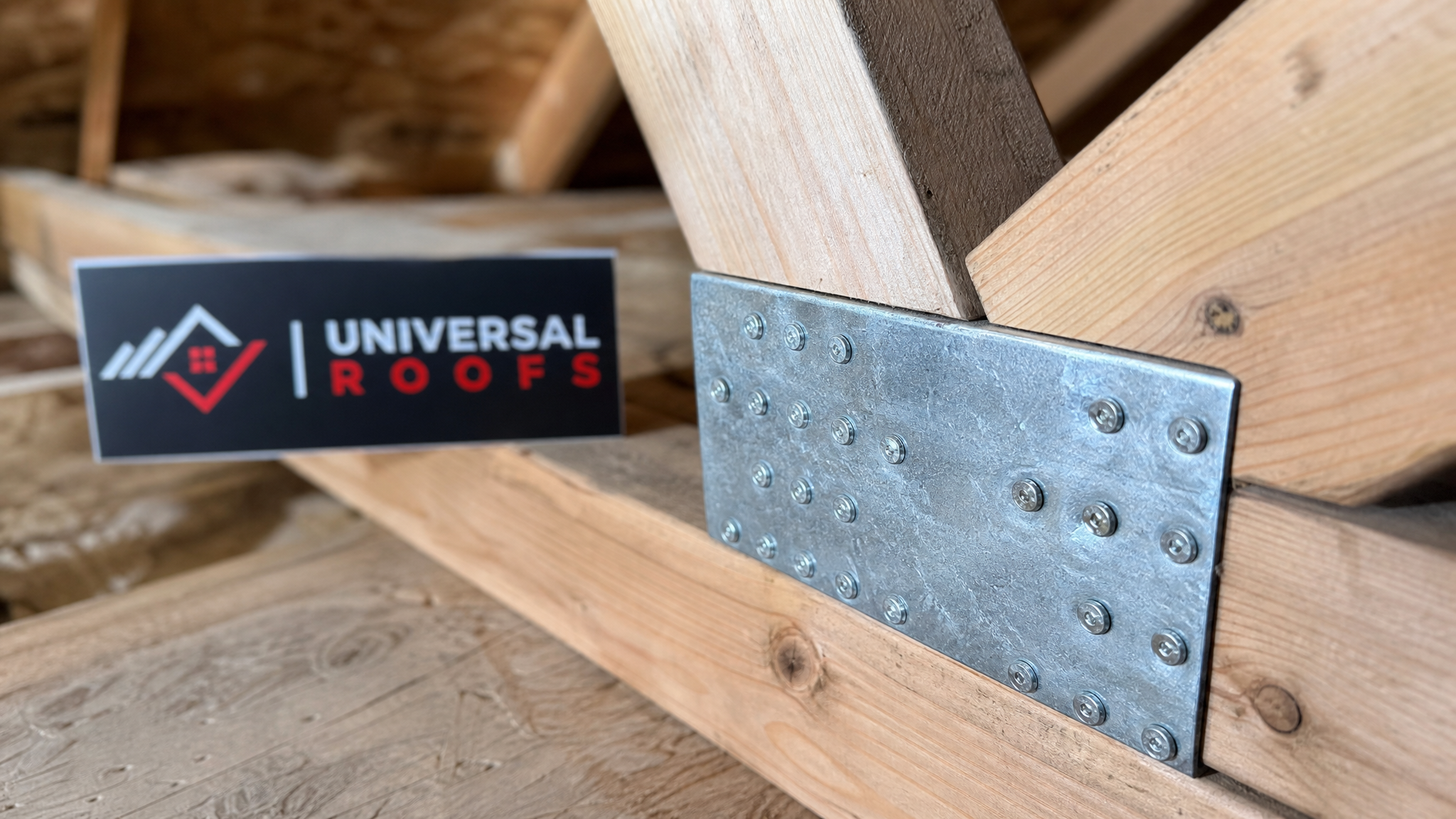
Failed connector plates, the metal gusset plates that join truss members at each joint, can rust, loosen, or pop free entirely in older homes, especially where roof leaks have already introduced moisture into the attic. A single failed connector plate can allow an entire truss to shift out of plane with its neighbours.
Finally, improper spacing or missing lateral bracing between trusses allows the whole roof structure to rack slightly under wind and snow load, which over time telegraphs into an uneven roof surface even when each individual truss looks fine in isolation.
Warning Signs Your Trusses Need Attention
Most homeowners never go up into their attic outside of storing seasonal items, so truss problems tend to go unnoticed until they show up as a ceiling stain, a sagging ridge line, or a stubborn ice dam that returns every winter no matter how much snow you rake off the roof. Watching for the following signs, both inside the attic and from the exterior, can help you catch truss issues before they become full ice damming emergencies.
| Warning Sign | Where to Look | What It Usually Means | Urgency |
|---|---|---|---|
| Visible sag in the ridge line | Exterior, viewed from the street or neighbouring property | Bottom chord or connector plate failure across several trusses | High — schedule an inspection promptly |
| Daylight gaps at connector plates | Attic, at truss joints | Rusted, popped, or undersized gusset plates | High — structural integrity affected |
| Recurring ice ridge in the same spot | Exterior eaves, every winter | Localized low spot from truss deflection or insulation gap | Medium to high — worsens each freeze-thaw cycle |
| Cracks in ceiling drywall below the attic | Interior ceilings, especially top-floor rooms | Truss movement transferring stress to the ceiling below | Medium — monitor and book an assessment |
| Doors or windows sticking on the top floor | Interior, top floor only | Roof structure shifting and racking the frame slightly | Medium — worth a professional look |
| Visible bowing of truss webbing | Attic, mid-span of truss members | Overloading from stored items, added insulation weight, or notched members | High — remove load and inspect immediately |
If you notice any two or more of these signs together, it is worth booking a professional roof repair assessment rather than waiting for the next storm to make the decision for you.
How Professional Truss Repairs Stop Ice Dams at the Source
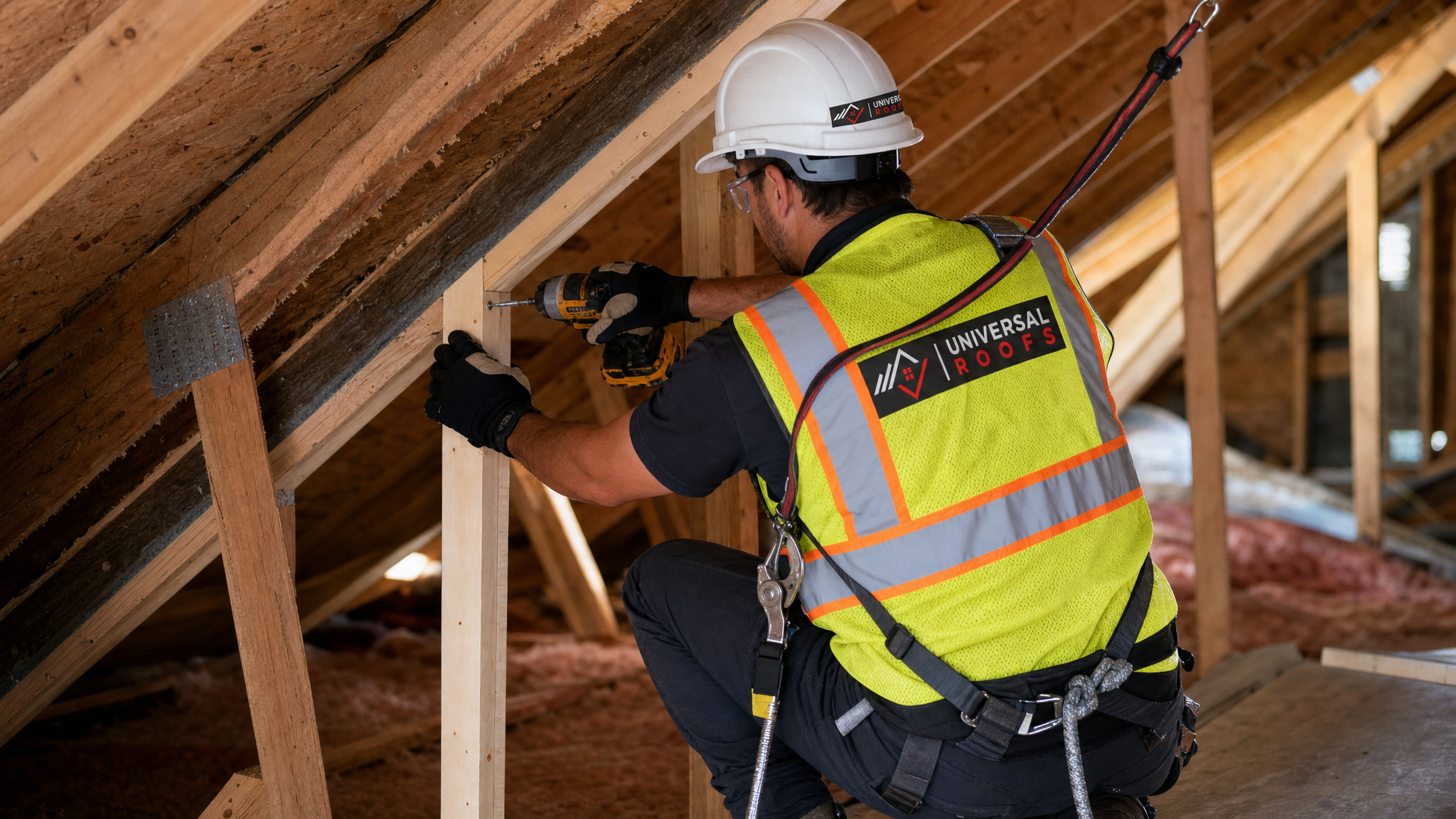
Once a truss issue has been diagnosed, the repair approach depends on the severity and type of damage. Our crews typically start with a full attic and exterior inspection to map out exactly which trusses are affected and how far the deflection extends across the roof plane. From there, repairs generally fall into a few categories.
Sistering is the most common repair for sagging or cracked chords. A new engineered lumber member is fastened alongside the damaged original, effectively doubling up the load path and restoring the truss to its designed strength and shape without needing to remove the entire truss.
Connector plate replacement addresses failed or rusted gusset plates. Our team removes the compromised plate, confirms there is no hidden rot at the joint, and installs a new galvanized connector rated for the specific load at that junction.
Additional lateral bracing is added where trusses have racked out of plane relative to their neighbours. This ties the whole roof structure back together so that wind and snow loads are distributed evenly rather than concentrating stress on individual weak points.
In more severe cases where multiple trusses have failed structurally, a licenced structural engineer is brought in to design a full or partial truss replacement. This is less common but happens most often in homes where water damage from a prior undetected leak has rotted through original truss members.
Once the structural work is complete, we always re-evaluate attic insulation and ventilation as part of the same visit, because trusses, insulation, and ventilation work together as a system. Restoring truss shape without correcting an insulation gap or blocked soffit vent only solves part of the ice damming equation.
The Connection Between Truss Repair, Insulation, and Ventilation
Truss repairs alone will not permanently eliminate ice damming if the attic is still losing warm air or if ventilation cannot properly flush that heat and moisture before it reaches the roof deck. Because ice dams are ultimately driven by uneven roof surface temperature, a complete prevention plan always treats the truss, the insulation layer, and the ventilation path as one connected system.
When a truss sags or shifts, it frequently compresses the insulation sitting on top of or beside it, thinning the insulation layer exactly where a low spot has already formed in the roof deck. That combination, thin insulation directly above a structural dip, is one of the most reliable predictors of a recurring ice dam we see on attic inspections across the region. Restoring the truss shape allows insulation to be re-laid at a consistent depth, closing that gap.
Ventilation matters just as much. Soffit intake vents and ridge or roof-vent exhaust need a clear, unobstructed path for air to travel along the underside of the roof deck. Truss webbing that has shifted or sagged can block that airflow path, trapping warm, moist air against the sheathing precisely where it does the most damage. Correcting truss alignment during a repair often restores airflow clearance that had been quietly blocked for years.
| System Component | Role in Ice Dam Prevention | Impact of Truss Damage | Typical Fix |
|---|---|---|---|
| Truss structure | Maintains flat, even roof plane | Sagging creates low spots that trap meltwater | Sistering, bracing, connector repair |
| Attic insulation | Keeps living-space heat out of the attic | Compressed or gapped near damaged trusses | Re-level and top up after structural repair |
| Soffit and ridge ventilation | Flushes warm, moist air from the attic | Airflow path blocked by shifted webbing | Clear pathway, add baffles if needed |
| Roof deck and shingles | Sheds water and blocks ice intrusion | Stressed and lifted over uneven deck areas | Deck repair or replacement over corrected trusses |
This is also why a proper roof replacement is sometimes the more cost-effective long-term choice on older homes where the deck, insulation, and truss system have all degraded together, rather than trying to patch each component separately over several seasons.
Cost Considerations for Truss Repair Versus Ongoing Ice Dam Damage
Homeowners are understandably cautious about structural repair costs, but it helps to compare the one-time cost of truss correction against the recurring, compounding cost of leaving the problem alone. Ice dam damage rarely stays contained to the roof; it typically works its way into insulation, drywall, and sometimes electrical fixtures, and each winter the damage tends to worsen rather than plateau.
| Scenario | Typical Cost Range (CAD) | Frequency | Long-Term Outcome |
|---|---|---|---|
| Sistering 1-3 damaged truss members | $800 – $2,200 | One-time | Roof plane corrected, ice dam source removed |
| Connector plate replacement (per joint) | $150 – $400 | One-time per affected joint | Restores structural connection, prevents further shift |
| Ice dam ice removal service only | $300 – $700 | Repeated every major thaw | Temporary relief, underlying cause remains |
| Ceiling and insulation water damage repair | $1,500 – $6,000+ | Recurs if truss issue is untreated | Cosmetic fix only, does not address structure |
| Full engineered truss replacement (severe cases) | $4,000 – $12,000+ | Rare, one-time | Complete structural correction |
In almost every case we have assessed, correcting the truss issue directly costs less over a five-year window than repeatedly paying for ice removal and interior water damage repair while the structural cause remains untouched.
Seasonal Timing: Why Summer Is the Right Time to Address Truss Issues
It might seem strange to think about ice damming in the middle of summer, but July and August are actually the ideal months to schedule truss repairs in the GTA. Attic temperatures are easier to work in safely without snow load complicating access, roofing crews have full daylight hours to complete structural work properly, and any deck or shingle work that needs to happen alongside truss repair can be completed without weather delays.
Booking now also means the work is finished well ahead of the first freeze-thaw cycles, which typically begin appearing in the GTA as early as late November. Homeowners who wait until the first snowfall to call about a sagging ridge line often find themselves on a longer wait list, competing with emergency ice dam removal calls, and sometimes facing temporary tarping instead of a proper structural fix until conditions allow safe access.
If your home has shown any of the warning signs discussed earlier, a summer inspection gives our team, and you, the most flexibility to plan a permanent repair rather than a rushed winter patch.
What a Professional Truss and Ice Dam Assessment Includes
When our team is called out for a suspected truss or ice damming issue, the assessment goes well beyond a quick look from the ladder. A thorough evaluation typically includes a full attic walk-through to visually inspect every accessible truss for sag, cracking, or connector plate failure, moisture readings taken at suspect areas to check for hidden rot inside truss members, an insulation depth check across the attic floor to identify thin or compressed zones, a ventilation path inspection to confirm soffit and ridge venting are clear and functioning, an exterior roof plane check using either a straightedge or drone imaging to spot subtle dips invisible from ground level, and a written report outlining findings, priority level, and recommended repair scope before any work begins.
This same process applies whether the roof in question is a straightforward asphalt shingle install or involves more complex elements like flat roofing sections, dormers, or skylights, since truss framing around these features is often where the most complex load paths, and the most common deflection issues, occur.
Skylights, Dormers, and Truss Complications
Homes with skylights or dormer windows deserve special attention in any truss and ice dam discussion, because these features require framing modifications that interrupt the standard truss spacing pattern. Whenever a truss run is cut or altered to accommodate a skylight shaft or dormer wall, header beams and additional framing members need to properly redistribute the load that the interrupted trusses would otherwise carry.
When this framing was done correctly at installation, it rarely causes problems. But we frequently find older skylight installations, sometimes decades old, where the surrounding truss modification was undersized or poorly braced for the era’s building standards. This creates a chronic weak point that is especially prone to both structural sag and heat loss, doubling the risk of ice dam formation directly around the skylight curb.
If you are dealing with recurring ice buildup near a skylight, it is worth having both the truss framing and the unit itself assessed together. In some cases, the most cost-effective long-term fix is pairing a structural truss correction with a skylight replacement using a modern, better-insulated unit, rather than repeatedly patching ice damage around an aging skylight and a compromised frame.
Preventive Maintenance to Protect Your Truss Investment
Once truss repairs are complete, a few ongoing maintenance habits will help ensure the correction holds and ice damming does not return. Avoid overloading the attic floor with heavy stored items directly above repaired truss sections, since added weight is one of the most common causes of renewed sag over time. Keep soffit vents clear of insulation, leaves, and debris so the ventilation path your roofer restored stays functional through every season. Schedule a brief annual attic check, ideally in early autumn, to confirm insulation depth has not shifted and that no new gaps have appeared around plumbing stacks, electrical fixtures, or bathroom exhaust fans. Address any new roof leaks immediately rather than letting moisture sit against truss members, since trapped moisture is the leading cause of connector plate rust and wood rot in older GTA homes. Finally, keep a simple record of any attic work done by electricians, plumbers, or HVAC technicians, and confirm none of that work involved cutting or notching truss webbing without engineering approval.
Why Local GTA Expertise Matters for Truss and Ice Dam Repairs
Toronto’s climate creates a particularly demanding freeze-thaw cycle compared to many other regions, with temperatures frequently swinging above and below freezing multiple times within a single week during late winter. This repeated thaw-and-refreeze pattern is exactly what turns a minor truss deflection into a persistent ice dam problem, because every cycle gives meltwater another chance to find its way under shingles and into the structure below.
Homes across Toronto, the Peel Region, York Region, Halton Region, and Durham Region each face slightly different exposure conditions depending on tree cover, elevation, and prevailing wind, but the underlying physics of truss-driven ice damming is consistent across the GTA. Since 2005, our crews have inspected and repaired truss systems in older post-war bungalows, 1980s subdivisions, and newer custom builds alike, and the pattern holds true regardless of neighbourhood: correcting the structural roof plane is the most reliable way to stop chronic ice dams for good.
You can read more about how past clients have experienced this process on our reviews page, or check our FAQ page and about page for more detail on our inspection process and history serving the region.
Why are roof truss repairs essential for ice damming prevention in the first place?
Can I tell if my truss is contributing to ice damming without going into the attic?
Is sistering a truss a permanent fix for ice dam prevention?
How much does truss repair cost compared to repeated ice dam removal?
Does insulation alone solve ice damming, or do trusses need to be fixed too?
Why is summer a good time to book truss repairs for ice damming prevention?
Need Help With Why Are Roof Truss?
If your home has shown any signs of truss deflection or recurring ice dams, the team at Universal Roofs can provide a thorough attic and roof plane assessment before the next freeze-thaw season arrives.
Call us today at (416) 732-2421 or request a free inspection to get started.
Universal Roofs proudly serves Toronto, Mississauga, Brampton, Vaughan, Markham, Oakville and the GTA since 2005.