
A commercial roof is one of the largest surfaces on any property, and it takes the full brunt of Toronto’s weather every single day. Summer heat waves, sudden downpours, and the freeze-thaw cycles that arrive every autumn and spring all put enormous stress on the membrane, seams, and flashings that keep water out of your building. Property managers and business owners who understand the essential roof sealing tips for commercial buildings can avoid the costly interior damage, tenant disruption, and emergency repair bills that come from a roof that has been neglected.
Roof sealing is not a single task performed once and forgotten. It is an ongoing programme of inspection, cleaning, repair, and reapplication that protects the underlying structure and extends the service life of the entire roofing system. For flat and low-slope commercial roofs especially, sealing the membrane properly can be the difference between a roof that lasts 20 years and one that fails in eight.
In this guide, we break down the six most important sealing practices every commercial property owner in the Greater Toronto Area should know, along with the materials, timelines, and warning signs that matter most. Whether you manage a single retail plaza or a portfolio of warehouses, these principles apply directly to protecting your investment.
Why Roof Sealing Matters for Commercial Properties
Commercial buildings typically use flat or low-slope roofing systems, which are inherently more vulnerable to water pooling than the pitched residential roofs found on most houses. Without a proper seal, even a small amount of standing water can work its way through hairline cracks, deteriorated seams, or aging flashing details around rooftop units, drains, and parapet walls. Once water gets under the membrane, it can travel laterally for metres before it ever shows up as a ceiling stain inside the building, which makes leak sources notoriously difficult to trace after the fact.
Sealing is the layer of defence that keeps that water on the surface, where it belongs, and channels it toward drains instead of into the insulation and structural deck below. A well-maintained seal also protects against UV degradation, which causes membranes to become brittle and crack prematurely, particularly on unshaded, south-facing sections of a roof. Our roof repair team frequently gets called out to buildings where a small sealing failure, left unaddressed for a season or two, turned into a five-figure interior remediation project.
Beyond water intrusion, poor sealing accelerates energy loss. A compromised membrane allows conditioned air to escape and outside air to infiltrate, which drives up HVAC costs throughout the year. For building owners tracking operating expenses, a properly sealed roof is a straightforward way to protect both the physical asset and the annual utility budget.
Tip 1: Choose the Right Sealant for Your Membrane Type
Not all commercial roofing systems use the same sealing products, and using the wrong one is one of the most common mistakes we see. TPO, EPDM, modified bitumen, and built-up roofing (BUR) each require a chemically compatible sealant, primer, or adhesive. Applying a solvent-based product to an incompatible membrane can actually cause the surface to degrade faster than if it had been left untreated.
Silicone coatings are popular for their UV resistance and ability to handle ponding water, which makes them a strong choice for older flat roofing systems that have some settling and minor drainage issues. Acrylic coatings are more affordable and perform well on roofs with good slope and drainage, but they are less tolerant of standing water over long periods. Polyurethane sealants offer excellent durability and flexibility, which suits buildings that experience a lot of foot traffic from mechanical servicing.
| Membrane Type | Recommended Sealant | Best For | Typical Lifespan |
|---|---|---|---|
| TPO | TPO-compatible seam tape and liquid flashing | Reflective, energy-efficient roofs | 15-20 years |
| EPDM (rubber) | Water-based acrylic or silicone coating | Roofs with moderate ponding | 20-25 years |
| Modified Bitumen | Asphalt-based mastic or silicone coating | Multi-ply systems, high traffic | 15-20 years |
| Built-Up Roofing (BUR) | Asphalt emulsion or silicone coating | Older gravel-surfaced roofs | 20+ years with maintenance |
| Metal Roofing | Butyl or polyurethane sealant | Standing seam panels, flashings | 10-15 years per application |
If you are unsure which membrane your building has, or whether a previous sealing job used the correct product, an inspection from a qualified contractor will confirm compatibility before any new material goes down. Mixing incompatible chemistries is a leading cause of premature membrane failure across the GTA.
Tip 2: Inspect and Reseal Seams and Penetrations First
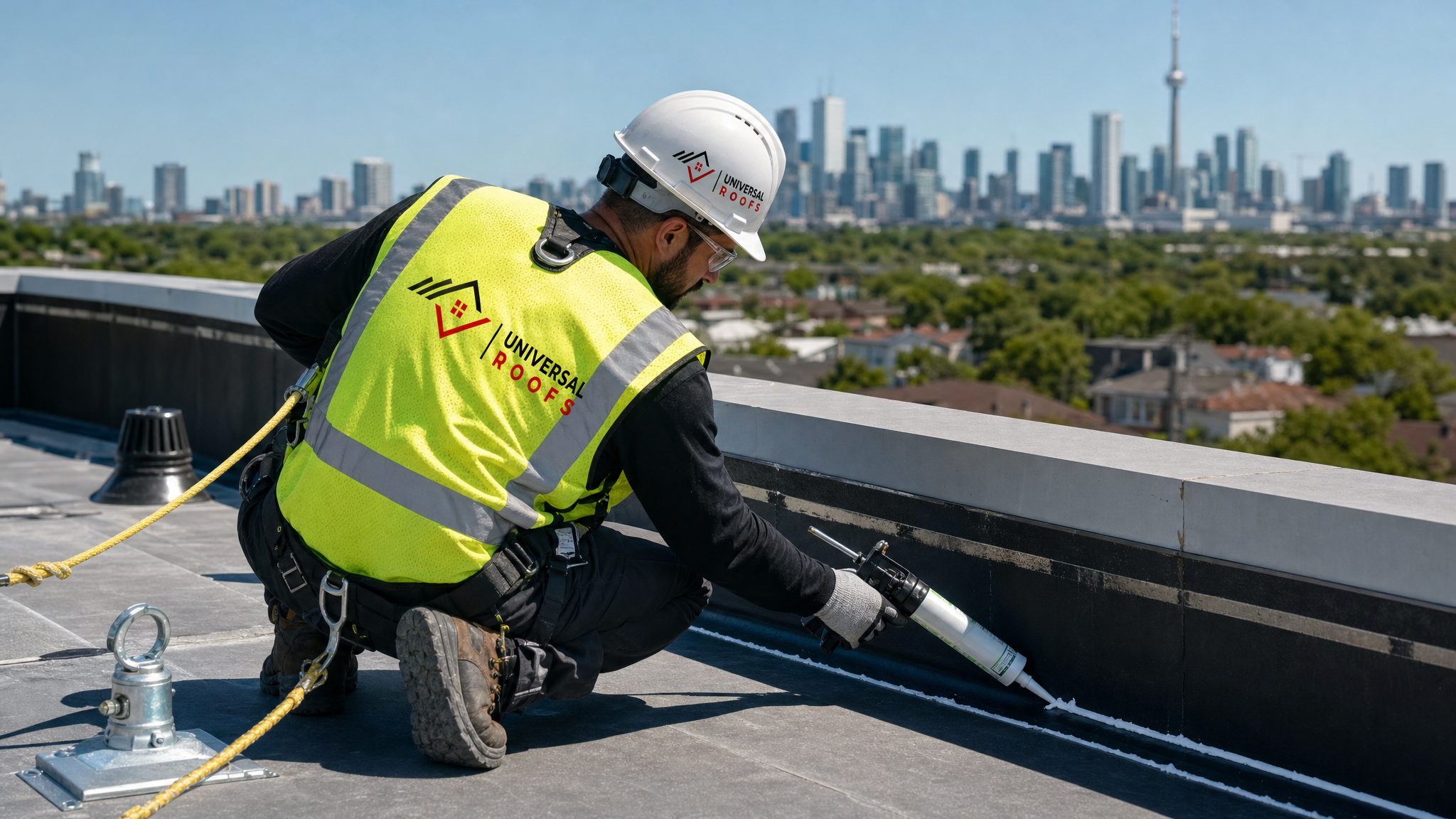
The flat field of a commercial roof rarely fails on its own. Nearly every leak we investigate traces back to a seam, a penetration, or a transition point, not the open membrane itself. Rooftop HVAC curbs, plumbing stacks, electrical conduits, skylight curbs, and parapet wall transitions are all places where two different materials meet, and that junction is inherently weaker than the surrounding field.
A thorough sealing programme starts with a seam-by-seam inspection. Technicians look for lifted or open seams, cracked pitch pans, deteriorated pipe boots, and gaps around curb flashing. Each of these needs its own targeted repair before a general coating or sealant is applied over the top, because coating over a failed seam simply hides the problem rather than fixing it.
Rooftop skylights deserve particular attention, since the curb flashing around a skylight is a common failure point after several Toronto winters of ice and thaw cycles. If your building has aging units, our skylights team can assess whether the flashing needs resealing or whether the unit itself has reached the end of its service life and needs a full skylight replacement.
Tip 3: Address Ponding Water Before You Seal
Sealing over a roof that regularly holds standing water treats the symptom, not the cause. Industry standards generally define problematic ponding as water that remains on the roof surface for more than 48 hours after a rain event. Prolonged ponding accelerates membrane breakdown, promotes algae and debris buildup that clogs drains, and adds dead load to the structure that the original design may not have accounted for.
Before applying any new sealant or coating, a contractor should map where water collects and why. Common causes include undersized or clogged drains, a roof deck that has settled unevenly over time, or insufficient slope built into the original installation. Solutions range from simple drain cleaning and the addition of overflow scuppers to more involved tapered insulation work that re-establishes proper drainage.
| Ponding Cause | Typical Fix | Relative Cost | Timeline |
|---|---|---|---|
| Clogged or undersized drains | Clean, enlarge, or add secondary drains | Low | 1 day |
| Deck settling / low spots | Tapered insulation crickets | Moderate to high | 2-5 days |
| Poor original slope design | Re-slope with new insulation layer | High | 1-2 weeks |
| Debris and vegetation buildup | Scheduled cleaning programme | Low | Ongoing, quarterly |
| Overloaded scuppers | Add overflow scuppers | Moderate | 1-2 days |
Correcting drainage before sealing protects the investment you are about to make in new coatings or membrane repairs, and it prevents the same failure from recurring within a year or two.
Tip 4: Time the Job Around Toronto’s Climate Windows
Most roof sealants and coatings need a specific temperature and humidity range to cure properly, and Toronto’s climate gives contractors a fairly narrow set of ideal windows each year. Late spring through early autumn, roughly May through September, generally offers the most stable conditions for sealing projects, with daytime temperatures and low humidity that let coatings cure fully before rain or overnight dew arrives.
Summer months bring their own challenges, since sealants applied during peak midday heat can skin over too quickly on the surface while remaining uncured underneath, trapping solvents and weakening adhesion. Scheduling application for early morning during a July or August heatwave, rather than midday, gives the product time to flow and bond correctly before the sun is at its most intense.
Waiting too long into the season is equally risky. Once nighttime temperatures start dropping toward freezing in late October, most sealants will not cure properly, and any moisture from morning frost trapped under a fresh coating can cause blistering the following spring. Property managers who plan their sealing maintenance for early summer, rather than scrambling in October before the first freeze, consistently get better results and fewer callbacks.
If a roof issue can’t wait for ideal weather, such as an active leak discovered mid-winter, a qualified roof repair contractor can perform a targeted emergency seal using cold-weather-rated products, with a plan to complete the full sealing programme once conditions improve.
Tip 5: Don’t Neglect the Roof Edge, Parapet, and Flashing Details
Property managers often focus their attention on the open field of the roof and overlook the perimeter, but roof edges, parapet walls, and flashing details are some of the highest-risk zones on any commercial building. Wind uplift concentrates at the roof edge more than anywhere else on the surface, and a poorly sealed edge metal or coping cap can allow wind-driven rain to get behind the membrane entirely, bypassing the field seal completely.
Parapet walls present a particular challenge because they involve a transition from a horizontal roof surface to a vertical wall, plus a coping cap on top that is exposed to sun, rain, and freeze-thaw cycling from three directions at once. Sealant joints at coping cap seams degrade faster than the field membrane and should be inspected at least twice a year.
Attic and soffit ventilation also plays a role in the overall building envelope’s performance, particularly on lower commercial buildings with pitched sections. Poor ventilation traps moisture that can undermine sealing work from the inside out. If your property has ventilation concerns alongside its flat roof sections, our attic specialists can evaluate whether airflow improvements should be part of your broader roof maintenance plan.
Tip 6: Build a Recurring Inspection and Maintenance Schedule
The single most effective thing a commercial property owner can do is stop treating roof sealing as a reactive, one-time event and start treating it as a scheduled maintenance programme. Roofs that receive a professional inspection twice a year, once in spring after the winter freeze-thaw cycle and once in autumn before the cold sets in, catch small sealing failures while they are still inexpensive to fix.
A good maintenance log tracks the condition of seams, flashings, drains, and coating thickness over time, which also gives you documentation to support warranty claims and insurance discussions if a major weather event does cause damage. Many commercial roof warranties actually require documented maintenance to remain valid, so a consistent inspection schedule protects both the physical roof and your legal standing if something goes wrong.
| Maintenance Task | Recommended Frequency | Performed By |
|---|---|---|
| Full roof inspection | Twice yearly (spring and autumn) | Licenced roofing contractor |
| Drain and gutter clearing | Quarterly | Maintenance staff or contractor |
| Seam and flashing check | Twice yearly | Licenced roofing contractor |
| Coating reapplication | Every 5-10 years, per product | Licenced roofing contractor |
| Post-storm inspection | After any major wind or hail event | Licenced roofing contractor |
If your building’s roof has never had a formal inspection schedule, or you have inherited a property with unclear maintenance history, it is worth starting with a full roof repair assessment to establish a baseline before deciding whether targeted sealing or a broader roof replacement makes more financial sense over the coming decade.
When Sealing Isn’t Enough: Recognizing the Signs of Replacement
Sealing extends the life of a sound roofing system, but it cannot rescue a membrane that has already failed structurally. Widespread blistering, deep cracking across the field, saturated insulation, or a membrane that has lost its flexibility entirely are all signs that coatings and patching will only delay an inevitable, more expensive failure. In these cases, a full replacement is the more cost-effective path, since repeated sealing attempts on a failing roof can end up costing more over a few years than a single replacement would have.
A qualified contractor should always assess the age, membrane condition, and insulation moisture content before recommending sealing over replacement. Ask for a straightforward comparison of both options, including expected lifespan and total cost over a 10 to 15 year horizon, rather than accepting a sealing quote at face value. You can read how other GTA property owners have approached these decisions on our reviews page, and browse common questions on our FAQ page.
Universal Roofs has served commercial and residential clients across Toronto, Peel Region, York Region, Halton Region, and Durham Region since 2005, and our teams have seen firsthand how a well-timed sealing programme protects a building’s bottom line. Learn more about our approach on our about page.
What are the most essential roof sealing tips for commercial buildings in Toronto?
How often should a commercial roof be resealed?
Can roof sealing fix a leak that’s already happening?
What is the best season to seal a commercial roof in the GTA?
Why does ponding water matter so much for roof sealing?
How do I know if my commercial roof needs sealing or full replacement?
Need Help With 6 Essential Roof Sealing?
Protecting a commercial property starts with a roof that is properly sealed, inspected, and maintained year-round, and Universal Roofs has the experience to get it right the first time.
Call us today at (416) 732-2421 or request a free inspection to get started.
Universal Roofs proudly serves Toronto, Mississauga, Brampton, Vaughan, Markham, Oakville and the GTA since 2005.