
If you own an older home in Toronto, Mississauga, or anywhere across the GTA, there is a real chance your roof still contains asbestos. Homes built before the early 1990s commonly used asbestos-cement shingles, asbestos-modified roofing felt, or asbestos-containing flashing compounds, and many of those original roofs are still up there today, decades past their intended lifespan. Understanding the options for asbestos roof replacement is essential before you call anyone to climb a ladder, because handling this material incorrectly can create a health hazard for your family and expose you to regulatory penalties.
The good news is that asbestos roofing is entirely manageable when it is approached correctly. It is not automatically an emergency, and in most cases a well-planned removal and replacement is a routine (if specialized) roofing project. This guide walks through how to identify asbestos roofing materials, the removal and disposal methods available, what a compliant replacement looks like, realistic costs and timelines, and how to choose a contractor who is actually qualified to do the work safely.
At Universal Roofs, we have been replacing roofs across the Toronto area since 2005, including a steady stream of asbestos-era homes where owners want a safe, code-compliant transition to a modern roofing system. This article distills what we tell homeowners on-site, translated into a straightforward reference you can use before you make any decisions.
How to Tell If Your Roof Contains Asbestos
Asbestos was prized in construction for decades because it is fire-resistant, durable, and cheap to produce. It was mixed into cement roofing shingles, corrugated roofing panels, some built-up roofing felts, and various flashing and sealant compounds from roughly the 1930s through the early 1990s, with widespread residential use continuing into the 1980s across Ontario. If your home was built or last re-roofed during that window, asbestos-containing materials are a real possibility.
Visually, asbestos-cement shingles tend to be flat, rigid, and grey-brown or slate-coloured, often with a slightly wavy or diamond-shaped pattern. They feel heavier and more brittle than asphalt shingles and may show a fibrous texture at broken edges. However, visual inspection alone is not reliable — many asbestos products were designed to closely resemble ordinary asphalt shingles or wood shakes specifically to blend in.
The only way to confirm asbestos with certainty is laboratory testing. A qualified inspector takes a small sample using wetted tools (to suppress fibre release), bags it, and sends it to an accredited lab for polarized light microscopy analysis. Never dry-cut, sand, pressure-wash, or pry apart suspected asbestos roofing yourself to “check” — disturbing the material is exactly what releases dangerous fibres into the air.
| Roof Age / Era | Likely Material | Asbestos Risk | Recommended Action |
|---|---|---|---|
| Before 1980 | Asbestos-cement shingles or corrugated panels | High | Lab test before any work begins |
| 1980–1990 | Mixed asphalt/asbestos-modified felts, some cement shingles | Moderate | Lab test recommended |
| 1990–2000 | Transitional asphalt shingles, occasional legacy flashing compound | Low to moderate | Test flashing/underlayment if unsure |
| After 2000 | Standard asphalt, metal, or synthetic shingles | Very low | Testing generally unnecessary |
Why You Cannot Just Tear Off an Asbestos Roof Like a Normal One
Intact, undisturbed asbestos roofing is generally considered low-risk because the fibres are bound in a cement or asphalt matrix and are not becoming airborne. The danger appears the moment that material is cut, broken, drilled, pressure-washed, or ripped off carelessly. Once asbestos fibres are airborne, they can be inhaled and lodge permanently in lung tissue, which is why Ontario’s Occupational Health and Safety Act and O. Reg. 278/05 impose specific handling, notification, and disposal requirements on any contractor performing this type of work.
Regular roofing crews without asbestos abatement training and certification are not legally permitted to remove these materials, and doing so without following the regulation exposes your household, your neighbours, and the workers themselves to unnecessary risk. This is also why “options” matters in the plural — you genuinely have more than one legitimate path forward, and the right one depends on the condition of your roof, your budget, and your timeline.
Your Realistic Options for Asbestos Roof Replacement
Homeowners typically choose from three broad approaches once testing confirms asbestos is present. Each has trade-offs worth understanding before you commit.
Option 1: Full Abatement and Removal, Then New Roof Installation
This is the most common and generally the most durable solution. A licensed asbestos abatement contractor sets up containment (poly sheeting, negative air pressure where required, decontamination procedures), wets the material to suppress fibre release, carefully removes the asbestos-containing shingles or felt, double-bags the waste, and transports it to an approved hazardous waste disposal facility with proper manifesting. Once the deck is exposed and inspected for rot or damage, a standard roof replacement proceeds exactly as it would on any other home — new underlayment, flashing, ventilation, and your choice of shingle or roofing system.
Option 2: Encapsulation (Overlay) — Rarely Recommended, Situational
In some limited cases, undisturbed and structurally sound asbestos-cement shingles can be sealed under a new layer of roofing rather than removed, avoiding the disturbance risk entirely. This is sometimes called a “roof over” approach. It can reduce upfront cost and disposal complexity, but it adds significant weight to the structure, is not permitted under every municipal building code, complicates future repairs, and does not solve the underlying problem — the asbestos material is still there and will eventually need proper abatement when the overlay itself is replaced. We generally only recommend this where the existing roof deck cannot support additional inspection disturbance and a structural engineer has signed off on the added load.
Option 3: Partial/Phased Removal for Larger or Multi-Section Roofs
On larger residential or light commercial roofs, some owners phase the abatement and replacement across sections to manage cash flow, particularly where only part of the roof (such as an addition or garage) contains the older asbestos material while the main house was already re-roofed. This requires careful sequencing so that transitions and flashing details tie in correctly, and it is only appropriate when a qualified contractor confirms the phasing will not compromise weatherproofing between sections.
| Option | Best For | Relative Cost | Long-Term Outcome |
|---|---|---|---|
| Full abatement + new roof | Most homes, especially aging or failing asbestos roofs | Higher upfront | Problem fully resolved, standard warranty available |
| Encapsulation/overlay | Structurally sound roofs where disturbance is not advisable | Lower upfront | Defers the issue; future removal still required |
| Phased/sectional removal | Large or mixed-material roofs, budget-constrained projects | Moderate, spread over time | Full resolution, but slower and requires careful sequencing |
| DIY removal (not recommended) | Nobody — not a legitimate option | Appears lower, often costs more after fines/health risk | High risk of contamination, fines, and re-work |
What the Removal and Replacement Process Actually Looks Like
A properly run asbestos roof replacement follows a fairly predictable sequence, and knowing the steps helps you evaluate whether a contractor’s quote is legitimate or is cutting corners.
- Testing and assessment — Sample collection and lab confirmation, plus a full roof inspection to check deck condition, ventilation, and the extent of asbestos-containing material.
- Notification and permitting — Depending on scope, the Ministry of Labour, Immigration, Training and Skills Development may require notification before work begins, and your municipality may require a building permit for the re-roofing portion.
- Containment setup — Poly sheeting around the work area, ground protection, and controlled access to prevent debris or dust from spreading to landscaping, walkways, or neighbouring properties.
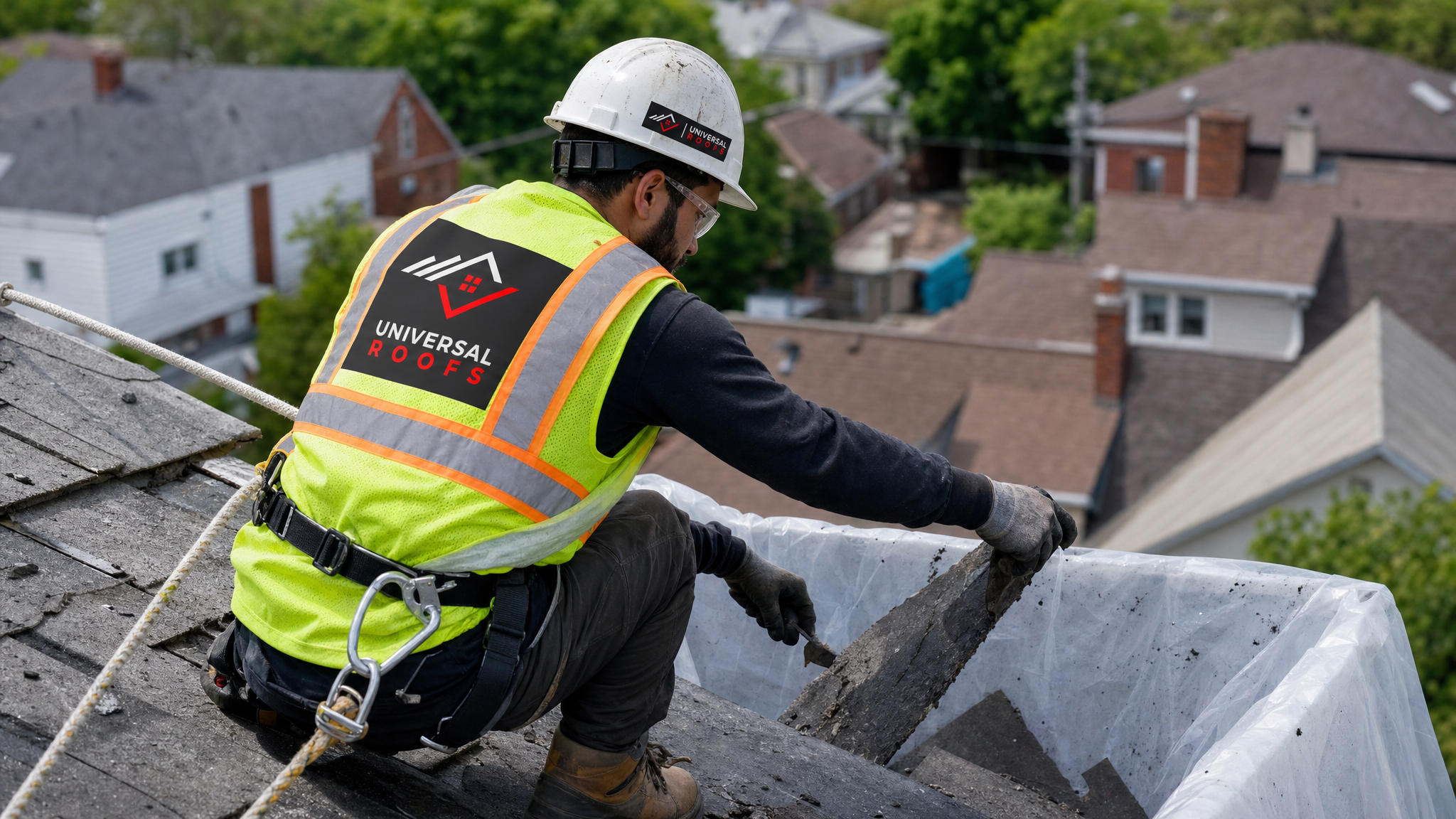
- Wet removal — Material is kept wetted throughout removal to minimize airborne fibres, using hand tools rather than power tools that could shatter the cement matrix.
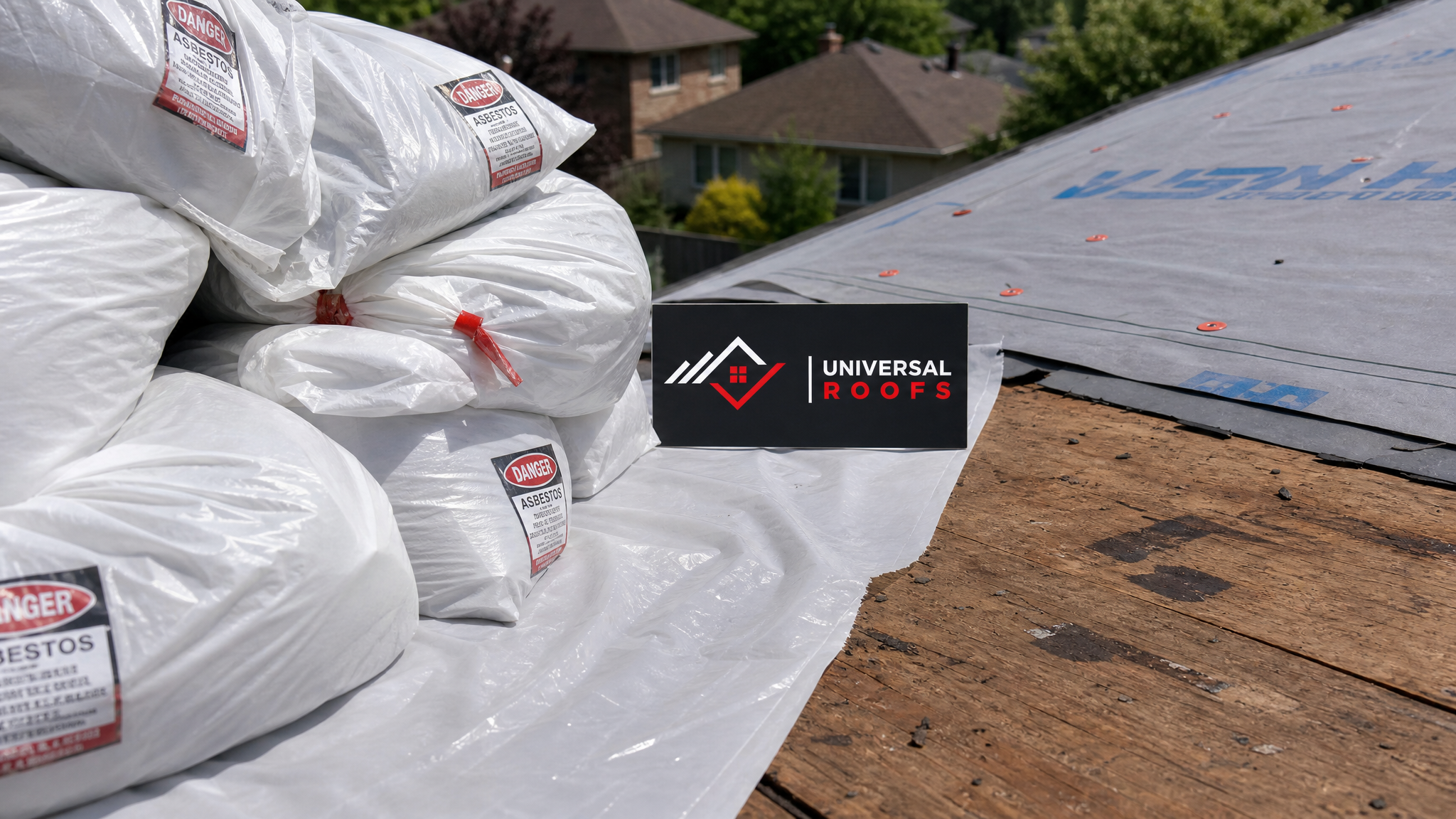
- Bagging and manifested disposal — Waste is double-bagged in labelled asbestos disposal bags and transported to a facility licensed to accept hazardous construction waste, with a paper trail you should request for your records.
- Deck inspection and repair — Once the old roofing is off, the crew checks the wood deck for rot, delamination, or pest damage and replaces any compromised sections before new materials go down.
- New roofing installation — Ice-and-water shield at eaves and valleys, synthetic underlayment, proper flashing at all penetrations, ventilation upgrades if needed, and your chosen shingle, metal, or flat roofing system installed to manufacturer specification.
- Final inspection and cleanup — A magnetic nail sweep of the property, gutter check, and a final walk-through so you can see the finished work before the crew leaves.
Cost and Timeline Expectations Across the GTA
Asbestos roof replacement costs more than a standard tear-off because it involves specialized labour, containment materials, and licensed disposal fees on top of the roofing work itself. Pricing varies with roof size, pitch, accessibility, and how much of the material needs to be removed, but the ranges below reflect what GTA homeowners typically see for a straightforward residential project.
| Project Stage | Typical Timeline | Approximate Cost Range (CAD)* | Notes |
|---|---|---|---|
| Testing and lab results | 2-5 business days | $300 – $800 | Faster turnaround available for an added fee |
| Asbestos abatement/removal | 1-3 days | $3,500 – $9,000 | Varies with roof size and material type |
| Deck repair (if needed) | 0.5-1 day | $500 – $2,500 | Depends on extent of rot or damage found |
| New roof installation | 1-3 days | $7,000 – $18,000+ | Depends on material choice (asphalt, metal, flat) |
*Estimates for illustration only; request a formal quote for your specific property, as every roof and every asbestos scope is different.
Summer is generally the most efficient season for this work in the GTA — warm, dry weather keeps containment materials workable and allows crews to complete both the abatement and re-roofing stages without weather delays, and it avoids the freeze-thaw complications that can affect flashing and sealant cure times in colder months. If your roof deck has been exposed to years of hidden moisture beneath aging asbestos shingles, a summer replacement also gives everything time to dry out fully before autumn rains and winter snow load arrive.
Choosing the Right Roofing System for the Replacement
Once the old asbestos material is safely removed, you are essentially choosing a new roof from scratch, which is a good opportunity to upgrade performance rather than simply match what was there before. Asphalt shingles remain the most common and cost-effective choice for GTA homes, with 25-to-50-year product lines now standard. Metal roofing offers a longer service life and strong performance against wind and ice but comes at a higher upfront cost. If your home has any flat or low-slope sections — common on additions, garages, and some bungalow designs — those areas need a dedicated flat roofing membrane system rather than shingles, since standard asphalt products are not rated for low-slope application.
This is also the ideal time to address anything else the old roof was masking. If your attic has ever felt uncomfortably hot in summer or you have noticed ice damming in winter, ask your contractor to inspect your attic ventilation and insulation while the roof deck is exposed — correcting airflow problems at this stage is far cheaper than doing it as a separate project later. Similarly, if you have been considering a skylight or need an existing one addressed, tying that into the same skylight replacement scope avoids paying for two separate roof openings and two separate flashing details.
Common Mistakes Homeowners Make With Asbestos Roofing
We see the same handful of costly mistakes repeated across the properties we assess. Avoiding them will save you money, time, and in some cases, a genuine health risk.
- Assuming a roof is asbestos-free because it “looks like normal shingles.” Many asbestos products were manufactured to resemble standard asphalt shingles.
- Hiring a general roofing crew without abatement certification. Standard roofers are not trained or legally authorized to disturb confirmed asbestos material.
- Pressure-washing or scraping a suspected asbestos roof to “clean it up” before selling. This is one of the most dangerous things a homeowner can do, since it aerosolizes fibres directly around the property.
- Skipping the lab test to save time. A $300-$800 test is inexpensive insurance against a much larger liability if the material turns out to be asbestos and was mishandled.
- Choosing encapsulation without an engineer’s sign-off. Overlaying a heavy asbestos-cement roof with new material without confirming structural capacity can overload the roof deck and trusses.
- Not requesting a disposal manifest. Always ask for documentation showing the asbestos waste was taken to a licensed facility — this protects you if questions arise later, including during a future home sale.
How to Vet an Asbestos Roofing Contractor
Not every roofing company is equipped to handle asbestos-containing material, and choosing the wrong one is the single biggest risk factor in this entire process. Before signing a contract, confirm the contractor holds current asbestos abatement certification for the workers who will actually be on your roof, ask to see their waste disposal manifests from recent similar jobs, and request references from asbestos-specific projects rather than general re-roofing work. A contractor who cannot clearly explain containment procedures, wet-removal technique, or where the waste goes is not the right fit for this job, regardless of price.
It is also worth checking how a company handles the transition from abatement to the new roof itself — you want one crew, or closely coordinated crews, managing both halves of the project so there is no gap where an exposed deck sits unprotected. You can review how past clients rate our own process on our reviews page, and browse common questions on our FAQ page if you want more background before reaching out.
Service Areas and Local Considerations
Asbestos-era housing stock is common throughout the older neighbourhoods of the GTA, and local by-laws around waste transport and permitting can vary slightly by municipality. Our crews regularly manage asbestos roof replacements across Toronto, the Peel Region (Mississauga and Brampton), the York Region (Markham and Vaughan), the Halton Region (Oakville and Burlington), and the Durham Region, so we are familiar with the permitting and disposal requirements specific to each municipality. If your home needs interim protection while you plan a full asbestos roof replacement, our roof repair team can also assess whether any urgent leaks need attention before the larger project begins — but keep in mind that repair work on confirmed asbestos material still requires the same careful handling as full removal, not a quick patch job.
What are the options for asbestos roof replacement if the material is still in good condition?
How do I know if my roof actually contains asbestos?
Is it safe to leave an asbestos roof alone instead of replacing it?
Can I remove asbestos roofing myself to save money?
How much does asbestos roof replacement typically cost in the GTA?
What roofing material should I choose after asbestos removal?
Need Help With What Are the Options?
Working through the options for asbestos roof replacement does not need to be overwhelming when you have an experienced team guiding the process from testing through final installation. Universal Roofs has managed asbestos roof replacements across the GTA for homeowners who wanted the job done safely, compliantly, and without unnecessary delay.
Call us today at (416) 732-2421 or request a free inspection to get started.
Universal Roofs proudly serves Toronto, Mississauga, Brampton, Vaughan, Markham, Oakville and the GTA since 2005.