
Proper attic airflow is one of the most misunderstood parts of a roofing system, yet it plays a direct role in shingle lifespan, ice dam prevention, and indoor comfort. Understanding roof ventilation requirements for building codes in Ontario helps homeowners avoid moisture damage, failed warranties, and costly repairs down the road. At Universal Roofs, we inspect attic ventilation on nearly every job we perform, because a roof can only perform as well as the air moving beneath it.
This guide walks through the six most important ventilation requirements that Ontario building codes and shingle manufacturers expect homes to meet, why each one matters for GTA weather, and how to tell whether your own attic is falling short. Whether you are planning a full roof replacement or simply troubleshooting a musty attic smell, the principles below apply to nearly every sloped residential roof in the region.
Why Roof Ventilation Requirements for Building Codes Matter in Ontario
The Ontario Building Code references the National Building Code’s provisions for attic and roof space ventilation, which generally require a minimum ratio of net free ventilation area to insulated ceiling area. In practice, this is usually expressed as 1:300, meaning one square foot of net free vent area for every 300 square feet of attic floor space, provided a vapour barrier is present and intake/exhaust are balanced. Without a vapour barrier, or in humid climates like ours near the Great Lakes, code often tightens that ratio to 1:150.
Toronto’s climate makes this especially important. Our winters bring long stretches below freezing punctuated by sudden thaws, and our summers bring humid, still air that traps heat in attics. A roof ventilation system that meets code on paper but is poorly balanced in practice can still lead to condensation, mould growth, and premature shingle failure. Meeting the letter of the building code is the starting point; achieving genuine balanced airflow is the real goal.
Requirement 1: The 1:300 Net Free Area Ratio
The most frequently cited rule in roof ventilation requirements for building codes is the 1:300 ratio. This means that for every 300 square feet of attic floor area, you need at least one square foot of net free ventilation area, split between intake and exhaust. Net free area is not the same as the physical size of a vent opening — it accounts for the screening, louvres, and baffles that reduce actual airflow. Manufacturers print the net free area rating on vent packaging, and it is usually 50 to 90 percent of the vent’s total open area depending on design.
For a typical 1,500 square foot attic, this works out to roughly 5 square feet of total net free vent area, or about 720 square inches, split evenly between soffit intake and ridge or roof exhaust. Homeowners are often surprised to learn how much total vent area this actually requires — a handful of small gable vents rarely comes close.
| Attic Floor Area | Required Net Free Area (1:300) | Approx. Split (Intake/Exhaust) | Typical Vent Combination |
|---|---|---|---|
| 1,000 sq ft | 3.3 sq ft (480 sq in) | 240 in / 240 in | Continuous soffit + 12 ft ridge vent |
| 1,500 sq ft | 5.0 sq ft (720 sq in) | 360 in / 360 in | Continuous soffit + 18 ft ridge vent |
| 2,000 sq ft | 6.7 sq ft (960 sq in) | 480 in / 480 in | Continuous soffit + 24 ft ridge vent |
| 2,500 sq ft | 8.3 sq ft (1,200 sq in) | 600 in / 600 in | Continuous soffit + roof-line vents |
Requirement 2: Balanced Intake and Exhaust
Code compliance is not just about hitting a total square footage — it is about balance. Building codes and most shingle manufacturer warranties expect intake ventilation (usually at the soffit) to roughly equal exhaust ventilation (usually at the ridge or roof-mounted vents). When exhaust significantly outweighs intake, high-powered exhaust vents or powered attic fans can actually pull conditioned air from the living space through ceiling penetrations, wasting energy and depressurizing the attic in ways that pull in moisture from the house below.
A properly balanced system relies on the stack effect: cooler air enters low at the soffits, warms as it rises through the attic, and exits high at the ridge, continuously flushing moisture and heat out of the space. This passive airflow does not need electricity and works around the clock, which is why our attic inspection visits always check both intake and exhaust together, never just one side of the equation.
Requirement 3: Clear, Unobstructed Soffit Intake
One of the most common code violations we find during inspections is not a missing vent — it is a blocked one. Insulation, especially loose-fill or improperly installed batt insulation, frequently gets pushed into the soffit area during renovations or top-up insulation jobs, sealing off the intake vents entirely. Even a fully code-compliant vent system fails if the intake path is obstructed.
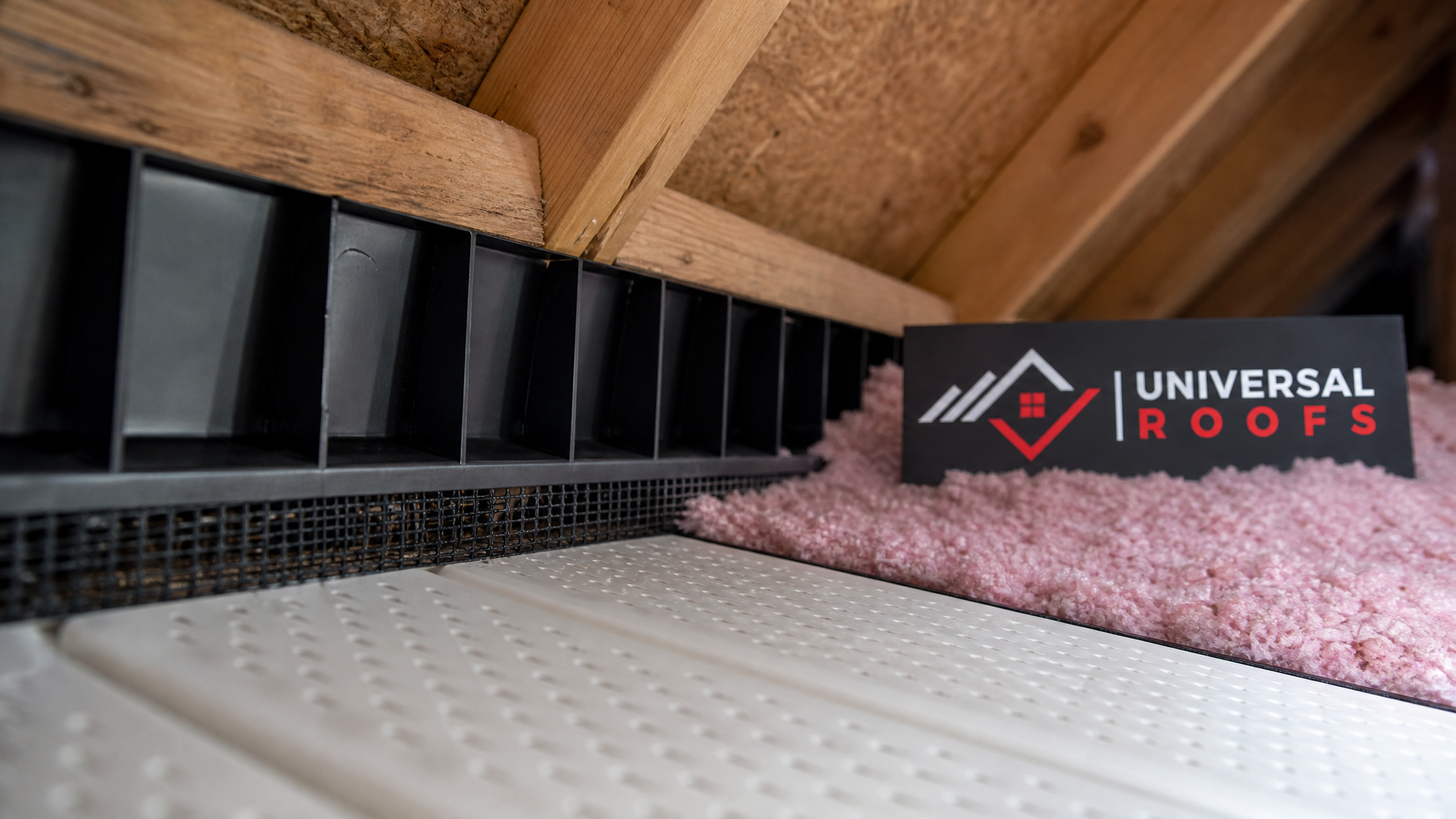
Baffles, sometimes called vent chutes, are required at each rafter bay where soffit vents are present. These rigid channels hold insulation back from the roof deck and preserve a clear air channel from the soffit to the attic space. Building codes increasingly specify baffles explicitly because so many ventilation failures trace back to insulation contractors who were never told to protect the intake path.
Requirement 4: Exhaust Vent Placement Near the Ridge
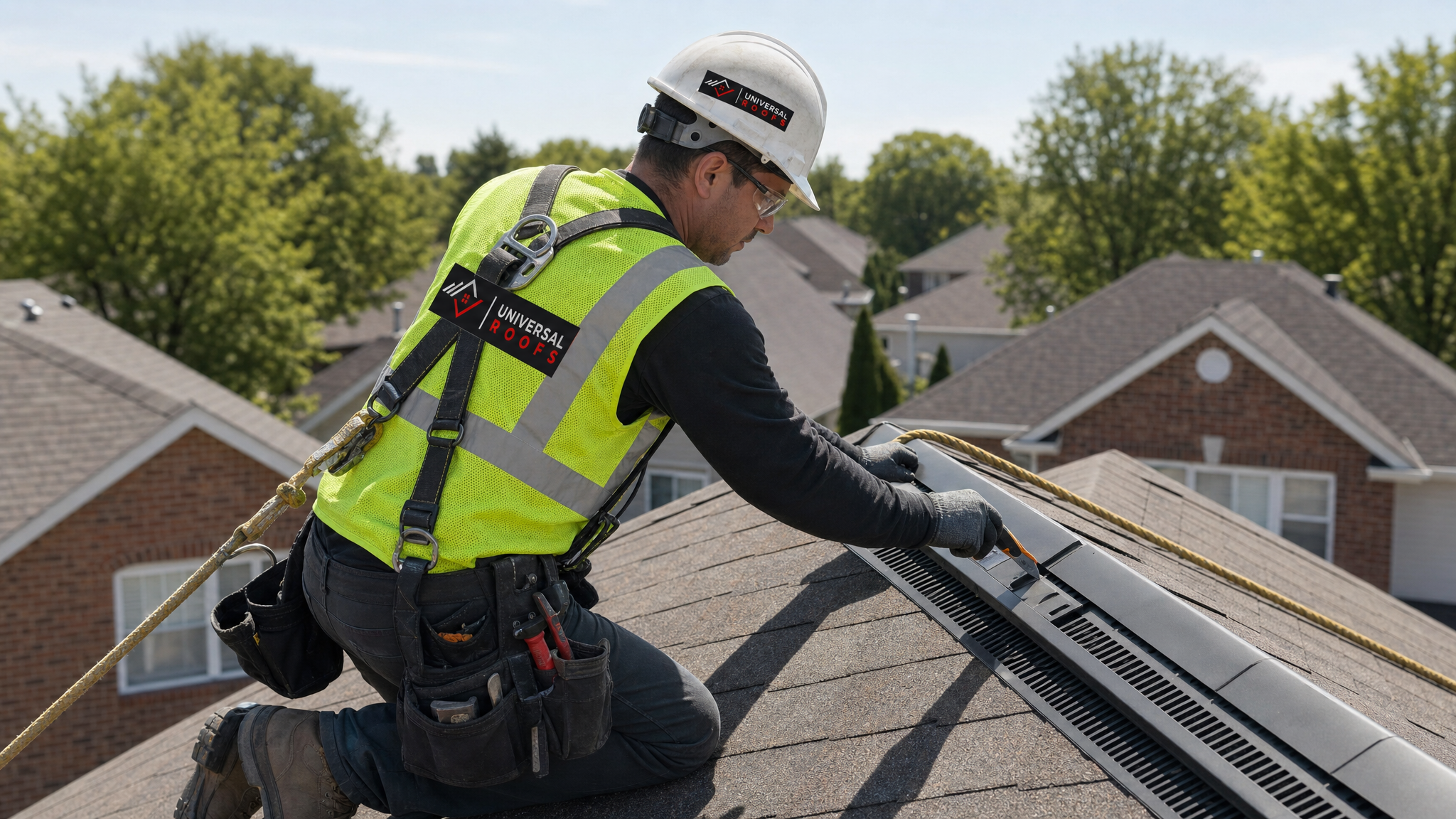
Exhaust vents must be positioned in the upper third of the roof slope to take full advantage of the stack effect, with ridge vents being the most efficient because they run continuously along the highest point of the roof. Roof-mounted box vents or turbine vents can also satisfy code, but they must be placed high enough to draw warm air effectively and should never be mixed indiscriminately with a ridge vent on the same roof plane, since combining exhaust types can short-circuit airflow and actually pull air between two exhaust points instead of from the soffit.
During a roof replacement, this is the ideal time to correct exhaust placement, because the roof deck is already exposed and ridge vents can be cut in cleanly along the full ridge line rather than retrofitted around existing shingles.
Requirement 5: Vapour Barrier and Insulation Coordination
Roof ventilation requirements for building codes are written in tandem with insulation and vapour barrier standards, because the three systems work together. A continuous, well-sealed vapour barrier on the warm side of the ceiling reduces the amount of moisture-laden air that reaches the attic in the first place, which is why code allows a more relaxed 1:300 ventilation ratio when a vapour barrier is present, versus 1:150 without one.
Bathroom exhaust fans, kitchen range hoods, and dryer vents must also terminate outside the building envelope, never into the attic space. We still occasionally find bathroom fans venting directly into attics in older GTA homes, which dumps enormous amounts of warm, humid air into the space and overwhelms even a well-designed ventilation system.
| Vapour Barrier Status | Required Ventilation Ratio | Typical Risk if Ignored |
|---|---|---|
| Continuous, sealed vapour barrier | 1:300 | Lower risk, but still needs balanced intake/exhaust |
| Partial or damaged vapour barrier | 1:150 recommended | Condensation on roof deck, sheathing rot |
| No vapour barrier (older homes) | 1:150 minimum | Frost accumulation, mould, insulation degradation |
| Bath/kitchen fans vented into attic | Correction required regardless of ratio | Localized moisture overload, wood rot |
Requirement 6: Cathedral Ceilings and Low-Slope Ventilation Channels
Homes with cathedral ceilings or low-slope additions present a special case in roof ventilation requirements for building codes, because there is no open attic space to move air through. Instead, code requires a minimum air channel depth — typically at least 2 inches — maintained continuously from the soffit to a ridge or high-point exhaust, running above the insulation and below the roof deck in each rafter bay.
These channels are easy to compress accidentally when adding insulation for energy efficiency, so any upgrade to a cathedral ceiling’s insulation should be paired with a ventilation review. On flat roofing and low-slope sections, ventilation strategy shifts again, often relying on vented soffits paired with mechanical exhaust or a fully vented cold-roof assembly, since traditional ridge venting is not possible on a flat plane.
How to Check Whether Your Attic Meets Ventilation Requirements
Most homeowners cannot easily calculate net free vent area from the ground, but there are visible warning signs worth checking before calling a professional. Frost on the underside of the roof deck in winter, peeling paint on soffits, a persistently hot upper floor in summer, or a musty smell when you open the attic hatch are all signals that airflow is inadequate. Ice damming along the eaves each winter is one of the clearest signs that warm attic air is escaping unevenly and melting snow from beneath, only for it to refreeze at the colder eave.
A visual inspection from inside the attic, checking for daylight at the soffits, undisturbed baffles, and a clear path from intake to exhaust, tells you most of what you need to know. For a full assessment, our team measures actual net free area against your attic’s square footage and compares it to current building code requirements, then recommends the smallest set of changes needed to bring the system into compliance rather than a full teardown.
| Warning Sign | Likely Cause | Typical Fix |
|---|---|---|
| Ice dams along eaves every winter | Warm air escaping attic unevenly | Balance intake/exhaust, seal ceiling penetrations |
| Frost or moisture on roof deck | Insufficient exhaust, blocked soffits | Clear baffles, add ridge or roof vents |
| Musty attic smell | Trapped humidity, poor air exchange | Rebalance vent ratio, check bath fan venting |
| Hot second floor in summer | Heat buildup with no exhaust path | Add ridge vent, improve soffit intake |
Bringing an Older GTA Home Up to Code
Many homes across Toronto, the Peel Region, York Region, Halton Region, and Durham Region were built decades before current ventilation standards existed, and their attics often carry a patchwork of gable vents, undersized soffit strips, and insulation added over the years without regard for airflow. Bringing these systems up to today’s roof ventilation requirements for building codes usually does not require gutting the attic — it typically means adding continuous soffit venting, installing baffles at each rafter bay, and cutting in a proper ridge vent during the next re-roofing project.
This work pairs naturally with a roof replacement, since the roof deck is already exposed and ridge cuts can be made cleanly along the full length of the roof. If your roof is not due for replacement, standalone ventilation upgrades are still possible and often resolve ice damming or attic moisture problems on their own.
Working With a Professional on Ventilation Upgrades
Because roof ventilation requirements for building codes intersect with insulation standards, vapour barrier detailing, and shingle manufacturer warranty terms, it is worth having a professional confirm your attic’s numbers rather than guessing. An undersized or unbalanced system can void a shingle warranty even if the shingles themselves were installed correctly, since most manufacturers explicitly require adequate ventilation as a condition of coverage.
Our crews measure attic square footage, existing net free vent area, and airflow balance during every roof repair and replacement estimate, and we explain exactly what is required versus what is optional. You can read about how past clients found this process straightforward on our reviews page, and we cover more ventilation questions on our FAQ page as well.
What are the basic roof ventilation requirements for building codes in Ontario?
How much roof ventilation does a 1,500 square foot attic need?
Can blocked soffit vents cause ice dams?
Do cathedral ceilings need different ventilation than a standard attic?
Will poor ventilation void my shingle warranty?
When is the best time to upgrade roof ventilation to meet current codes?
Need Help With Roof Ventilation Upgrades?
Since 2005, Universal Roofs has helped homeowners across the GTA protect their properties with expert workmanship and honest advice.
Call us today at (416) 732-2421 or request a free inspection to get started.
Universal Roofs proudly serves Toronto, Mississauga, Brampton, Vaughan, Markham, Oakville and the GTA since 2005.